Home Blog Page 10

Frank Edwards’ all-time Montserrat cricket team is revealed

3
Local cricket insiders agree that Frank Edwards should be the captain on any Montserrat all-time team.

Frank Edwards loved cricket. As a boy, he honed his skills on a rugged field at Barton Bay, a short distance from his home in Water Lane in Plymouth, Montserrat. He joined the national team as a teenager and played professionally for almost a decade. He also served as an umpire, administrator and mentor to many cricketers. But most of all he was a cricket fan, and he could discuss the game for hours. In March of 2017, Edwards was asked to select his all-time Montserrat cricket team. Although he was ailing at the time, he was in good spirits, especially when the subject of cricket came up.

Edwards possessed a vast knowledge of the game. He played with, or watched, some of the most talented cricketers Montserrat has produced. Montserrat has been playing in the Leeward Islands tournament since 1913. Edwards was born in 1937, and although he followed the game all his life he admits it would be difficult to judge cricketers who came before his time. The lack of statistics and other archival documentation makes it even more challenging. For instance, Edwards said he has heard great stories about spin bowler Eddie Roberts, who starred in the 1930s. “But I never saw him play,” Edwards said.

Edwards’ all-time list is comprised of cricketers he saw first-hand. So that would be the era from about 1950 onward. All-Star lists are always controversial and contain elements of subjectivity. There was no criteria discussed with Edwards, but all the players on the list earned selection to the Leeward Islands team or a higher level during their career, not just for the Montserrat team.

Edwards passed away June 7, 2019. But as his legacy is celebrated, it is refreshing that he was able to leave us with his all-time Montserrat XI. Edwards’ picks are listed in the format of a batting order. The years each player represented Montserrat are in parentheses:

FRANK EDWARDS’ ALL-TIME MONTSERRAT XI

1. Thomas “Legs” Davis (1950-55): “Legs” was an aggressive opening batsman and standout cover-point fielder who helped Montserrat capture the 1951 and 1953 Leeward Islands tournaments. His 84 runs against St. Kitts in 1953 at Sturge Park helped Montserrat clinch the Shield. Montserrat has never won the Shield again. “Legs” was selected for the Leeward Islands team twice and was the only Montserratian selected for a friendly match in British Guiana in October of 1953: Robert Christiani XI vs. Jeffrey Stollmeyer XI. Davis played for Christiani’s team and scored 42.

Thomas “Legs” Davis in 1951.

2. Sylvester “Nul” Greenaway (1962-75): “Nul” was never a swashbuckling scorer but instead a patient, deliberate technician who was content to play a supporting role as his teammates took the aggressive route. “Nul” scored 157 runs against Antigua in his final season for Montserrat in 1975 and also captained the team from 1973 to ’75. He played two matches for Leeward Islands, including one vs. the New Zealand Test team in 1972.

Sylvester “Nul” Greenaway, pictured in 1972, opened for the Montserrat team and also served as captain.

3. Jim Allen (1969-84): The most accomplished cricketer in Montserrat history is an automatic selection, but Edwards also agreed on making Allen the wicket-keeper in order to open a spot for another player. Allen, a hard-hitting batsman and frenetic scorer, hit four centuries for Montserrat in the Leeward Islands tournament, five more playing first-class cricket for Leeward Islands, Combined Islands and the West Indies team at World Series Cricket (Kerry Packer), and 11 centuries for the Hyde Cricket Club in England.

Jim Allen, shown in 1973, is widely considered the greatest cricketer in Montserrat history.

4. Kingsley Rock (1955-64): In 1959, Rock became the first Montserratian to score a century in the Leeward Islands tournament, tallying 125 in a victory against host Nevis. Rock, a two-time selection to the Leeward Islands team, was a stylish batsman and methodical strokemaker. In 1961 he represented Antigua in the Leewards tournament and scored 99 against Nevis in the final as Antigua won the Shield. He later returned to Montserrat and played for his home country for the final time in 1964.

Kingsley Rock is pictured in 1954 while part of the Montserrat Defense Force team.

5. Frank Edwards (1955-65): Edwards was too modest to name himself to the all-time team. However, when he was told that Montserrat cricket experts agree that he should be captain of the team, he simply responded with a chuckle. Former teammate John Wilson says Edwards had leadership skills that other players could only dream of. “He was always thinking ahead,” Wilson said. Edwards was an elegant batsman and reliable off-break bowler. “He scored his runs with great care,” Wilson said. Edwards is also one of only four Montserratians to captain the Leeward Islands team. He was a three-time selection to the Leeward Islands team (1958, 1960, 1965) and also played for Combined Islands in 1962.

Frank Edwards left an indelible imprint on cricket in the Caribbean.

6. Alford Corriette (1970-76): Edwards said Corriette must be included on any Montserrat all-time team. Corriette is widely considered the best all-rounder Montserrat has produced. He played 22 first-class matches for Leeward and Combined Islands, taking 44 wickets. Among his highlights playing for Montserrat: 116 against Nevis in 1973 and a fighting 90 against St. Kitts in 1975 that almost pulled out an improbable victory. He scored 113 not out for Combined Islands against Trinidad in 1973. That same year he scored 81 against the touring Australian Test team, which featured great fast bowler Dennis Lillee. In his final season for Montserrat in 1976, Corriette scored 103 not out against Nevis and took 7 wickets for 27 runs in the first innings against Antigua.

Alford Corriette, shown in 1972, says his proudest career achievement is his 81 runs against the touring Australian Test team for Leeward Islands in 1973.

7. Sylvester “Fred” Davis (1939, 1946-52): Edwards’ eyes lit up when he mentioned all-rounder “Fred Delinger” — the only Montserrat cricketer with two career hat tricks (1949, 1952). In the 1951 Leewards tournament against Antigua, he scored 97 not out and took 7 wickets with his pace bowling. He served in the military during World War II while the Leeward Islands tournament was on hiatus from 1940 to 1945. He was also an excellent soccer player. He was a three-time selection to the Leeward Islands team.

Sylvester “Fred” Davis had two career hat tricks: one for Montserrat and the other for Leeward Islands.

8. Melford Roach (1959-65): A genuine fast bowler, Roach had one of the most graceful deliveries during his time. He was also no slouch with the bat, as evidenced by his 151 not out against St. Kitts in Antigua in June of 1965. That same year he played for Leeward Islands against the touring Australia Test team. He migrated to the United States at the tender age of 23, leaving many to wonder what could have been. Some say he was talented enough to play for West Indies.

Melford Roach scored 151 not out against St. Kitts in 1965. It was only the second century by a Montserrat player in the Leeward Islands tournament.

9. Austin White (1976-85): Like Roach, White was an all-rounder who could bowl fast and hold his own at the crease. White, a great athlete who learned cricket at Lansen Park near his home in Cork Hill, captained the Leewards Under-19 team, then captained the West Indies Under-19 team (West Indies Young Cricketers) that toured England in 1979. He captained the Montserrat team in 1978 and was a four-time selection to the Leeward Islands team. White played five first-class matches and eight “List A” matches.

Austin White was a genuine all-rounder who captained the Montserrat side for several years.

10. George Edwards (1949-64): “Teacher George” was a terror with the new ball as he and William Riley (Son Harris) lashed opponents with perpetual pace during the 1950s. He was part of the 1951 team that posted Montserrat’s first away Shield in the Leewards tournament, and the 1953 squad that won the Shield at home. He was a two-time Leeward Islands selection.

George Edwards teamed with Son Harris in the 1950s to form a fearsome fast-bowling tandem for Montserrat.

11. Lionel Baker (2000-16): On December 11, 2008, Baker became the first cricketer from Montserrat to play in a Test match for West Indies. The pace bowler ended up playing four Test matches and 10 one-day matches for Windies. Frank Edwards said Baker’s distinction of being the only Montserratian to play Test cricket merits his selection in the all-time XI team. Baker took 94 first-class wickets, including five in Test matches and 11 in one-day internationals.

Lionel Baker remains Montserrat’s only Test cricketer.

THE RESERVES

George Allen (1966-81): Allen, an all-rounder and brother of Jim Allen, was a mainstay on the Montserrat team for more than a decade. He bowled a tidy, slow medium pace and was a student of the game. He played nine first-class matches for Leewards and Combined Islands, taking 15 wickets at a decent average of 24.93.

Lesroy Weekes (1989-93): “Cosmic” starred for Montserrat and Leeward Islands but made his biggest impact playing county cricket in England. He took 69 first-class wickets at an average of 27.11.

From left, George Allen, Lesroy “Cosmic” Weekes and Fitzroy Buffonge.

Fitzroy Buffonge (1979-94): In 1979, Buffonge became the third member of his family to play for the Montserrat team, following uncles George “Hammy” Buffonge (1968) and Joseph “Bulu” Buffong (1977). After a rough start, he settled down to become a consistent opener and later team captain. He played four first-class matches for Leeward Islands. He is Montserrat’s all-time leader in centuries and runs.


For comparison, below is a look at the all-time Montserrat cricket team selected by former player, ICC International Cricket Umpire and statistician Basil Morgan:

1. Fitzroy Buffonge8. Oakland Greaves
2. Sylvester Greenaway9. George Edwards
3. Jim Allen10. Lionel Baker
4. Kingsley Rock11. Eddie Roberts
5. Frank Edwards (CPT)12. Austin White
6. Alford Corriette13. George Allen
7. Melford Roach14. Herbert Mason (WK)

From premier to prisoner: How a legal tactic backfired on Montserrat’s David Brandt

2

David Samuel Brandt, prominent attorney and former Chief Minister of Montserrat, is currently one of 20 inmates at Her Majesty’s Prison. Brandt has not been convicted of a crime, but he is incarcerated because a “fed up” judge issued a punitive measure to counteract four years of stall tactics by Brandt’s attorneys.

Unless defense attorneys can file successful motions to dismiss Brandt’s charges or have his bail reinstated, the former head of state will spend at least the next five months in a jail cell. It is the latest twist in a sad fall from grace for one of Montserrat’s most colorful and popular attorneys and politicians.

In 2015, Brandt was charged with several counts of sexual exploitation of underage girls. His trial was finally scheduled to begin this week following four years of delays and legal challenges, including an unsuccessful request for change of venue. Brandt’s defense team on Monday asked for another continuance because one of the attorneys is unavailable due to illness. High Court Judge Gareth Evans QC granted the adjournment until November 18, 2019 . . . but also revoked Brandt’s bail. When a person is charged with a crime, the issue of bail is addressed during different stages: the initial charges, the sufficiency hearing, and for the actual trial. So even if bail is granted at one point in the case it can be rescinded at another stage at the judge’s discretion.

A source familiar with the case said Evans appeared to be “fed up” with what he deemed another delay maneuver by the defense. After Evans’ ruling, Brandt was reportedly handcuffed and escorted to H.M. Prison, which is a stone’s throw from his former office where he served as the country’s sixth Chief Minister from 1997 to 2001.

Dr. David Dorsett, who says he was once Brandt’s lead attorney, was not present for Tuesday’s ruling. He said he was stunned to hear the news.

“It was like a bolt out of the blue,” Dorsett said Friday from his office in St. John’s, Antigua. “I am astonished and quite surprised. I am aware of attempts being made to see if that decision can be reversed.”

Dorsett, who describes Brandt’s case as multi-dimensional, said his main role is to present constitutional arguments. Among the issues he plans to challenge is the manner in which the evidence was collected. He also contends that the charges against Brandt are vague. Dorsett said he is in the process of filing a motion with the Privy Council.

“It was like a bolt out of the blue. I am astonished and quite surprised.”

— David Dorsett, one of Brandt’s attorneys, on his client’s bail being revoked

Brandt, who hails from Windy Hill in eastern Montserrat, first earned fame as a cricket standout. He went on to study law and become one of Montserrat’s most well-known attorneys. He later entered politics and earned a seat in Montserrat’s Parliament. In August of 1997 he was appointed Chief Minister after Bertrand Osborne resigned following heavy criticism over his handling of negotiations with the British amid the island’s volcanic crisis.

Brandt, dubbed “Big Charlie” and “The Heavy Roller” over the years, gained popularity for his colorful arguments as an attorney and politician. His grandstanding and antics during legislative meetings became legendary. But he has been plagued for decades by rumors about dalliances with underage girls. Brandt has refuted the accusations but his responses often seem couched in legal parsing of words instead of specific, unequivocal denials.

Following this week’s news that Brandt’s bail was revoked and he was remanded to prison, reaction from Montserratians, including on social media, was mixed. Some say he is being unfairly targeted, while others feel Brandt is finally getting his comeuppance.

Another legend gone: Frank Edwards’ death continues tough year for Montserrat

2
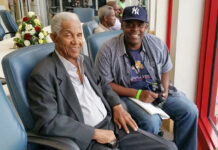
D.R.V. "Frank" Edwards, known mostly for his involvement in cricket and real estate, passed away Friday, June 7, 2019.

For the third time in the past four months, Montserrat is mourning the loss of a mega-figure. Frank Edwards, who impacted real estate, sports, politics and several other areas on the island, died Friday night, June 7, 2019, in Florida after a long illness. He was 81 years old.

In early February, Montserrat lost former scholar, musician and social engineer Dr. George Irish; two months later, former government minister Margaret Annie Dyer-Howe passed away. News of Edwards’ passing prompted an outpouring of condolences on social media, with many people sharing stories of how Edwards mentored or assisted them.

Known for his quiet demeanor, strong leadership skills and trademark bald head, Edwards made his biggest impact in sports and real estate. After graduating from the Montserrat Secondary School in the early 1950s, he began working for Montserrat Company, which held a virtual monopoly in real estate and agriculture on the island. Montserrat Company was started in 1857 by Joseph Sturge, patriarch of the powerful Sturge family. The company was renamed Montserrat Real Estate Company (MORECO) in 1961.

During an interview in 2017, Edwards spoke about how he once held the title of Comptroller (financial officer) and later managing director. In the 1960s and ’70s, Montserrat underwent a real-estate evolution that saw expansion of areas such as Richmond Hill, Foxes Bay, Isles Bay and Old Towne. Edwards and MORECO were heavily involved in those developments.

Edwards was also a standout cricketer and cricket administrator. He played for Montserrat from 1955 to 1965 — often as captain — when the team featured other stars such as batsman Kingsley Rock and fast bowler George Edwards. A top-order batsman and part-time bowler, Edwards captained the Leeward Islands team against Australia in 1965 and also played for Combined Islands against the touring India Test team in 1962 in St. Kitts.

“He was a person you can easily deal with. He never argued. I learned a lot from him. It was an honor to work with him.”

Alfred Christopher, longtime friend and colleague of Franklyn Edwards

In the 1970s he became one of the most powerful cricket administrators in the Caribbean. Already president of the Montserrat Cricket Association, he was elected president of the Leeward Islands Cricket Association, replacing Calvin Wilkin of St. Kitts. That post gave him a crucial seat with the West Indies Cricket Board and heavy influence over player selection. Edwards once spoke about how he had to navigate the fine line of fielding the best Leeward Islands team possible but also lobby for Montserrat cricketers. In February of 1973, Leeward Islands played a warm-up match against the Australian Test team in Antigua. Four of the 11 Leewards players were from Montserrat: Jim Allen, George Allen, Alford Corriette and Vendol Moore.

Franklyn Edwards was born Daniel Rudolph Valentine Edwards on September 12, 1937. He grew up in the heart of Plymouth in Water Lane, an area nicknamed Boobie Alley. “Franklyn is my jumbie name,” he said smiling during a 2017 interview when asked about his many names. His father, Freddy Edwards, was a butcher. His mother Margaret, affectionately known as “Nenen”, was a housewife.

In 1962, Edwards was a member of the Montserrat Jaycees that organized the first official year-end festival. The other members included Cedric Osborne, Bertrand Osborne, Kenneth Allen, Kenneth Cassell and Sir Howard Fergus. Edwards later served as president of the Jaycees. He was also known for his long association with the Endeavour Club and its cricket team.

In 1964, Edwards married Eileen Tonge. They had three daughters: Beverly, Sharon and Dawn. The couple would have celebrated their 55th anniversary in July.

Photo credit: Montserrat Reporter
Frank Edwards is pictured on September 27, 2012 at the Cultural Center in Montserrat during a tribute to retiring umpire Basil Morgan.

Alfred “Christo” Christopher, who knew Edwards since they were teenagers and worked alongside him while both were with the Montserrat Jaycees, says Edwards was one of the greatest leaders he ever met.

“He was a person you can easily deal with,” Christopher says. “He never argued. If he had something to tell you, he would say it and that would be the end of it. I learned a lot from him. It was an honor to work with him.”

In his later years Edwards ran a successful real estate company and also served as chairman of Bank of Montserrat. He also had a stint as Speaker of the Legislative Assembly. On March 16, 2016, Edwards was presented with the Order of Excellence medal during the National Awards for his distinguished service and contribution to the development of Montserrat.

“He was always a very unassuming, quiet person,” said Cedric Osborne, who knew Edwards for more than 60 years and served with him on the board of Montserrat Electricity Services (MONLEC) for more than a decade. “We used to play a lot of tennis together. He was a fantastic friend.”

Edwards is survived by his wife Eileen, daughters Beverly Gumbs, Sharon Nicholas and Dawn Harris, brother Arnold Edwards in Canada, sister Kitty Lynch in the UK, and five grandchildren.

The funeral service will be held Friday, June 28, 2019 at the St. Patrick’s Catholic Church in Lookout, Montserrat. Interment will be held at the Lookout Public Cemetery.

The untold story of Helen Joseph, Montserrat’s only Miss World contestant

9
Photo credit: British Pathé
Helen Joseph, shown in 1966, is the only person to represent Montserrat in an international beauty pageant.

Helen Joseph never won the Miss Montserrat Festival Queen competition. In fact she never competed. But she holds the distinction of being the only woman to represent Montserrat in an international beauty pageant.

On Thursday, November 12, 1964, Joseph and 41 other contestants graced the Lyceum Ballroom in London as they competed for the coveted title of Miss World. Joseph, then 22 years old, advanced to the Final 16 but failed to reach the Final 7. Ann Sidney of the United Kingdom eventually claimed the crown.

Although Miss Universe is often regarded as the most popular international beauty contest, Miss World, which began in 1951 and is based in the UK, also has a storied history and prestige. Indian actress and singer Priyanka Chopra, twice listed by Forbes Magazine as one of the World’s 100 Most Powerful Women, was crowned Miss World in 2000. Jamaica, one of three islands in the English-speaking Caribbean to boast a Miss World winner, has captured the title four times: Carole Joan Crawford (1963), Cindy Breakspeare (1976), Lisa Hanna (1993) and Toni-Ann Singh (2019). Breakspeare drew additional publicity for her relationship with reggae legend Bob Marley, a union that produced their son Damian “Junior Gong” Marley, also a reggae artist.

Helen Joseph arrives at Heathrow Airport a few days before the 1964 Miss World contest at the Lyceum Ballroom in London.

The story of how Joseph came to represent Montserrat in the competition is interesting. She was already residing in England and working as a model when she was approached about entering the contest. The only country she could logically represent was her native Montserrat, even though she left at a young age. There is no rule stating that a Miss World contestant has to have won a previous pageant representing her country. As long as she provides proof of her birthplace, meets the age requirement and is unmarried, she qualifies.

In December of 1963, Pamela Nanton (Arthurton) was crowned Miss Montserrat during the annual festival. The conventional progression should have meant that she would represent Montserrat in any regional or international pageant. It didn’t happen that way, but she has no regrets.

“No one asked me to enter Miss World,” said Mrs. Arthurton, who now resides in Antigua and has run Carib-World Travel since 1973. “When Helen entered some people thought it was me because we’re both light-skinned and tall. I think it was one of those things where she was living in England and someone sponsored her. She was a very beautiful girl. I admired her and was proud that she represented Montserrat well.”

Helen Joseph was born Edith Iona Kirnon on April 27, 1942, at Glendon Hospital in Plymouth, Montserrat. Like many locals, she was given a “pet” name, as everyone called her Helen. The Kirnon family was based in Cudjoe Head Village in the north. Helen’s mother, Edith Augusta Kirnon, took Helen to live with her in Dominica at an early age. When Edith married carpenter Stephen Joseph, she not only changed her surname from Kirnon to Joseph, but Helen’s as well. The identity of Helen’s biological father is unknown.

Helen Joseph, second from right, is shown during the swimsuit segment of Miss World in 1964.

The Joseph family migrated to England in January of 1955 when Helen was 12. They lived in Highbury, longtime site of the famed Arsenal Stadium in north London. As Helen matured she began to draw attention with her stunning beauty. Slender and fair-skinned with a gleaming smile, she fit the mold of what modeling agencies and talent scouts were seeking. She was encouraged to enter the Miss World contest.

Although she fell short in the pageant, she earned critical attention and was soon fielding movie and TV offers. She appeared in two movies: The Girl With a Pistol (1968) and Virgin Witch (1972). Both were small parts, but in Virgin Witch she had an extended scene in which she sang You Go Your Way, accompanied by piano in a lounge setting. She also had guest spots on several British TV shows, including Love Story (1967), Out of the Unknown (1969) and Doomwatch (1970).

Helen Joseph, credited as Helen Downing, appears in the movie Virgin Witch in 1972.

In 1966 Helen was featured in a short British Pathé film at her north London flat. During the two-minute clip, which has no audio and has been uploaded to YouTube, she is seen feeding and playing with a pet fox.

During her show business career she was billed as Helen Downing, the surname of her first husband. Virgin Witch turned out to be her final role as she settled into family life.

Helen, who married three times, later relocated to Montserrat and built a home on the Kirnon family property near Rendezvous Bay. Due to health problems, she returned to England for treatment. She passed away on June 17, 2008 at age 66.

“She was a very beautiful girl. I admired her and was proud that she represented Montserrat well.”

Pamela (Nanton) Arthurton, Miss Montserrat 1963-64

For several reasons, Helen’s inclusion in the Miss World pageant went mostly unnoticed in Montserrat. For one, in 1964 the main source of news was the radio. Surely, in today’s age of instant news and social media, her quest would have gotten much better exposure. Two other factors aided the obscurity: She left Montserrat at a young age and had not built a local following, and also she was not sponsored for the Miss World show in conjunction with a group on Montserrat such as the Jaycees. Helen herself was also not forthcoming in her later years about her pageant and show business careers.

“She didn’t really talk about it much,” said Helen’s cousin Charles T. Kirnon, a longtime minister with the Government of Montserrat. “Only if you asked her about it.”

At any rate, Helen Joseph should be prominently included in the annals of Montserrat history, and not just as the answer to a trivia question.

Helen Joseph is shown with her granddaughter Laura.

Montserrat stalwart Margaret ‘Annie’ Dyer-Howe gets emotional sendoff

0
Margaret Annie Dyer-Howe was laid to rest Friday during a state funeral. She passed away April 6 at age 77.

She was honored for her tireless crusade to elevate women, protect children and uplift the underprivileged. She was remembered for her calm and measured demeanor, generous spirit and quiet dignity. She was celebrated through words, song and even the steel pan.

She took her beloved country under her wing. And now she flies with the angels.

The Right Honourable Margaret Mary “Annie” Dyer-Howe O.E. received an emotional homegoing Friday at the Roman Catholic Church in Lookout. Following the two-hour-plus service, a procession led by the Montserrat Defense Force, with marching band in tow, made a one-mile trek to the Lookout Public Cemetery. Mrs. Dyer-Howe received a gun salute and was laid to rest as family members, friends and dignitaries sang hymns.

Mrs. Dyer-Howe’s casket was as regal as the woman herself, white with gold trim and a hint of the Montserrat madras. It was draped with the country’s flag as it was carried out of the church.

“Miss Annie’s homegoing service was one that truly summed up the woman she was,” says Rose Willock, Dyer-Howe’s longtime friend and a broadcasting legend in Montserrat. “Outgoing, community-spirited in every way and dedicated to her homeland.”

Mrs. Dyer-Howe died April 6 after a long illness. She was 77 years old.

“She was an ordinary woman who produced extraordinary outcomes,” said Hon. Donaldson Romeo, Premier of Montserrat. “Giving to her community and country was always her overriding interest. Mrs. Howe has left much for us to emulate as a nation.”

Robert Howe, widower of Margaret “Annie” Dyer-Howe, looks on during the burial Friday, May 10, 2019 at Lookout, Montserrat.

Mrs. Dyer-Howe influenced just about every sector of Montserrat. Principled, pragmatic and devoutly Roman Catholic, she helped enact social change during a time when women were mostly excluded from prominent positions in society. Due to her efforts, the protocol for acceptance into the Montserrat Secondary School was changed to allow non-affluent students a fairer chance. Mrs. Dyer-Howe argued that students from wealthy families had an unfair advantage because their parents could afford private tutoring.

“Miss Annie’s homegoing service was one that truly summed up the woman she was.”

Rose Willock, broadcasting legend

Mrs. Dyer-Howe, who was profiled in the book Gallery Montserrat by Sir Howard Fergus, was born Margaret Corbett on November 18, 1941 and grew up in St. Patrick’s in southern Montserrat. She was heavily influenced by her grandmother, who was a district midwife. She attended the St. Augustine School, which was then on George Street in Plymouth, and later taught at the school before migrating to the United States for secretarial training. In 1964, she married businessman and politician Michael Dyer. It was during that union that her political aspirations took shape.

In 1974, Michael Dyer passed away. In 1979, Mrs. Dyer-Howe competed in a by-election in the Southern district for the seat of the late Joe Taylor. She won, essentially reclaiming the seat lost years earlier by her husband. In 1983 she was re-elected and assigned the Ministry of Education, Health, Community Services, Women’s Affairs, Culture and Sports. She became only the second woman in Montserrat to hold a ministry, following Mary Rose Tuitt in 1970. She married Robert Howe in 1984.

Fergus, a longtime friend, was among the luminaries paying tribute Friday. Speaking about Mrs. Dyer-Howe helping to break the female barrier in parliament, he said: “She was No. 2 to wear the toga of a minister, and she did more than warm the bench. She did more than any of her generation to elevate women in skills and consciousness.”

Added Willock: “She empowered women at every level.”

The casket of Margaret “Annie” Dyer-Howe is prepared for burial at the Lookout Public Cemetery in Montserrat.

Aside from her work in politics, Mrs. Dyer-Howe established the Montserrat Small Business Association, promoted vocational training for teenage mothers and pregnant teens and fought for the elderly. Mrs. Dyer-Howe is also remembered for her time at the Montserrat Water Authority, where she served as executive secretary, administrative officer, and later manager.

In 2018 she was presented with the Order of Excellence during the Montserrat National Awards for her exemplary contributions to the country.

Hon. Speaker of the House Shirley Osborne perhaps summed up Mrs. Dyer-Howe’s legacy best during Friday’s service. “Many of the building blocks of Montserrat were put up, leveled out and cemented in place by this woman.

“So Montserrat is Annie’s house.”

Mrs. Dyer-Howe is survived by her husband Robert, step-daughter Joycelyn Howe, brother Neville Corbett (aka Dick Martin) and many other family members.

Dr. Sir Prince Ramsey, Antiguan physician and calypso writer, dies

0
Dr. Sir Prince Ramsey passed away Friday, May 3, 2019 after a long battle with cancer.

Dr. Sir Prince Ramsey, an award-winning physician and renowned calypso writer who penned the popular song Man Is Nothing But Dust for Montserrat’s Keithroy “De Bear” Morson, died Friday afternoon after a long battle with cancer. He was 75.

Ramsey, who has received numerous accolades for his work in educating the Caribbean about HIV/AIDS, returned to his native Antigua last week after being treated for about two months at the University of Miami Sylvester Comprehensive Cancer Center. On Thursday, he underwent what turned out to be his final chemotherapy session.

“He was a smiling man, a happy man, a great man,” said 10-time Montserrat calypso monarch Justin “Hero” Cassell, who collaborated with Ramsey on many songs and spoke to him at least once a week. “We probably had a million conversations about calypso. He treasured friendships.”

In 2010, Cassell’s brother, soca legend Alphonsus “Arrow” Cassell, died from cerebral cancer. During Arrow’s illness, Ramsey was a trusted consultant for the family who helped coordinate Arrow’s care in Antigua. Although oncology was not Ramsey’s field of medicine, he actually helped diagnose Arrow’s illness.

Speaking in 2010, Ramsey said: “Arrow’s family called me and told me that whenever he picks up something with his left hand, he drops it. I immediately told them that means something is wrong with the right side of his brain.”

Everton “Reality” Weekes, a five-time Montserrat calypso monarch who also collaborated with Ramsey, was stunned to hear of his friend’s passing Friday.

“It’s really hard to talk about it right now,” Weekes said. “The last time I spoke to him he told me he was getting better. He was the most genuine, honest person I ever met in my life. He’s the greatest human being I’ve ever known.”

Besides being a respected and popular family physician, Ramsey was a businessman whose ventures included banking, pharmaceuticals, insurance and a rental-car company.

Born in Willikies in rural Antigua, Ramsey was one of eight children. At 15, he traveled to Oxford, where his elder brother resided. Ramsey’s father thought it would be beneficial for Prince to finish his secondary education in the UK. Ramsey’s first interest was theology. “I wanted to be a priest,” he said smiling during an interview with ABS TV Antigua in 1995. “I was brought up in a Christian environment.”

While in Oxford, Ramsey got a job as an orderly at a hospital. That spurred his interest in medicine and public service. However, he grew tired of the racism he encountered in school and returned to Antigua. He later returned to the Oxford school and asked to be enrolled in the science department. He worked at a local hospital as a lab technologist, then at the Royal Free Hospital in London on a fellowship in clinical biochemistry. In 1969, he enrolled at the University of the West Indies in Mona, Jamaica, to formally study medicine.


“He was the most genuine, honest person I ever met. He’s the greatest human being I’ve ever known.”

Everton “Reality” Weekes, on Dr. Sir Prince Ramsey

Ramsey’s passion eventually became the area of family planning.

“At the home where I lived in Oxford, my brother had six children born within about five to seven years,” he told ABS TV. “I saw the hardships those children had. I don’t think children should be brought into the world having this type of suffering. As a student in Jamaica I would go to the schools and lecture about family planning.”

The AIDS epidemic in the 1980s forced Ramsey to expand his family planning crusade in order to educate the public. Ramsey served on the board of the Antigua Planned Parenthood Association and was president of the Antigua & Barbuda Medical Association from 1991 to 1992. He held HIV/AIDS symposiums around the Caribbean, including in Montserrat.

His quest to edify the public carried over to his calypso writing. In 1988, he wrote the song AIDS for calypso legend McLean “Short Shirt” Emmanuel, who won the crown. In 2002, he wrote Protect Yourself for Lynwall “Zero” Joseph, who had contracted HIV. Zero also won the crown, then teamed with Ramsey to promote AIDS prevention throughout Antigua. He died in 2004.

Ramsey also worked with other Antigua calypsonians such as Joseph “Calypso Joe” Hunte, Paul “Obstinate” Richards and Trevor “Zacari” King, all former monarchs. He also helped Toriano “Onyan” Edwards of Burning Flames win four crowns in a row (1997-2000).

De Bear says he considers Man Is Nothing But Dust to be Ramsey’s greatest composition. “He wrote the lyrics and me and Daryl Edwards did the melody,” he said.

Among the numerous awards Ramsey has won: Order of Merit for Outstanding Contribution to Antigua & Barbuda (1989), Distinguished Service Award from the Caribbean Family Planning Affiliation (1992), and Order of Distinction (1994). In 2016 he was awarded an honorary Doctor of Science degree by the University of the West Indies for his work in the field of HIV/AIDS.

In 2007, the Government of Antigua & Barbuda presented him with the country’s highest award: the Knight Grand Cross of the Most Distinguished Order of the Nation.

Ramsey was also an avid domino player and a member of a local domino club. “I can play dominoes every day if you let me,” he once said.

Tributes poured in on social media Friday evening as word of Ramsey’s passing spread. The Government of Antigua & Barbuda confirmed that Ramsey will be honored with a state funeral.

“He was my friend, doctor, writer and inspirer,” De Bear says. “I miss him forever.”

Ramsey is survived by his wife Ava and sons Renard and Ryan.

Opinion: Brian Lara, the mercurial master, reaches a half century

1
Photo credit: Edwin Martin
Brian Lara is pictured during a practice session Monday, March 12, 2007 at Kensington Park in Kingston, Jamaica. The West Indies team was preparing for its opening match against Pakistan the following day in the Cricket World Cup.

Brian Lara hit 92 centuries during his brilliant 20-year first-class career. Unfortunately for me, he never hit any of them while I was watching in person. The several times I saw him play, he often had poor or mediocre outings. Actually, let me take that back. I saw him hit a century in 1995. But it was in a friendly match (a little too friendly) at Lockhart Stadium in Fort Lauderdale. Lara teamed up with some aging former West Indies players against a local squad. Lara entertained the crowd with some vintage shots, but he also skied the ball several times. Oddly, the catches were always dropped. I’m not a conspiracy theorist, but I would bet the organizers told the local team to assure that Lara stayed in the wicket as long as possible. After all, it was Lara whom the fans came out to see. Lara eventually got his century, the fans went home happy, and all was well in Cricketville.

Brian Charles Lara – the other “Little Master” and arguably the most exciting batsman of his generation – turned 50 on May 2, 2019. For cricket folks, that’s a half century. Knowing Lara, we should not be surprised if he keeps batting for some time. Lara is the only player in cricket history to hit 100, 200, 300, 400 and 500. His 501 not out for English club Warwickshire in 1994 is the highest individual score in first-class history. He thrived on big innings. Unlike some batsmen who hit a century and often gave away their wicket soon after because they mentally felt their job was done, Lara was greedy. If he got 100, he wanted 200, and so on.

During the 20th century, it seemed as if a legendary West Indies batsman came along every 20 years. George Headley passed the baton to Garry Sobers, Sobers passed it to Viv Richards, and Richards passed it to Lara. Those other legends had more talented teammates around them, so it can be argued that Lara’s stats deserve more merit because they were accomplished under more pressure. Comparing eras is often a dicey proposition, but Lara faced a heavier burden that his predecessors. When he made his Test debut in 1990, West Indian legends such as Richards, Gordon Greenidge, Joel Garner, Michael Holding and Andy Roberts were either gone or on their way out. So whenever the inevitable arguments arise over which batsmen are the best in West Indies history, one must not just look at their raw stats but also the circumstances under which they achieved them.

Photo credit: Edwin Martin
Brian Lara was often surly with the media but his genius with the bat cannot be denied.

I recently re-watched Lara’s 400 not out against England in 2004, which remains the highest score in Test cricket. His shots were not only awe-inspiring but technical and precise. He hit several fours that barely cleared the outstretched arms of the slip fieldsmen, a feat that has little margin for error. Some batsmen pick their shots wisely and wait for bad deliveries. Lara consistently put away good deliveries with a deft touch, bisecting fielders with purpose rather than hitting the ball as hard as he could and hoping for good results. If Viv Richards was Mike Tyson, Lara was Sugar Ray Leonard, killing you softly.

I not only got to see Lara play in person, I interviewed him a few times. Off the field, he could be very mercurial and even callous. On Monday, March 12, 2007, I covered the West Indies team’s practice at Kensington Park in Kingston, Jamaica. The Windies were preparing for their opening match in that year’s Cricket World Cup. Kensington Park, home of the Kensington Cricket Club, is located in a poor neighborhood near downtown Kingston. As the team practiced, many young boys from the neighborhood gathered outside the gates, elated that the West Indies team, led by the legendary Lara, was in their area. Most of them wore ragged clothes, and some were shirtless. When the practice finished, Lara and the other players began walking toward the team bus that was parked just outside the gate. “Lara!” “Lara!” “Lara!” the boys began shouting, hoping to get the star’s attention, whether for an autograph or a simple chat. Lara walked past the dozens of kids, looking straight ahead, and stepped onto the bus as if the children were invisible. I looked on in disbelief. The disappointment on the faces of the kids was heartbreaking. Even if he was not in the mood to mingle with the children a bit, he could have said, “Kids, sorry, I have to leave. Maybe another time.” But to not acknowledge them at all was quite jarring. It was a stark reminder that even our stars are flawed.


If Viv Richards was Mike Tyson, BRIAN Lara was Sugar Ray Leonard, killing you softly.

A couple days before the unfortunate snub of the kids, I interviewed Lara at Jarrett Park in Montego Bay. I asked him about his feud with Australia fast bowler Glenn McGrath. Lara enjoyed some classic innings against Australia but always seemed to have trouble against McGrath, who got him out for duck or low scores several times. Lara’s career Test batting average was 52.88. But his personal average against McGrath was about 28. Lara and McGrath also exchanged words on the field and almost came to blows. “We had our battles on the field,” Lara said, suggesting the animosity never seeped off the field. The following evening I met McGrath during a World Cup welcome party. I asked him if his battles with Lara ever got personal. “I don’t know about him,” he said, “but not for me.” After my interaction with both men, I found McGrath much more gracious and friendly. Two men. Both legends. But distinctly different demeanors.

Photo credit: Edwin Martin
Brian Lara, right, stops to take photos with fans during Cricket Legends Weekend at Central Broward Regional Park in Fort Lauderdale in 2015.

The West Indies team reached the Super 8 round of that year’s World Cup, but it would turn out to be the last time Lara wore a West Indies uniform. He retired from Test cricket with 34 Test centuries and 11,953 Test runs, both West Indies team records. His Test record 400 not out has lasted 15 years and counting. He was often compared to Sachin Tendulkar, the other great batsman during Lara’s era. Tendulkar’s statistics are in the stratosphere and he will go down in cricket lore as possibly the best ever. But Lara’s legacy is secure as well.

The last time I saw Lara in person was on January 25, 2015 at Central Broward Regional Park in Fort Lauderdale. He was in town for West Indies Legends Weekend. He looked fit, happy and rested. He competed in a Legends game. At 45 years old, he still looked like the Lara of old at times, unleashing classic drives through the covers. After the match, he made his way through the crowd as a throng of fans requested autographs and selfies. He was patient and much more amenable than I remembered. He autographed a bat for me that also has the signatures of fellow West Indies icons Garry Sobers, Lance Gibbs and Wes Hall. I will always treasure that bat, just as I treasure getting the opportunity to watch one of the best in my favorite sport.

Happy birthday, Brian Lara. Now it’s on toward a century.

‘Iceman’ back in Montserrat and thankful after eye surgeries but still faces challenging road

1
Steve "Iceman" Weekes underwent six surgical procedures on his left eye in Canada. He returned to Montserrat on March 13.

Steve “Iceman” Weekes celebrated his 45th birthday on March 28. There was no party, no fanfare, no elaborate presents. There was no need. He had already received the ultimate gift three weeks earlier: His eyesight.

Weekes, a father, former soldier, musician and erstwhile calypso monarch of Montserrat, returned to his homeland from Canada on March 13. Already blind in his right eye, he spent almost two months up north undergoing six procedures on his left eye – five laser surgeries to fix bleeding veins and, finally, an operation March 4 to remove a cataract and insert an artificial lens. His vision in the left eye is about 75 percent and he’s optimistic it can fully heal, but a lot of that depends on him.

“As a diabetic I have to adopt some lifestyle changes,” he says. “I also have to avoid lifting anything heavy, I have to avoid bending down because it might put strain on the eye.”

Weekes wears prescription sunglasses and must avoid dust and other similar hazards. Even rubbing the eyes can hinder the healing process. He admits the precautionary directives from his doctors were overwhelming at first.

“When I came home I was really mentally down,” he says. “I was even wondering how long I’m going to live. The journey has taken me through some mixed emotions. But the strength within me has multiplied.”

Weekes has the utmost gratitude for his countrymen at home and in the diaspora who raised more than E.C. $9,000 toward his surgeries. The funds also helped defray costs for his air fare and other items such as the protective sunglasses, which cost more than $300 (CAD).

Weekes has been on an emotional and physical roller-coaster with eye problems since 2013. That year he was struck in the right eye while driving a roller for Montserrat Public Works. He subsequently underwent surgery, but over time the sutures came loose. Montserrat does not have a permanent eye specialist, so he often had to wait for one to visit, or travel to Antigua himself. Even when he visited specialists, he would get conflicting diagnoses.

Last September, Weekes began having trouble seeing out of the left eye due to damage from diabetes. He kept his struggles hidden for a while. But after enduring legal setbacks, government bureaucracy and financial hardships, he went public. His emotional phone call to Radio Montserrat on the morning of January 7, 2019, led to an E.C. $15,000 grant from the government. But when exchanged to Canadian funds it was not enough to cover the surgeries. As a non-Canadian citizen, his health costs must be pre-paid. So Weekes pleaded for help again through social media and Radio Montserrat, leading to the $9,000-plus fund-raising drive.

“Everything I’ve done so far, including the lens, has been paid in full,” he says. “I still have some funds available that will help in case I need to go back to Canada for post-op checks.”

Although he has gotten a reprieve with his vision in the left eye, Weekes continues to face challenges. First, he prefers to communicate through voice notes these days because reading texts on the small screen of his phone is difficult. The artificial lens is extremely sensitive, and even the slightest ray of light can create a powerful glare. He returned to his job at Montserrat Public Works earlier this month but his duties are quite limited. Working out in the field is not an option and would surely endanger his delicate eye situation.

“The Human Resources department is currently in dialogue with my ministry [Public Works] as to whether I can be functional,” he says. “I have a diploma in social work. I can be a social worker. But getting transferred from one government department to another takes forever. I really need to move on to a job that is more conducive to my current situation.”


“What I’ve been through, somebody else might have taken a rope and gone to the hills and hang themselves. But as long as I have life, I give thanks and I press on.”

Another area that Weekes has been concerned about is his ability to perform one of his great loves: singing calypso. Weekes, who won the calypso monarch title in 2015 with his popular song Nar Sell Out, reached the calypso finals last December. But along the way he struggled to learn his own lyrics and missed valuable rehearsal time as a result. He still finished fifth out of the 10 finalists.

“Music is my life,” he says. “I would like to find an easier way of writing songs, even if I have to record the lyrics on my cellphone. I must adapt to a new way. Writing songs and performing is something I still want to do because this is one of my strengths.”

Weekes says he has been boosted by his local support system, which includes his brother, his 6-year-old son Ky-Ron and his good friend, former classmate and legal adviser Marcelle Watts.

“What I’ve been through, somebody else might have taken a rope and gone to the hills and hang themselves,” he says. “But as long as I have life, I give thanks and I press on. I feel like I’m now an advocate for people with impaired vision.

“I have one eye, but I cherish the one eye. Because I can’t cherish zero.”

Montserrat loses a pioneer in Margaret ‘Annie Dyer’ Howe

0
Photo credit: Montserrat Reporter
Margaret "Annie Dyer" Howe was the second female government minister in Montserrat, following Mary Tuitt.

Less than two months after the death of Dr. George Irish, the Montserrat community is mourning the passing of another stalwart who was the virtual female equivalent of Irish in community activism, social engineering and historical impact.

Hon. Margaret “Annie Dyer” Howe, the second female government minister in Montserrat history, passed away Saturday following a long illness. She was 77 years old.

Mrs. Howe, who hails from St. Patrick’s in the south of Montserrat, delved in just about every sector in Montserrat, including politics, education, culture, business and religion. She advocated for children and the elderly alike and ascended during an era in which women were still expected to know their place in society. In the process, she paved the way for other women to infiltrate theretofore male-dominated fields.

“Anything I put my mind to, I can do,” she once said during an interview with Under The Tamarind Tree, a program on Radio Montserrat. “I don’t have any difficulty to survive.”

Staunchly Roman Catholic, Mrs. Howe embraced a principled approach and used her government platform to enact social change, such as revamping the education paradigm to ensure students lower on the socio-economic ladder had a fair shot at qualifying for the Montserrat Secondary School.

Mrs. Howe, who was profiled in the book Gallery Montserrat by Sir Howard Fergus, was born Margaret Corbett on November 18, 1941.  She was heavily influenced by her grandmother, who was a district midwife. She attended the St. Augustine School, which was then on George Street in Plymouth, and later taught at the school before migrating to the United States for secretarial training.

“The nuns had a great hand in inspiring me,” she told Under The Tamarind Tree. “They not only taught you educationally, they taught you self-sufficiency.”

In 1962, she was a contestant in the first Montserrat Festival queen show. She did not place, as Edna Tuitt (Baptiste) won the title.

In 1964, she married Michael Dyer, a prominent businessman and politician. That union was the impetus for her foray into politics. Michael Dyer represented the Southern district in the late 1950s and 1960s before, ironically, losing to Mary Tuitt, who became the first female government minister in Montserrat.

Michael Dyer passed away in 1974 but his political influence remained with his widow. And even though Annie would marry Robert Howe in 1984, the name “Annie Dyer” had already been stamped in the local lexicon.

Mrs. Howe was first elected in 1979 via by-election to replace the late Joe Taylor, in essence reclaiming the seat lost by her husband years earlier. In 1983, she was part of the victorious PLM delegation led by John Osborne. She was assigned the Ministry of Education, Health, Community Services, Women’s Affairs, Culture and Sports. The parallels between Annie and Dr. George Irish were again notable because Irish was soundly defeated in that year’s election, ending his brief political career.

Mrs. Howe is also remembered for her time at the Montserrat Water Authority, where she served as executive secretary, administrative officer, and later manager.

In 2018 she was presented with the Order of Excellence during the Montserrat National Awards for her exemplary contributions to the country.

Mrs. Howe, who didn’t have any children, is survived by her husband Robert, brother Dick Martin and step-daughter Joycelyn Howe, among others.

Nerissa Golden is named acting director of Montserrat Arts Council

0
Photo courtesy Nerissa Golden
Nerissa Golden has assumed the position of acting director of the Montserrat Arts Council.

Montserrat-born entrepreneur, author and business coach Nerissa Golden on Tuesday was appointed acting director of the Montserrat Arts Council, with her immediate goal to bring stability to an organization that has been plagued recently by resignations and defections.

MAC, the vital statutory outfit that organizes and supervises the annual Christmas Festival along with ancillary cultural events, has been searching for a new director following the departure of Chadd Cumberbatch, whose tenure concluded at the end of March. Golden, who was a member of the MAC Board of Directors, resigned that position in order to assume the acting director role.

“My main goal is to reassure the staff, for one, that the board is committed to supporting them to do their jobs,” she said. “We are also looking at the budget and how we manage and support not just festivals but the growth of cultural programming on the island.”

Another immediate objective for Golden is to prepare a delegation for the 14th CARIFESTA (Caribbean Festival of Arts), which is set for August 16-25 in Trinidad & Tobago. Golden, who attended a Regional Cultural Committee meeting last week in Trinidad, explained why this summer’s CARIFESTA will be a crucial barometer for Montserrat’s future cultural plans.

“We want to use it as a practice run for showing up bigger in 2021 when CARIFESTA comes to Antigua,” said Golden, who served as Director of Information & Communications for the Government of Montserrat from 2009 to 2013.


“My main goal is to reassure the staff, for one, that the board is committed to supporting them to do their jobs.”

Golden, author of eight books and purveyor of the Discover Montserrat website, said there is no strict timetable for how long she plans to be in the acting role. “I plan to be here until they select a new director,” she said.

Other than the search for a permanent director, MAC also has an opening for Head of Planning and Production.

TRENDING NOW

MOST POPULAR ALL-TIME STORIES

error: Content is protected !!