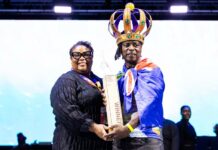
Lionel "Dougie" O'Brien, right, is presented with a "Closest to the Pin" award during the FortunaPix Golf Open.
Lionel “Dougie” O’Brien can’t help but wonder what might have
been.
He began playing golf in his early teens while working as a caddie at the Belham Valley Golf Club in Montserrat. He learned the game on his own by observing the club members when they played, and he even went on to win a caddies tournament.
But his true love was cricket, and for 15 years (1970 to ’85) he shelved golf clubs in favor of a bat. He was a solid opening batsman, first for his village team in Cork Hill and later for the Montserrat national team, for whom he played from 1977-83.
After his cricket career ended, golf came calling again. He earned a spot on the Montserrat golf team in 1985, sharing the course with local standouts Neville Bradshaw and Ivan “Pocket” Hixon, among others. He represented Montserrat for several years, with the pinnacle coming in 1991 when he was selected for the Herman Cup, a tournament featuring the top golfers in the Caribbean.
Lionel “Dougie” O’Brien (back row, second from right) is pictured with the Montserrat cricket team in 1978.
After migrating to Antigua in 1995 following the Soufriere Hills volcanic eruption in Montserrat, O’Brien’s game flourished. To date he has won 13 tournaments around the Caribbean, including the Antigua Seniors Open six times.
“I always ask myself, ‘Why didn’t someone spot me [early on] and take me to the United States,’ ” says O’Brien, who wonders if he could have played on the prestigious PGA Tour. “If I knew better back then I would have stuck to golf. But it’s gone. It can’t be undone.”
O’Brien earned the nickname “Dougie” during his youth days playing friendly cricket games in Cork Hill. One day a friend told him he bats like Doug Walters, the Australian Test cricketer. Everyone called him “Dougie” after that.
Lionel “Dougie” O’Brien represented Antigua in a tournament in Scotland in 2011.
Although he didn’t achieve stardom in cricket, O’Brien says the
fundamentals required to be successful in cricket and golf are similar.
“Your left hand controls the ball in golf, just like in cricket,” says O’Brien, who swings right-handed. “But you have to be mentally stronger in golf than cricket because it’s a very hard game. The most bad words you will ever hear is on a golf course. They’re not cursing you, they’re cursing themselves.”
O’Brien says the key to his golf success is his short game.
“From 150 yards to the hole I’m deadly,” he says. “A lot of them can [drive] the ball longer than me, but chipping and putting is my strength.”
When O’Brien resumed playing golf in 1985 following his cricket career, he was a 17-handicap. At his peak in 2007, when he won three regional tournaments, he was a plus 1 handicap. He is currently a 4.
The “handicap” is a figure assigned to amateur golfers in order to level the playing field during tournaments. A 17-handicap is typical for a beginner. If that player shoots a round of 90, for instance, his score is adjusted to 73.
“You have to be mentally stronger in golf than cricket because it’s a very hard game. The most bad words you will ever hear is on a golf course.”
Despite his success, O’Brien says it’s unfortunate that he has not represented Montserrat for all his victories. When he relocated to Antigua he still played for Montserrat in regional tournaments, and sometimes would even pay his own fare to attend and compete in tournaments in the region. But he later switched to playing for Antigua.
Amateur golfers don’t receive cash prizes, and they depend on
the countries they represent to provide funding for travel and other expenses.
O’Brien says that has been a sticking point in his quest to play for
Montserrat.
“In 2007 after I won in St. Croix they played the Antigua national anthem and I was standing next to the Antigua flag and I felt bad,” he says. “I really wanted to play for Montserrat. But due to circumstances I have had to play for Antigua.”
Regardless which country he represents, it’s the result that counts. O’Brien, who recently competed in a tournament in Barbados, says he’s considering taking a step back from competitive golf.
“I believe I’ve done enough,” he says. “I’ve traveled all over and I’ve done it all. Also, playing golf has taken me away from church. I’m a Seventh Day Adventist.
“I will continue to play golf on Sunday as usual, but just for fun.”
“Dougie” O’Brien says chipping and putting are the keys to his success. “From 150 yards to the hole I’m deadly.”
Lionel O'Brien tournament victories
Antigua Senior Open (2005, 2006, 2007, 2010, 2011, 2012)
“I look forward to a very lively campaign," said Honourable Premier of Montserrat Donaldson Romeo.
Honourable Premier of Montserrat Donaldson Romeo announced Monday
morning that national elections will be held Monday, November 18. He also
confirmed the dissolution of Parliament.
“I look forward to a very lively campaign where all ideas
contend, and as usual free and fair elections where the people of Montserrat
exercise their democratic right to choose their representatives,” the Premier said
on Radio Montserrat during an announcement that lasted just over one minute.
The dissolution of Parliament means that in essence the terms are up for the nine members of the Legislative Assembly and the governing body will be in a virtual holding pattern until the election and sitting of the new Parliament. The Montserrat Constitution states:
Upon a dissolution of
the Legislative Assembly the Premier and other Ministers in office at the time
of such dissolution shall remain in office and discharge their functions until
a general election is held and a Premier is appointed . . . following such
election; but such functions may not be exercised, save in the event of a
public emergency, to commit or bind the next successor Government to public
funding or liability except in the ordinary course of the day to day affairs of
Montserrat.
Montserratians on island and in the diaspora had been
waiting for weeks for Romeo’s announcement. But the often-embattled Premier
waited until the deadline for the dissolution of Parliament. The move gives him
a month-plus reprieve to try and mend fences with a Montserrat populace that
has been critical of his five-year tenure as Premier.
Romeo earned the most votes in the 2014 national elections as his People’s Democratic Movement captured seven of the nine seats in Parliament. But the party has been plagued by acrimony and defections. Two members – Dr. Ingrid Buffonge and Gregory Willock – crossed the floor and joined the opposition, and another – Claude Hogan – was relieved of his post as Minister of Agriculture, Lands, Housing and Environment.
David Osborne, who replaced Hogan, has been off island addressing health issues, and it is unclear if he will contest the upcoming election. More than 30 persons have announced their intention to run, but that number will not be confirmed until Nomination Day, which is tentatively set for November 7.
Members of the Montserrat Rasta community hold a protest at Carr's Bay on Friday, September 27, 2019.
The Rastafarian community in Montserrat earned a historic concession last Friday when it was issued an apology following recent incidents that they deemed blatant examples of police profiling, harassment and excess.
Armed with placards and uttering chants of protest, about a dozen Rastas marched a half-mile from Carr’s Bay to The Governor’s Office in Brades. They were granted a meeting with Governor Andrew Pearce and Police Commissioner Steve Foster. And although it remains to be seen whether the gesture will spark actual reform, it was a pivotal victory for a group that has felt subjugated for decades.
Karen “Lioness” Allen has been a spokesperson for the Rasta community. An aspiring politician, she is one of more than 30 declared candidates contesting the upcoming national elections. She attended the meeting with the governor and commissioner.
“We asked the police to respect us like we respect them,” Allen says. “The police culture in Montserrat is very aggressive toward Rastafarians. We’ve had to face armed raids. Who else in Montserrat can attest to that?”
Karen “Lioness” Allen, a spokesperson for the Rasta community, says her goal is to be Premier of Montserrat.
In the 1970s when the Rasta movement began to expand in Montserrat, the Rastas were considered uncouth and ungodly by many on the Christian-dominant island. The “Raska” were the men that mothers would warn their daughters about. They were openly discriminated against. In the 1980s a popular night club in Plymouth even had a sign outside stating Rastas were not allowed.
And when it came to law enforcement, the treatment was even harsher. Rastas are not a monolithic group, as some members are more orthodox than others. But there is one commonality: the use of cannabis. That makes Rastas an easy target for profiling, police raids and general harassment.
And sadly, the Rastas feel not much has changed in Montserrat society. Two recent incidents have brought the issue to the forefront:
▪ On August 11, reigning Montserrat calypso monarch Garnett “Sylk” Thompson, who is a Rasta, was searched by police at Little Bay despite being cleared by customs after returning from Anguilla, where he competed in the Leeward Islands Calypso Monarch competition. Police, ostensibly acting on a tip, found nothing illegal.
▪ On September 14, Lloyd “Bimsha” Francis, another local musician, says he was detained and searched by four policemen wearing masks near Carr’s Bay. Francis says the men never identified themselves as officers. He was roughed up, and officers tried to confiscate his cellphone when they saw him taking photos at the scene. Police searched his vehicle and found nothing illegal.
Allen says Commissioner Foster confirmed during the meeting that the mask-wearing officers have been identified and the matter is being investigated.
“We would like [the officers] to be fired and face criminal charges,” Allen says. “Are we supposed to be comfortable with not only the fact that police are doing what they’re doing without repercussion, but that our fellow citizens are watching this and it doesn’t bother them? That’s also a sore point for the Rasta community.”
Governor Andrew Pearce addresses members of the Rasta community on Friday, September 27, 2019.
Allen says she cited the Montserrat Constitution during the meeting, particularly Section 2B, which states that every person is entitled to: “Freedom of conscience and of religion, of expression, and of assembly and association.” She says Foster explained that he was acting under the authority granted to him by the Police Act. However, he conceded that Constitutional rights should take precedence.
This
presents a quandary for police: Cannabis is illegal in Montserrat (there is not
even a provision for medicinal marijuana). So should police abdicate their duty
for fear of violating someone’s freedom of religion?
The best solution going forward is for the government to adopt new legislation. That is one reason Allen is vying for a seat in the Montserrat Parliament. Legalization of marijuana is one issue in her manifesto. She feels Montserrat should follow the lead of places such as Colorado and Canada, where marijuana has been legalized and regulated.
“I can see legalizing
marijuana having a direct economic effect on Montserrat,” Allen says. “Why can’t
we utilize natural resources? Also, what’s the worse that’s going to happen if
we say tomorrow by 11 o’clock that marijuana is legal in Montserrat?”
“The police culture in Montserrat is very aggressive toward Rastafarians. We’ve had to face armed raids. Who else in Montserrat can attest to that?”
Karen “Lioness” Allen
During the protest last Friday, Allen pointed out that police have been enforcing laws inconsistently. She says while Rastas have been jailed for marijuana possession, police seem to ignore prostitution. However she was optimistic after the meeting, especially with the response by Pearce, who gave a public statement.
“The Rastafarian community should feel valued and respected,” Pearce said. “The police do not just act on a whim. There was certain information that prompted police activity that night [September 14]. But Commissioner Foster and his colleagues do recognize that in some respects the handling of those searches wasn’t of the professional standing that we would have expected.
“Lessons will be learned for the future in how to handle those activities.”
After gaining the unprecedented audience with the governor and commissioner, the Rastas assembled at Carr’s Bay for a celebration. They hope it will indeed be a watershed moment.
Robin Ramdeen says she still plans to fly despite a scary incident Monday at John A. Osborne Airport.
Robin Ramdeen has flown with Fly Montserrat “hundreds of times” since arriving on the island in 2015. She feels at home on the twin-engine, eight-seater plane and often takes a nap during the short commute between Antigua and Montserrat.
On Monday afternoon Ramdeen boarded Fly Montserrat Flight 807 at V.C. Bird International Airport along with five other passengers and the pilot. After buckling up she settled in for her customary snooze. The airplane took off without incident and amidst good weather. “We actually took off a little early because all the passengers checked in early,” she says.
When Ramdeen
woke up about 15 minutes later – at a time when the plane would normally be
preparing to land – she looked out the window and saw dense fog. She was not
alarmed, as she had flown under similar circumstances before.
“Everybody was pretty calm,” the Trinidad native said. “Finally, we got out of the fog and we were about to land.”
The normally 20-minute flight was extended by at least 10 minutes as the pilot navigated through the poor visibility. Most pilots are trained for instrument flight, and the hazards and obstacles for each island are well-known by the Fly Montserrat pilots. However, they must have a good visual in order to land, and sometimes they circle the coast of the island until visibility improves.
Credit: Fenty Photography First responders arrive after a Fly Montserrat plane skidded off the runway at John A. Osborne Airport on Monday, September 23, 2019.
When the
plane finally touched down at around 4:20 p.m., it seemed like a routine
landing.
“When we landed there was a tiny little bounce, which is normal,” Ramdeen says. “Then we drive, drive, drive . . . and I remember thinking, ‘When is this plane going to slow down, because we were coming to the end of the runway.’
“That’s when we ended up in the bush.”
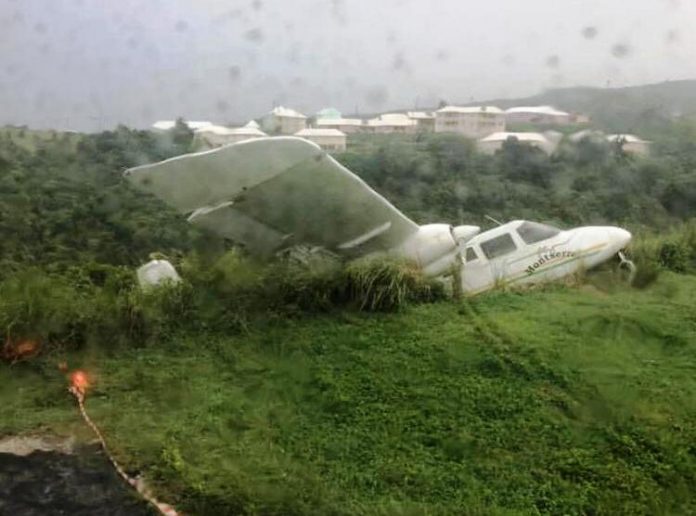
The plane skidded, turned, and traveled tail-first down an embankment and settled in the thick vegetation near the edge of the runway. The airstrip has a retaining fence, but both ends of the runway at Osborne Airport feature down-slopes, leaving pilots virtually no margin for error.
Ramdeen says she’s not sure what the pilot did to avoid breaching the airstrip boundary, but she’s grateful. “She controlled that plane,” Ramdeen says.
It is
unclear if the pilot experienced a braking problem that was complicated by the
wet runway. A team from the UK-based Air Accident
Investigation Branch
arrived in Montserrat on Wednesday to further probe the incident.
Fly Montserrat has experienced several incidents in recent years. Among them:
On
April 16, 2011, a Fly Montserrat plane’s right brake malfunctioned after landing
at Osborne Airport, and the pilot was forced to apply the left brake and veer
off into the grass to avoid the end of the runway. There were no injuries.
On October 7, 2012, a Fly Montserrat flight from Antigua to Montserrat crashed shortly after takeoff from V.C. Bird International. Three of the four passengers were killed, including the pilot. An investigation revealed the presence of water in the fuel line.
Ramdeen says she remained calm throughout the events Monday. She says some passengers even posed for photos next to the disabled plane when they disembarked.
“I don’t think one person yelped or screamed [during the incident],” she says.
“I remember thinking, ‘When is this plane going to slow down, because we were coming to the end of the runway.’ ”
Robin Ramdeen
Ramdeen, whose hobbies include scuba diving, admits she is probably more daring than the average person and likely handled the anxiety of the situation better than others. “I’m super calm,” she says.
However, two
other passengers who were contacted stated that they were still too traumatized
to discuss the incident.
Going forward, Ramdeen says she has no trepidation or reluctance about flying. “I fly very frequently and I know all the pilots,” she says. “They all handle themselves very well. As a matter of fact I’m supposed to fly tomorrow.”
Still, she
is thankful to walk away unscathed.
“When we got out of the plane, I called my mom and I said, ‘Thank God for life, thank God for that pilot . . . and thank God for the bushes.’ “
A look at the world’s shortest runways for commercial airports:
A Fly Montserrat plane rests on the embankment at the northeast end of the runway at John A. Osborne Airport.
A Fly Montserrat airplane skidded off the runway Monday afternoon at John A. Osborne Airport with six passengers and one pilot onboard. The passengers did not sustain any serious injuries and were examined by medical personnel at the scene and sent home.
At about 4:20 p.m. Eastern Time, the plane, which embarked from Antigua, had just landed and was in the process of slowing down to begin taxiing to the terminal. It was raining at the time, and the plane skidded off the northeastern end of the runway and rested on an embankment near the edge of the airstrip.
Later in the day, after investigators had completed their work, the aircraft was pulled up from the embankment by crane and towed to the tarmac. A source close to the investigation said it didn’t appear that the plane sustained any serious damage. Removing the plane and any residue was a priority in order to assure that the airport re-opens in a timely manner, and also to alleviate the distraction.
It was not the first time that a Fly Montserrat airplane had gone off the runway under similar circumstances. On Saturday, April 16, 2011, a Fly Montserrat plane’s right brake malfunctioned after landing. In order to avoid departing the end of the runway, the pilot applied the left brake and ended up in the grassy area parallel to the runway. No one was injured but the plane sustained damage to the nose and wing.
On Sunday, October 7, 2012, a Fly Montserrat flight from Antigua to Montserrat crashed shortly after takeoff from V.C. Bird International. Three of the four passengers were killed, including the pilot. An investigation revealed that the crash was likely caused by water in the fuel line.
Monday’s incident will surely provide ammunition to critics who have maintained for years that John A. Osborne Airport is unsafe and the airport project was ill-conceived. With an election upcoming, the topic will also surely be campaign fodder.
John A. Osborne Airport opened July 11, 2005 as Gerald’s Airport and was renamed in 2008 in honor of the former Chief Minister. The airport is at an elevation of 550 feet and the airstrip is 600 meters (1,969 feet), one of the shortest in the world for commercial airports. Both ends of the runway feature ravines, leaving pilots very little margin for error.
William H.
Bramble Airport, located in Trants in eastern Montserrat, was destroyed in 1997
by pyroclastic flows from the Soufriere Hills volcano. From 1997 to 2005,
Montserrat was only accessible by boat or helicopter.
Fly Montserrat planes are Britten-Norman BN-2 Islanders with two engines. They can seat up to 10 passengers, including the pilot, but the cabin is sometimes altered to fit fewer passengers and more cargo.
Fly Montserrat is owned and managed by captain Nigel Harris, a British expatriate who has owned a home in Montserrat since 1989 and previously managed Montserrat Airways Limited at Bramble airport from 1990-96.
Above is the same model Boeing 707 aircraft that crashed into Montserrat's Chances Peak on September 17, 1965.
Fifty-four
years later, the carnage remains vivid to William Duberry.
On September 17, 1965, Duberry was a rising cricket star and an officer with the Montserrat Defense Force. Only four years removed from school, he had ascended up the ranks to become a lieutenant and was assigned to train cadets at the Montserrat Secondary School.
But his next assignment would turn out to be the most unsettling of his military tenure.
“I remember that morning,” says Duberry, better known as Sugar Duberry. “It was rainy, dull and overcast. I was at my home in Cork Hill and had no idea what had happened until I heard a report on the radio.”
William Duberry is pictured during his early years with the Montserrat Defense Force.
The report stated that a Pan Am aircraft had crashed into Chances Peak in southern Montserrat, not far from the Soufriere Hills volcano that would erupt 30 years later and change Montserrat forever.
At about 7:24 a.m., Pan Am flight 292 – amid poor visibility and a fatal error in navigation – crashed into the side of the mountain, killing all 30 aboard (21 passengers, nine crew). Duberry and other Defense Force soldiers were tasked the following day with recovering the remains. They trekked Chances Peak by way of Broderick’s Estate, just above Trials Village. Some soldiers had gone to the crash site on Friday, but the rainy weather and muddy terrain hampered the mission.
“We went up thinking we were going to see a plane, but there was just a lot of bits and pieces,” Duberry says. “Part of the plane was down in a gorge. We saw burned-out trees. We saw torso sections, bodies with no head. After the whole recovery mission I didn’t eat meat for about five years.”
The plane, a Boeing 707 that had been in operation since December of 1957, had embarked from Le Lamentin Airport in Martinique and was headed to Antigua’s Coolidge Airport (now V.C. Bird International). From there it was bound for Saint Croix, then Puerto Rico, and finally New York City.
“The plane seemed to hit the mountain maybe a couple hundred feet from the summit,” Duberry says. “We found about four or five bodies and brought down the remains in body bags. One of the [soldiers] was bringing down a body that they believed was the captain, and the body bag slipped from his hand and went down the mountain.”
The body bag was eventually recovered.
A few days later, investigators from the Federal Aviation Administration arrived from the United States. Duberry and fellow soldiers had to escort them 3,002 feet back up the treacherous mountain. The climb was steep and rife with obstacles.
“Sometimes we would have to go ahead of the investigators and then throw back ropes and pull them up,” Duberry says. “The whole recovery was awful. It wasn’t for the faint-hearted. But we had a job to do and that’s what we did.”
“The whole recovery was awful. It wasn’t for the faint-hearted. But we had a job to do and that’s what we did.”
William “Sugar” Duberry
A forensics team was also brought in to identify the bodies. Of the 30 victims, 15 were American – mostly residents of New York state – 10 were from Martinique, three were Canadian, and two from the Dominican Republic. Most of the remains were buried in the Plymouth Public Cemetery, with a large headstone featuring the names of the victims.
Although the crash was a tremendous tragedy, there is some solace in the fact only 30 people perished. For one, the plane did not crash in a populated area of Montserrat. Also, the aircraft could accommodate as many as 140 passengers but had only 21 because it was on the first leg of the trip.
As expected,
the crash was the dominant news in Montserrat for 1965. In December of that
year, calypsonian James Lee – also known as Daddy Murrain or “Tangler” – penned
a popular song that memorialized the event. Below is an excerpt of the lyrics:
PAN AM CRASH (1965)
It was early one Friday
morning,
The whole of Montserrat was sleeping,
It was early one Friday
morning,
The whole of Montserrat was screaming,
Why they screaming I don’t know,
People just running to and fro,
Is then ah hear a shout,
A plane crash-landed on
Chances Mount,
We tried to render
assistance of every kind,
But the scene of the
crash we just could not find,
You know the whole of Montserrat did mourn,
We will never forget that morn,
When the people were dead . . . and gone
Below are the 30 victims of the Pan Am crash in 1965 in Montserrat:
Pallbearers carry the casket of Frank Edwards after the service Friday, June 28, 2019 in Lookout, Montserrat.
There’s an old saying in Montserrat folklore when referring to a person who appears to be mild-mannered or passive: “He look like he can’t mash fly.” Frank Edwards’ friends can’t remember ever seeing him in a confrontation. They don’t even recall him ever raising his voice for that matter. But Edwards’ stoic nature belied his steady leadership, intellect and enduring drive to succeed.
The Right Honourable Daniel Rudolph Valentine “Frank” Edwards, OBE, OE, was remembered Friday as a man of integrity, character and accomplishment. He was lauded by friends and associates, some of whom knew him upward of 60 years. And there was one recurring theme: Edwards was a quiet storm. He was reserved but resolute, calm but competitive, soft-spoken but self-assertive.
Edwards passed away June 7 after a long illness. On Friday, family and friends gathered at the St. Patrick’s Roman Catholic Church in Lookout, Montserrat, for his home-going ceremony. Following the two-and-a-half hour service, Edwards was interred at the Lookout Public Cemetery.
Sir Howard Fergus, Edwards’ longtime friend and colleague, delivered the eulogy. He spoke about Edwards’ profound impact on Montserrat society, then concluded with one of his trademark poems. One line in particular resonated:
“At 81 you batted very well, even though we were hoping for a much longer spell.”
Edwards delved into many areas during his life, but his involvement in cricket and real estate were heavily noted. In one light moment Friday, veteran attorney Kenneth Allen, Edwards’ longtime friend, quipped: “He was once a member of the West Indies Cricket Board. … They can use him right now.”
Edwards was born in Plymouth, Montserrat, on September 12, 1937. His father, Freddy Edwards, was the most well-known butcher on the island. His mother Margaret was a housewife. One of Edwards’ neighbors while growing was Tony Maloney, who became a lifelong friend and served as Edwards’ secretary-treasurer when Edwards was president of the Leeward Islands Cricket Association.
“Thanks for
over 60 years of unblemished friendship,” an emotional Maloney said as he
wrapped up his tribute.
Tony Maloney was Frank Edwards’ neighbor while growing up in Water Lane in Plymouth.
Edwards played on the Montserrat cricket team from 1955 to ’65, including several years as captain. His leadership skills led to his appointment as Leeward Islands captain, an impressive feat considering Montserrat often played third or fourth fiddle in the Leewards hierarchy. After his playing career, Edwards ventured into the administrative side of the game. He became president of the Montserrat Cricket Association, then president of the Leewards Association, earning a crucial seat on the West Indies Cricket Board.
Meanwhile, Edwards was also heavily involved in real estate development in Montserrat as part of Montserrat Company, which he joined in the 1950s after graduating from the Montserrat Secondary School. Many of the villages that saw expansion during the 1960s and ’70s, such as Richmond Hill, Foxes Bay, Isles Bay and Old Towne, came during Edwards’ stewardship.
In the early 1990s, Edwards took on a big challenge when he was recruited as Chairman of the Board at Bank of Montserrat. Dalton Lee, the current chairman, spoke Friday about how Edwards rescued the teetering bank. After Hurricane Hugo in 1989, the bank approved many loans to homeowners. But the volcanic crisis six years later destroyed much of the collateral used to attain the loans. When Edwards came on board, the bank was operating at a loss and had received a loan of more than E.C. $10,000,000 from the Eastern Caribbean Central Bank. Lee said that by the time Edwards’ tenure ended, the bank was turning a profit and had repaid the loan two years early.
“There is a saying that a true sign of a good leader is that he leaves the organization in better condition than he found it,” Lee said. “That is certainly very true of our dearly departed chairman.”
Lee also had a surprise announcement: The Bank of Montserrat board voted to establish the D.R.V. Frank Edwards Memorial Scholarship that will be awarded on a tri-annual basis to a young Montserratian who seeks a degree in banking, finance or a related field.
Among those paying tribute to Edwards were Kenneth Allen QC, left, and Dalton Lee.
Two of Edwards’ granddaughters also paid tribute at the service. Amanda Harris sang a stirring acapella version of The Beatles’ Let It Be, and Ashley Nicholas performed a number on the steel pan.
Montserrat Premier Hon. Donaldson Romeo, who attended a United Nations Committee meeting this week in New York, was unable to be at the service. In his place was former government minister Claude Hogan, who called Edwards a “founding father of a business-centered Montserrat.”
Amanda Harris, granddaughter of Frank Edwards, sings Let It Be during the service.
Edwards is
survived by his wife of 54 years, Eileen, his daughters Beverly Gumbs, Sharon
Nicholas and Dawn Harris, his brother Arnold Edwards, sister Kitty Lynch, five
grand-children, and many other extended family members.
Allen, who along with Edwards, Fergus and several others were part of the Jaycees group that organized Montserrat first official Festival in 1962, capped his speech Friday with an emotional sendoff:
“Goodnight, prince,” Allen said. “May flights of angels guide you to your rest.”
Police commissioner Steve Foster is flanked by Peter White, left, and Alvin Ryan of the Montserrat Defense Force during the funeral for Frank Edwards at a packed Roman Catholic Church in Lookout.
Local cricket insiders agree that Frank Edwards should be the captain on any Montserrat all-time team.
Frank Edwards loved cricket. As a boy, he honed his skills on a rugged field at Barton Bay, a short distance from his home in Water Lane in Plymouth, Montserrat. He joined the national team as a teenager and played professionally for almost a decade. He also served as an umpire, administrator and mentor to many cricketers. But most of all he was a cricket fan, and he could discuss the game for hours. In March of 2017, Edwards was asked to select his all-time Montserrat cricket team. Although he was ailing at the time, he was in good spirits, especially when the subject of cricket came up.
Edwards possessed a vast knowledge of the game. He played with, or watched, some of the most talented cricketers Montserrat has produced. Montserrat has been playing in the Leeward Islands tournament since 1913. Edwards was born in 1937, and although he followed the game all his life he admits it would be difficult to judge cricketers who came before his time. The lack of statistics and other archival documentation makes it even more challenging. For instance, Edwards said he has heard great stories about spin bowler Eddie Roberts, who starred in the 1930s. “But I never saw him play,” Edwards said.
Edwards’ all-time list is comprised of cricketers he saw first-hand. So that would be the era from about 1950 onward. All-Star lists are always controversial and contain elements of subjectivity. There was no criteria discussed with Edwards, but all the players on the list earned selection to the Leeward Islands team or a higher level during their career, not just for the Montserrat team.
Edwards passed away June 7, 2019. But as his legacy is celebrated, it is refreshing that he was able to leave us with his all-time Montserrat XI. Edwards’ picks are listed in the format of a batting order. The years each player represented Montserrat are in parentheses:
FRANK EDWARDS’ ALL-TIME MONTSERRAT XI
1. Thomas “Legs” Davis (1950-55): “Legs” was an aggressive opening batsman and standout cover-point fielder who helped Montserrat capture the 1951 and 1953 Leeward Islands tournaments. His 84 runs against St. Kitts in 1953 at Sturge Park helped Montserrat clinch the Shield. Montserrat has never won the Shield again. “Legs” was selected for the Leeward Islands team twice and was the only Montserratian selected for a friendly match in British Guiana in October of 1953: Robert Christiani XI vs. Jeffrey Stollmeyer XI. Davis played for Christiani’s team and scored 42.
Thomas “Legs” Davis in 1951.
2. Sylvester “Nul” Greenaway (1962-75): “Nul” was never a swashbuckling scorer but instead a patient, deliberate technician who was content to play a supporting role as his teammates took the aggressive route. “Nul” scored 157 runs against Antigua in his final season for Montserrat in 1975 and also captained the team from 1973 to ’75. He played two matches for Leeward Islands, including one vs. the New Zealand Test team in 1972.
Sylvester “Nul” Greenaway, pictured in 1972, opened for the Montserrat team and also served as captain.
3.Jim Allen (1969-84): The most accomplished cricketer in Montserrat history is an automatic selection, but Edwards also agreed on making Allen the wicket-keeper in order to open a spot for another player. Allen, a hard-hitting batsman and frenetic scorer, hit four centuries for Montserrat in the Leeward Islands tournament, five more playing first-class cricket for Leeward Islands, Combined Islands and the West Indies team at World Series Cricket (Kerry Packer), and 11 centuries for the Hyde Cricket Club in England.
Jim Allen, shown in 1973, is widely considered the greatest cricketer in Montserrat history.
4. Kingsley Rock (1955-64): In 1959, Rock became the first Montserratian to score a century in the Leeward Islands tournament, tallying 125 in a victory against host Nevis. Rock, a two-time selection to the Leeward Islands team, was a stylish batsman and methodical strokemaker. In 1961 he represented Antigua in the Leewards tournament and scored 99 against Nevis in the final as Antigua won the Shield. He later returned to Montserrat and played for his home country for the final time in 1964.
Kingsley Rock is pictured in 1954 while part of the Montserrat Defense Force team.
5.Frank Edwards (1955-65): Edwards was too modest to name himself to the all-time team. However, when he was told that Montserrat cricket experts agree that he should be captain of the team, he simply responded with a chuckle. Former teammate John Wilson says Edwards had leadership skills that other players could only dream of. “He was always thinking ahead,” Wilson said. Edwards was an elegant batsman and reliable off-break bowler. “He scored his runs with great care,” Wilson said. Edwards is also one of only four Montserratians to captain the Leeward Islands team. He was a three-time selection to the Leeward Islands team (1958, 1960, 1965) and also played for Combined Islands in 1962.
Frank Edwards left an indelible imprint on cricket in the Caribbean.
6. Alford Corriette (1970-76): Edwards said Corriette must be included on any Montserrat all-time team. Corriette is widely considered the best all-rounder Montserrat has produced. He played 22 first-class matches for Leeward and Combined Islands, taking 44 wickets. Among his highlights playing for Montserrat: 116 against Nevis in 1973 and a fighting 90 against St. Kitts in 1975 that almost pulled out an improbable victory. He scored 113 not out for Combined Islands against Trinidad in 1973. That same year he scored 81 against the touring Australian Test team, which featured great fast bowler Dennis Lillee. In his final season for Montserrat in 1976, Corriette scored 103 not out against Nevis and took 7 wickets for 27 runs in the first innings against Antigua.
Alford Corriette, shown in 1972, says his proudest career achievement is his 81 runs against the touring Australian Test team for Leeward Islands in 1973.
7. Sylvester “Fred” Davis (1939, 1946-52): Edwards’ eyes lit up when he mentioned all-rounder “Fred Delinger” — the only Montserrat cricketer with two career hat tricks (1949, 1952). In the 1951 Leewards tournament against Antigua, he scored 97 not out and took 7 wickets with his pace bowling. He served in the military during World War II while the Leeward Islands tournament was on hiatus from 1940 to 1945. He was also an excellent soccer player. He was a three-time selection to the Leeward Islands team.
Sylvester “Fred” Davis had two career hat tricks: one for Montserrat and the other for Leeward Islands.
8. Melford Roach (1959-65): A genuine fast bowler, Roach had one of the most graceful deliveries during his time. He was also no slouch with the bat, as evidenced by his 151 not out against St. Kitts in Antigua in June of 1965. That same year he played for Leeward Islands against the touring Australia Test team. He migrated to the United States at the tender age of 23, leaving many to wonder what could have been. Some say he was talented enough to play for West Indies.
Melford Roach scored 151 not out against St. Kitts in 1965.It was only the second century by a Montserrat player in the Leeward Islands tournament.
9. Austin White (1976-85): Like Roach, White was an all-rounder who could bowl fast and hold his own at the crease. White, a great athlete who learned cricket at Lansen Park near his home in Cork Hill, captained the Leewards Under-19 team, then captained the West Indies Under-19 team (West Indies Young Cricketers) that toured England in 1979. He captained the Montserrat team in 1978 and was a four-time selection to the Leeward Islands team. White played five first-class matches and eight “List A” matches.
Austin White was a genuine all-rounder who captained the Montserrat side for several years.
10. George Edwards (1949-64): “Teacher George” was a terror with the new ball as he and William Riley (Son Harris) lashed opponents with perpetual pace during the 1950s. He was part of the 1951 team that posted Montserrat’s first away Shield in the Leewards tournament, and the 1953 squad that won the Shield at home. He was a two-time Leeward Islands selection.
George Edwards teamed with Son Harris in the 1950s to form a fearsome fast-bowling tandem for Montserrat.
11. Lionel Baker (2000-16): On December 11, 2008, Baker became the first cricketer from Montserrat to play in a Test match for West Indies. The pace bowler ended up playing four Test matches and 10 one-day matches for Windies. Frank Edwards said Baker’s distinction of being the only Montserratian to play Test cricket merits his selection in the all-time XI team. Baker took 94 first-class wickets, including five in Test matches and 11 in one-day internationals.
Lionel Baker remains Montserrat’s only Test cricketer.
THE RESERVES
George Allen (1966-81): Allen, an all-rounder and brother of Jim Allen, was a mainstay on the Montserrat team for more than a decade. He bowled a tidy, slow medium pace and was a student of the game. He played nine first-class matches for Leewards and Combined Islands, taking 15 wickets at a decent average of 24.93.
Lesroy Weekes (1989-93): “Cosmic” starred for Montserrat and Leeward Islands but made his biggest impact playing county cricket in England. He took 69 first-class wickets at an average of 27.11.
From left, George Allen, Lesroy “Cosmic” Weekes and Fitzroy Buffonge.
Fitzroy Buffonge (1979-94): In 1979, Buffonge became the third member of his family to play for the Montserrat team, following uncles George “Hammy” Buffonge (1968) and Joseph “Bulu” Buffong (1977). After a rough start, he settled down to become a consistent opener and later team captain. He played four first-class matches for Leeward Islands. He is Montserrat’s all-time leader in centuries and runs.
For comparison, below is a look at the all-time Montserrat cricket team selected by former player, ICC International Cricket Umpire and statistician Basil Morgan:
David Samuel Brandt, prominent attorney and former Chief Minister of Montserrat, is currently one of 20 inmates at Her Majesty’s Prison. Brandt has not been convicted of a crime, but he is incarcerated because a “fed up” judge issued a punitive measure to counteract four years of stall tactics by Brandt’s attorneys.
Unless defense attorneys can file successful motions to dismiss Brandt’s charges or have his bail reinstated, the former head of state will spend at least the next five months in a jail cell. It is the latest twist in a sad fall from grace for one of Montserrat’s most colorful and popular attorneys and politicians.
In 2015, Brandt was charged with several counts of sexual exploitation of underage girls. His trial was finally scheduled to begin this week following four years of delays and legal challenges, including an unsuccessful request for change of venue. Brandt’s defense team on Monday asked for another continuance because one of the attorneys is unavailable due to illness. High Court Judge Gareth Evans QC granted the adjournment until November 18, 2019 . . . but also revoked Brandt’s bail. When a person is charged with a crime, the issue of bail is addressed during different stages: the initial charges, the sufficiency hearing, and for the actual trial. So even if bail is granted at one point in the case it can be rescinded at another stage at the judge’s discretion.
A source familiar with the case said Evans appeared to be “fed up” with what he deemed another delay maneuver by the defense. After Evans’ ruling, Brandt was reportedly handcuffed and escorted to H.M. Prison, which is a stone’s throw from his former office where he served as the country’s sixth Chief Minister from 1997 to 2001.
Dr. David Dorsett, who says he was once Brandt’s lead attorney, was not present for Tuesday’s ruling. He said he was stunned to hear the news.
“It was like a bolt out of the blue,” Dorsett said Friday from his office in St. John’s, Antigua. “I am astonished and quite surprised. I am aware of attempts being made to see if that decision can be reversed.”
Dorsett, who describes Brandt’s case as multi-dimensional, said his main role is to present constitutional arguments. Among the issues he plans to challenge is the manner in which the evidence was collected. He also contends that the charges against Brandt are vague. Dorsett said he is in the process of filing a motion with the Privy Council.
“It was like a bolt out of the blue. I am astonished and quite surprised.”
— David Dorsett, one of Brandt’s attorneys, on his client’s bail being revoked
Brandt, who hails from Windy Hill in eastern Montserrat, first earned fame as a cricket standout. He went on to study law and become one of Montserrat’s most well-known attorneys. He later entered politics and earned a seat in Montserrat’s Parliament. In August of 1997 he was appointed Chief Minister after Bertrand Osborne resigned following heavy criticism over his handling of negotiations with the British amid the island’s volcanic crisis.
Brandt, dubbed “Big Charlie” and “The Heavy Roller” over the years, gained popularity for his colorful arguments as an attorney and politician. His grandstanding and antics during legislative meetings became legendary. But he has been plagued for decades by rumors about dalliances with underage girls. Brandt has refuted the accusations but his responses often seem couched in legal parsing of words instead of specific, unequivocal denials.
Following this week’s news that Brandt’s bail was revoked and he was remanded to prison, reaction from Montserratians, including on social media, was mixed. Some say he is being unfairly targeted, while others feel Brandt is finally getting his comeuppance.