Home Blog Page 6

Cricket icon Basil Morgan has dedicated 60 years to the game – and country – he loves

1
Basil Morgan, who played several years for the Montserrat cricket team, is the island's first international umpire.

This story was originally published in the book A Century of Montserrat Cricket.

On a warm summer day in 1960, a young boy from Harris Village in eastern Montserrat got his calling. Not a divine calling . . . an actual one.

While the lad was at Hyde Park, about a quarter-mile from his home, a Women’s Cricket League match was set to begin. But there was a problem. The ladies didn’t have anyone to keep score. So one of them made a suggestion.

“Why don’t we ask that little boy over there to keep score?” said Sarah Lee, one of the players.

They asked, and the boy – flattered by their show of confidence – happily obliged.

That unexpected assignment would turn out to be a vital moment for 13-year-old Basil Elliot Walton Morgan.

Sixty years later, Morgan has delved in just about every facet of cricket – as a player, coach, statistician, administrator, selector, groundskeeper, historian and pitch preparer, among other roles.

But he has gained his greatest prominence as the only international umpire in Montserrat’s history. Morgan has been umpiring locally since the 1960s, but in the 1990s he became an International Cricket Council umpire.

For more than a decade, Morgan got a close-up view as Brian Lara, Adam Gilchrist, Jacques Kallis, Chris Gayle and other legends displayed their batting artistry. He has stood behind the stumps and felt the breeze as Curtly Ambrose, Courtney Walsh and Glenn McGrath streaked past him to deliver 90 mph heat. As a TV umpire he overheard the infamous quarrel between McGrath and Ramnaresh Sarwan that almost came to blows in 2003.

He has seen villainous stares from players after he adjudged them LBW and he has been heartened by kind gestures from players, coaches and administrators who sought him out to compliment his umpiring.

On Monday, March 16, 2015, Montserrat presented Morgan with an Order of Excellence award – the nation’s second-highest civilian honor after National Hero. It was a fitting tribute to Morgan’s half-century-plus of service.

It has been an intriguing ride for Morgan, one with more than a few pitfalls along the way.

A CRICKET HAVEN

Anyone who’s familiar with the close-knit village of Harris (pronounced Harris-is) will agree that cricket was a virtual religion there. Morgan was the fifth of six children born to William Henry Morgan – district registrar and a teacher at St. George’s School in the village – and his wife Louise, a seamstress and housewife. Morgan loved cricket so much while growing up that he kept score while listening to matches on the radio.

“We had a Grundig radio,” he says of the popular German brand from the 1950s. “We were one of the few people in the village who had a radio. People used to come by the house to listen to cricket.”

If West Indies was playing England, for instance, Morgan would grab pencil and paper and keep score. He was also scorekeeper for matches at St. George’s School.

But Morgan wasn’t just interested in statistics. He also played the game. He was a decent off-spin bowler. In 1965 he joined his village’s team, Rivals. That year, Rivals defeated the mighty Defense Force team. That win helped dispel the unfortunate myth among some that country folks were inferior. After the win, dozens of fans from Harris led a motorcade from Sturge Park back to the village.

In the aftermath, four players from the Harris area were named to the Montserrat national team: Morgan, wicket-keeper Samuel “Barman” Tuitt, spin bowler David Corbett and medium-pacer George Allen.

Being selected doesn’t guarantee making the final 11. Morgan was often relegated to being “emergency fielder” but he finally got to play in the 1970 Leeward Islands tournament. He bowled 10 overs vs. St. Kitts, taking one wicket. The next year he played in all three Montserrat matches, claiming four wickets. In 1972 he took three wickets against Nevis and had a 51-run partnership with Jim Allen. By then he had begun thinking seriously about his post-cricket career.

“My asthma was acting up and I was getting tired of playing,” Morgan says.

Morgan, circa 1972

MAKING THE TRANSITION

Starting in the mid-’60s, Morgan umpired league matches while he was playing. He later left Rivals, which was renamed Antilles, and played for town club Malvern, which was captained by Bennette Roach.

“Bennette and I used to umpire league matches that we weren’t playing in,” Morgan says. “The players were confident that we wouldn’t cheat.”

Ex-Montserrat player Theodore Bramble, an umpire who became a confidante for Morgan, suggested in 1979 that Morgan take the Leeward Islands umpire’s exam.

“I took the preliminary exam and passed,” Morgan says. “When I took the written exam I failed miserably.”

Morgan was distressed by the abject failure. He put his dream of top-flight umpiring on the backburner and focused on his day job working in airport security.

In 1981, Minister of Education Johnny Dublin contacted Morgan and convinced him to re-take the exam.

“Thirty-nine of us from around the Caribbean took the written exam and I finished first,” Morgan says. “When we did the oral exam I finished first again.”

On June 26, 1982, Morgan made his regional umpiring debut in a Leeward Islands tournament match between Montserrat and Nevis at Sturge Park.

Seven years later, an unfortunate incident almost derailed his career.

Basil Morgan’s decision to stop umpiring matches in Montserrat made the front page of the Montserrat Reporter. Morgan eventually reneged.

FACING ADVERSITY

On May 14, 1989 – one day after Morgan’s 42nd birthday, Montserrat faced Antigua in a Leewards match at Sturge Park. On the final delivery of the day, Morgan adjudged Montserrat’s Oakland Greaves out caught behind for naught off the bowling of Vaughn “Hungry” Walsh. There had already been rising resentment among locals who felt Morgan’s umpiring was often skewed against the Montserrat team. Greaves insisted he didn’t hit the ball. Fans stormed the pitch. One man tried to choke Morgan.

“When I went to the doctor I could hardly talk,” Morgan says. “I was ready to give up umpiring.”

Morgan officially announced that he will no longer umpire matches in Montserrat. The story ran on the front page of the Montserrat Reporter with a screaming headline: “Basil Bows Out.” But a few close friends told Morgan he had come too far – especially in passing the tough umpire’s exam – to give up. He eventually reneged.

A pivotal moment came in 1995, the year Montserrat’s volcanic crisis began. Morgan received a phone call from Lloyd Barker, president of the Barbados Cricket Umpires Association. “I recommended you to the West Indies Cricket Board,” Barker told Morgan, whom he had seen umpire for several years. Morgan thought Barker was joking.

Two days later Morgan received a phone call from the West Indies Board. Four umpires were added that year: two elite, one standby, one TV umpire. Morgan was assigned the TV job, then later promoted to an on-field umpire based on his decisiveness and accuracy in the booth.

Morgan was now officially a member of the ICC panel of international umpires. In the span of a decade he umpired 51 first-class matches, 15 one-day internationals, 58 “List A” matches and one Twenty20, plus served as a TV umpire several times.

Being an umpire comes with great power and great responsibility. Scrutiny is omnipresent. But Morgan says umpiring also came with perks. The pay was good and he had a bird’s-eye view to some of the game’s top players.

“I recall one time Brian Lara hit a shot and after I signaled four I felt like clapping,” Morgan says laughing.

One of his proudest moments came in 2001 when he helped bring the South Africa team to Montserrat for a match against a University of West Indies Vice-Chancellor’s XI squad. It was pivotal for Montserrat, especially with an active volcano. Morgan umpired that match. He also prepared the pitch and was humbled when South Africa captain Shaun Pollock called it the best in the region.

Morgan umpired his final first-class match in 2006. In 2007, shortly after his 60th birthday, he received a letter from the ICC stating that his services would no longer be needed for international umpiring.

Many umpires are often relieved of their duties at age 60, although there are a few exceptions. Morgan was told by the West Indies Cricket Board that he can continue to umpire regional first-class matches. He declined.

“I had already passed that stage,” Morgan says. “If I went back there I would be blocking the path of a younger umpire. I didn’t want to do that.”

Morgan worked a couple Stanford Twenty20 matches in 2008, then called it a career. He has umpired some matches in Montserrat since, but only at his discretion.

Basil Morgan signals a wide during a Stanford Twenty20 match in 2008 in Antigua.

IT’S BEEN A GREAT RIDE

Morgan looks back on his career with pride. He was one of the first umpires in the region to use a light meter, for instance. “The great Frank Edwards got it for me,” Morgan says. “It cost $1,200. I don’t even know how he paid for it.”

Morgan, who was honored in October of 2020 by the Leeward Islands Cricket Board for 60 years of service to the sport, is also proud that he has always approached his job with utmost integrity.

“One time I was umpiring a match between Eastern and Cork Hill,” he says. “I gave a Harris batsman out LBW on 99. The people were mad at me because that’s my village. It has never dawned on me to make a hometown decision.”

These days Morgan keeps busy as curator of the Little Bay Cricket Field. He misses umpiring, but not the travel. For a decade he was constantly on a ferry or airplane.

“I have no regrets,” he says. “I’ve made lots of friends. I’ve earned the respect of my colleagues. I’ve traveled all over the Caribbean. I’ve been to Jamaica 39 times.”

Morgan can’t help it. He’s still keeping score.

1977: Actress Esther Rolle enjoyed good times during visit to Montserrat

2
Photo credit: Famous African Americans
Esther Rolle held workshops at the University Center during her visit to Montserrat in 1977.

Esther Rolle was born and raised in Pompano Beach, Florida, about 25 miles north of Miami. She attended Spelman College in Atlanta and lived in New York for decades. But don’t be fooled by her American experience. Her culture is not baseball and hot dogs. It’s conch and Junkanoo. Rolle is a Bahamian through and through, down to her last name, which is the most popular surname on the nation of 700 islands.

As part of her appreciation for her Caribbean roots, Rolle – best known as star of the classic 1970s TV show Good Times – often traveled to other islands in the West Indies. In June of 1977 she visited Montserrat. When Rolle lived in New York one of her best friends was Marie Lee McBroom, who hails from Montserrat. McBroom’s daughter, Dana McBroom Manno, says her mom urged Rolle to visit Montserrat. Bahamian actor Calvin Lockhart once rented a home on Montserrat, and that was also a possible catalyst for Rolle’s visit.

When the Emmy Award-winning actress arrived in Montserrat her intention was not just to relax and enjoy the sun and surf. She wanted to engage with the public, including anyone involved in the arts. She was introduced to David Edgecombe, director of the Theater Group at the University Center in Dagenham. Edgecombe invited her to the campus.

Winston “Kafu” Cabey, a photographer and journalist who hosts the popular Drive Time program Thursday nights on Radio Montserrat, was a member of the Theater Group.

“She did some great drama workshops with us,” Cabey said. “She taught us voice control and body language. She showed us how to get into character and become the person we are playing.”

Photo from Facebook
Journalist and playwright David Edgecombe was Esther Rolle’s unofficial chauffeur during her visit to Montserrat in 1977.

In 1977, many Montserratians didn’t own a TV set. And even for those who did, Good Times – which debuted in 1974 – was not among the programs televised locally. In the 1980s, with the popularity of Air Studios, celebrities became commonplace on Montserrat. But before that it was a big deal whenever a famous person graced the shores of the Emerald Isle.

“We knew she was an American and that she was an actress,” Cabey says. “It was only afterward that we realized how famous she was.”

Edgecombe became Rolle’s unofficial chauffeur during her stay in Montserrat.

“She liked the way I drive,” says Edgecombe, a playwright, journalist and former radio personality who is now a professor at the University of the Virgin Islands. “She thought people in Montserrat drove too fast. She liked the fact that I didn’t drive at break-neck speed.”

Rolle stayed at the Vue Pointe Hotel, and Edgecombe took her to the homes of several luminaries in Montserrat, including Attorney Kenneth Allen Q.C.

Rolle also made it a point to meet with children. She visited Cork Hill School, where she spoke to students and they serenaded her in song. She also met with the group Y-Teen, a branch of the local YWCA. Juliette Brade, who was director for Y-Teen, remembers Ms. Rolle’s visit.

“She was a lovely lady who was very relaxed and obviously loved children,” says Brade, who now lives in England. “She wanted to meet children from various communities and backgrounds. She had a pep talk with them and they asked her questions about television.”

Photo from Montserrat Mirror newspaper archives
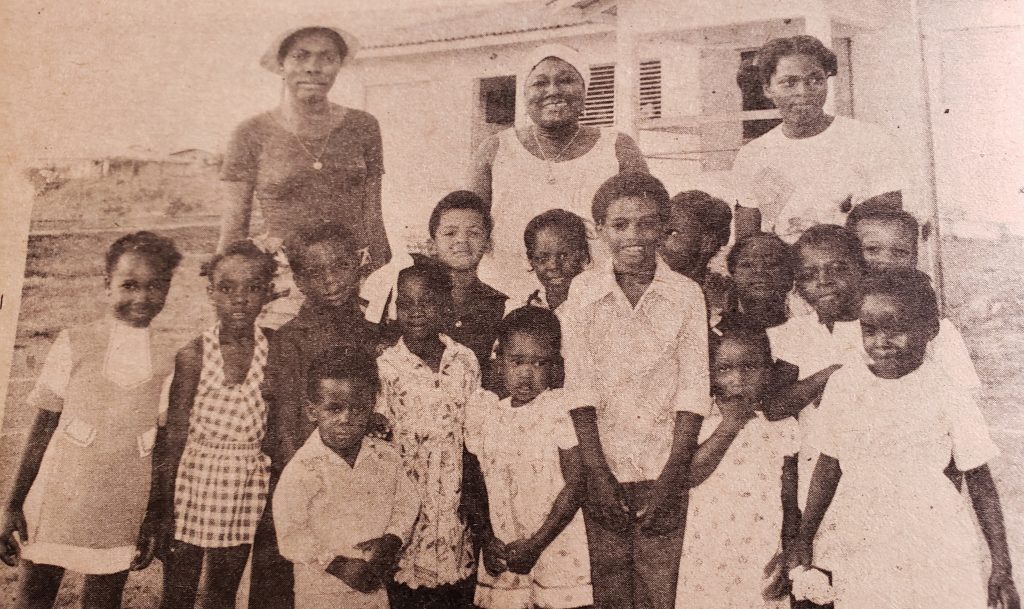
Esther Rolle poses with children during her visit to Montserrat. At back is Juliette Brade, left, and Carol White of Y-Teen.

As it turned out, Rolle had an indirect Montserrat connection even before her visit to the island. Her sister Rosanna Carter, who was also an actress, helped start the Caribbean American Repertory Theater in New York in 1975 along with Montserrat playwright and novelist Edgar Nkosi White.

Rolle’s work with the University Center Theater Group proved beneficial for the performers, including Gus White, Glynis “Mon” Hunter, Wilfred Francis and “Bacchanal” Joe West. In late 1977, Edgecombe wrote, produced and directed the play Sonofabitch. The play was a smash in Montserrat, and Edgecombe took it to the Virgin Islands and Barbados.

Esther Rolle played Florida Evans on the sitcom Good Times from 1974 to 1979.

Cabey, who designed the set for the play and had a minor role, says Ms. Rolle’s tutelage was crucial to the play’s success.

“At the workshops, if you did something bad she would tell you,” he says. “But when you did something good she would come over and give you a big hug — and you know she was a good-size woman. I owe a lot to her. She was a fantastic lady.”

During much of her show business career, Rolle — known for her deep voice and gap-toothed smile — had to hide her Bahamian accent while playing American roles. But in the 1989 movie The Mighty Quinn — which was filmed in Jamaica and helped catapult Denzel Washington’s career — Rolle got an opportunity to unleash her native tongue. She was convincing as the wheelchair-bound, pipe-smoking witch Ubu Pearl. Incidentally, the movie’s soundtrack featured the song Groove Master by Montserrat’s Arrow.

After Good Times was canceled in 1979, Rolle continued to work in movies and television. She won an Emmy Award that same year for the mini-series Summer of My German Soldier. She appeared in the John Singleton movie Rosewood in 1997, one of her final roles. She passed away in 1998 just nine days after her 78th birthday.

An emotional Esther Rolle accepts her Emmy Award in 1979.

Opinion: Death of Montserrat’s Mighty Ruler is sad on many different levels

1
William "Ruler" Murrain spent eight years at the Margetson Memorial Home before he passed away May 12, 2021.

A visit to the Margetson Memorial Home is not for the faint of heart. It is quite jarring to witness once-strong men now broken, incoherent and incontinent. The former bad-word bishops have become ailing acolytes, slumped over, waiting to die, some hoping to die. It is a depressing departure lounge and a harrowing glimpse of mortality.

For more than eight years, this was the home of William Murrain, the Montserrat calypso legend better known as the Mighty Ruler. He was sent there in 2012 after suffering a stroke and having a portion of his right foot amputated amid his battle with diabetes.

Whenever I visited Montserrat, I made a point to visit Ruler at the Margetson home. He and I are not related. We are not contemporaries. But I felt an obligation to check in on him.

I’ve known Ruler my entire life. He lived in Cork Hill Village. I grew up in Byer, about a mile up the hill, but I frequented Cork Hill virtually every day. It was the location of my primary school, and my dad owned a popular bar on the main corner in the village.

Ruler was a frequent patron of my dad’s bar. He was vocal. He loved calypso and would break into song unprompted. He carried around a blue “exercise book” – the classic ones that featured an image of the Queen on the cover. He would fold it vertically and place it in his back pocket. I recall snatching the notebook one time and running away to get a peek of what he had written. I glanced at some of the lyrics before he caught up to me. He was usually jovial, but that day he turned serious. “Don’t do that again,” he said sternly.

I feel an affinity toward Ruler the same way I feel it toward cricket legend Jim Allen. I rooted for both while growing up. They played a memorable part of what remains the happiest time of my life: my childhood in Montserrat.

Ruler was a great fan of Antigua calypso star King Short Shirt. In 1977, Short Shirt visited Montserrat. He was in his prime, coming off his classic album Ghetto Vibes that was released a year earlier. I vividly remember seeing Ruler walking up the Cork Hill main road from Plymouth. He strolled into the yard of my dad’s shop, where many of the regulars were hanging out: “Fireheart,” “Marshall,” “Harper,” “Piggy” and others. Ruler was holding a half-full bottle of Heineken.

“Me just meet de great Short Shirt,” he announced. “He was drinking this beer, and he gave me the rest. I brought it to show all of you proof that I met the great man.”

ROOTING FOR RULER

In those days Cork Hill had two main calypsonians who entered the Festival competition each year: Ruler and Winston “Young Warrior” Christopher. My family would huddle next to the radio to listen to the calypso show, hoping Ruler would finally wear the crown. Each year brought more disappointment, with Ruler’s fans chanting the usual refrain. “Dem tief Ruler!”

After I migrated in 1978, I lost touch with the calypso competition in Montserrat. When I returned in 1985, I was impressed to hear that Ruler was still competing. That year he sang Strain and No Mash Up Me Sick Toe. I watched him thrill the crowd at Sturge Park in the calypso finals, but once again he came up short on the judge’s scoresheet.

Over the years, during my frequent visits to Montserrat, I would see him around Cork Hill. Later on, post-volcano, I saw him in Salem. He would often greet me by using my Dad’s nickname: “Showl, put subben na mi hand.” I always obliged, even if I didn’t have much in my possession.

In 2012, the 50th anniversary of Montserrat Festival, I decided to conduct video interviews with many of the luminaries of Festival. At that time, Ruler had been relocated from Salem to the Assisted Living Ward in Lookout. I visited him on Monday, August 27, 2012 and had a 10-minute video interview. Afterward, I noticed he was limping.

I said: “Ruler, you a hep, man.”

He replied: “Yeah boy, dem cut off some of mi toe dem.”

About a month after, I received news that Ruler had suffered a stroke and was hospitalized. He was later transferred to the Margetson home.

FREQUENT VISITS

I visited Montserrat that December and went to see him. When I arrived, he was sitting in a chair at the entrance. As soon as he saw me he said: “Showl, me want to go home.”

For the next seven years or so, I would visit him each time I went to Montserrat. He would always ask me for cash. I always gave something, even though I knew he was not in a position to spend it even if he wanted to.

In March of 2017, Cork Hill had a village reunion. The activities included a friendly cricket match at Lansen Park, directly across from Ruler’s former house. I asked the manager of the Margetson Home if it would be possible for me to take Ruler to Cork Hill. She said yes, but then she explained the stipulations. A nurse would need to accompany us, plus Ruler needs to take medication at a certain time. I also had to consider that if Ruler encountered a medical emergency we would be miles away from the hospital. I eventually decided it wouldn’t be worth the risk.

William “Ruler” Murrain listens to one of his songs on an iPod at the Margetson Memorial home Tuesday, March 20, 2018.

In March of 2018 I went to see Ruler while he and fellow residents were having lunch on the verandah. I assisted him with his lunch and had a brief conversation with him. Although his speech was slurred I could understand most of it.

I asked him what his father’s name was. “Henry Murrain,” he said clearly.

How many kids do you have? He raised one finger.

I told him that I knew some of his family members who live in America.

“Tell dem fu write me,” he said.

During my 2018 visit I brought him a gift. I gave him an iPod on which I had uploaded about 10 of his songs, plus some other calypso hits by Sparrow and others. I placed the headphones over his ears and watched his eyes light up when he heard his own voice.

Before I left, I told the staff that the iPod would need to be recharged every now and then, and I explained how to do it by attaching a USB to the staff computer. Months later, the iPod was gone. I never got an explanation about its disappearance.

IMPERFECT MAN

Ruler was not a perfect man. He loved his liquor, and when he consumed a fair amount he could be crude and lewd. Many have opined that Ruler was denied the calypso crown several times because it would be an embarrassment to send someone like him to represent Montserrat regionally.

They say he lacked decorum. But how many men in our society – politicians, businessmen, “upstanding citizens” – comported themselves in public but behind the scenes destroyed lives through their abuse of power? Ruler didn’t hurt or kill anyone. Most of his wounds were self-inflicted. And last time I checked it was not a cardinal sin to be impolite.

Following Ruler’s death on May 12, I saw countless tributes on social media. I wondered: Where were some of these people when Ruler was drooling uncontrollably and wearing a diaper? Where were they when Ruler would go months without a single visitor?

The crocodile tears are now flowing.

It’s a crying shame.

Legendary Montserrat calypsonian William ‘Ruler’ Murrain dies at 76

1
William "Ruler" Murrain performs "Fine Twine" in the Kings of Kings competition during Montserrat Festival 2002.

The Mighty Ruler never won a calypso crown. He didn’t achieve international fame. He didn’t earn riches. Yet he was an icon. He was a calypsonian to his core, untrained and undeniably gifted. Ruler’s lyrics were profound simplicity – from the plaintive Strain and Sinking Sand to his humorous opus Fine Twine. During a life marked by adversity, he was often judged unfairly – on stage and off – and defined more by his stumbles than his skill. But his legacy is forever woven into the fabric of Montserrat culture.

William “Ruler” Murrain – the organic calypso crooner, the gravelly-voiced balladeer, passed away Wednesday, May 12, 2021 at age 76. He had been boarded at the Margetson Memorial Home since suffering a stroke in late 2012.

“Ruler was the only 365-days-a-year calypsonian in Montserrat,” says Kenneth “Fisher” Fenton, one of Ruler’s calypso rivals from the 1970s. “Give him a guitar and he will sing for you anywhere and anytime.”

Born February 26, 1945, Ruler spent most of his life in Cork Hill but is originally from the east, in a tiny area called Killy Hawk Ghaut near Tuitt’s Village. His family moved to Cork Hill in the late 1950s and settled just west of Lansen Park, the village’s cricket field.

BOTTLES FLYING

As a teenager, Ruler got a job at Hamsey Allen’s sweet drink factory near George Street in Plymouth. An incident at the factory inspired one of his first calypso songs. When the soft drink bottles were capped they would sometimes shatter. Ruler received cuts on his arm one day and wrote a song called Bottles Flying.

In 1962 at age 17, Ruler was one of five entrants in the inaugural Montserrat Festival calypso show at the Secondary School. Justin “Hero” Cassell won that night, Alfred “Christo” Christopher was first runner-up and Ruler was second runner-up. It was the start of a two-decade-plus run in the calypso arena for Ruler.

“I consider Ruler one of the only natural calypsonians in Montserrat,” says Christopher, who was inspired to sing calypso because of Ruler. “A lot of us had to learn the art form. Ruler was a natural. He needed no coaching. He had a special gift.”

THE SHIRT INCIDENT

After one of the Festival calypso shows in the 1960s, Ruler was involved in an incident that would haunt him for years. In those days, the runners-up received modest consolation prizes. Ruler was given a Terylene shirt by local businessman Habib Hadeed during a presentation at the Vue Point Hotel. Already upset about his placement in the competition, Ruler saw the prize as an insult. He threw the shirt on the ground and walked on it.

“I believe that is one of the things that gave me trouble in Montserrat,” Ruler said of the incident during an interview in 2012, suggesting calypso judges were harsh on him following that defiant act.

In 1968, led by Alphonsus “Arrow” Cassell, Ruler and several other calypsonians boycotted the Festival calypso show to protest the meager cash prizes. The show went on despite just four competitors, all of whom were performing for the first time. In 1969, 1970 and 1971, there was no Festival calypso show. The show returned in 1972, and Ruler was also back.

Through the rest of the 1970s and up to 1986, Ruler was an annual crowd favorite. In 1974, he recorded the mega-hit Fine Twine, but for reasons that remain muddled, he didn’t sing it during the competition. He finished second runner-up.

Justin “Hero” Cassell, left, and Alfred “Christo” Christopher visit Ruler at the Margetson Memorial Home on March 27, 2017. The three men competed in the first Montserrat Festival calypso competition in 1962.

ALWAYS OUTSPOKEN

Ruler was brash and outspoken and he often utilized gamesmanship in an effort to gain an edge during the calypso season.

Fisher, who hails from St. John’s Village, recalls a particular incident. “On the day of the calypso show Ruler stopped every bus coming from North and told the people to tell me that I shouldn’t show up in the park because he’s going to destroy me.”

Ruler also had a much-ballyhooed rivalry with another calypsonian, 1977 monarch Ishmael “Cutter” Skerritt, often poking fun at the bespectacled Salemite and vowing to defeat him.

Ruler’s popular songs during the ’70s and ’80s included Time For Mass, Stop Sing Calypso, Woodum Boom, Demons Pon Me and the suddenly ironic All a We Got To Go. He participated in the calypso finals for the last time in 1986 when Hero captured the crown.

“He always brought intensity to the competition,” Hero says. “He pushed you to be your best. He was a grassroots calypsonian. The only thing that would affect his delivery was when he had a certain product made from sugar cane.”

TRYING TIMES

In 1991, Ruler was struck by a speeding bus in Cork Hill and knocked unconscious. He spent weeks in the hospital and was unable to speak for some time. He recovered to some extent, but some close to him say he was never the same.

Following the volcanic crisis and the evacuation of Cork Hill in 1997, Ruler lived in Salem and earned a living through landscaping.

In 2002 he competed in the Kings of Kings calypso competition to commemorate 40 years of Montserrat Festival. He sang Fine Twine and entertained the crowd with some of his customary stage antics.

In 2007, a William “Ruler” Murrain Crowd Favorite award was added to the Festival calypso show, with audience applause determining the winner.

Asked if Ruler’s failure to win the calypso crown is a stain on his legacy, both Fisher and Hero say no.

“He made his contribution – and that’s foremost,” Hero says. “He didn’t have to win the crown to prove his worth.”

Fisher summed it up: “Ruler was the people’s calypsonian. He was the people’s king.”

Mighty Ruler reveals his favorite song on December 30, 2010.

Mighty Ruler's notable songs

Bottles FlyingParty CrasherStop Sing CalypsoSoca Madness
Hold Fast and SteadyWoodum BoomChanges in LifeFine Twine
Time for MassMash Up Me Big ToeDemons Pon MeBeautiful Montserrat
Sinking SandAll a We Got To GoStrainWash Way
KongThis Is CarnivalStand Firm Education

Ruler Trophy winners (crowd favorite)

The William "Ruler" Murrain award, determined by crowd applause, was introduced in the Montserrat Festival calypso competition in 2007.

YearCalypsonianPopular song
2007Vickie "Storm" LockerThe Storm
2008Rondell MeadeI Love My Festival
2009Davon "Rackatang" WilliamsLiquor in Front, Poker Behind
2010Neilson "Tiger" DuberryI Just Can't Wait
2011Garnett "Sylk" ThompsonNever Give Up
2012Alexander "A.J." CassellThe Pedigree
2013Baptiste WallaceDracula System
2014Keithroy "De Bear" MorsonGot To Go
2015Steve "Iceman" WeekesNar Sell Out
2016Garnett "Sylk" ThompsonGimme De White Man
2017Baptiste WallaceFire In De Bambi
2018Stevel "Mighty Soca" RodneyWhat We Need is Unity
2019Herman "Cupid" Francis200 Million to Spend
2020Keithroy "De Voice" MorsonCall Daddy
2021Roland "Kenzie" JohnsonCome Back and Sing
2022Keithroy "De Voice" MorsonAh Shoulda

1971: Shamrock Cinema opened 50 years ago and became a cultural phenomenon in Montserrat

3
Photo courtesy Midge Kocen
Shamrock Cinema, Montserrat's first major movie theater, was built on a former cotton field off Church Road in Plymouth.

On Thursday, April 29, 1971, Shamrock Cinema made its debut on Montserrat with an invitation-only gala that featured 330 guests, including Chief Minister Austin Bramble. The following night the cinema opened to the public as a sold-out crowd watched the movie Airport.

Fifty years later the Shamrock – like most of Plymouth – has been buried under an avalanche of volcanic ash. All that remains are mostly memories of a theater that provided larger-than-life entertainment, thrilling concerts and festive shows.

Shamrock Cinema was built on the fringe of downtown Plymouth on a former cotton field, just west of Church Road near the intersection that featured Barclays Bank and the National State (John Bassie) Building that housed Kelsick’s Supermarket.

Shamrock was not Montserrat’s first cinema. A few others preceded it, including the Rialto theater on George Street in the 1950s. Movies were also shown for a time at the Roman Catholic school auditorium. But Shamrock was Montserrat’s first authentic cinema, with quality video and sound, a wide screen, ample seating and concessions.

An ad in the Montserrat Mirror newspaper for the grand opening of the Shamrock Cinema erroneously lists the year as 1970.

Owned and operated by American businessman Leonard Kocen and his wife Midge, Shamrock became a cultural phenomenon. In the early 1970s most Montserratians did not own a television. The movies provided an outlet for entertainment and kept locals in touch with the latest international trends.

Mr. Kocen was an executive with Klein’s department store in Manhattan when he decided to relocate to Montserrat. During a 1975 interview he said: “I didn’t know a thing about the movie business but decided it was something the island needed . . . so I just quit my New York job, moved down here with the family and started from scratch.”

In 2011, Midge Kocen provided details about the cinema’s operations.

“We had a proper concession stand with a popcorn machine and soft-drink dispenser,” she said. “We got our syrups from the [Coca-Cola] distributor. We also had a peanut machine. We got the raw peanuts from Guadeloupe. Our machine was too small to roast the peanuts so we took them to Mr. Walkinshaw’s bakery in Salem and he roasted them for us while the oven was still hot from baking his bread.”

INSIDE THE SHAMROCK

The cinema, which had a seating capacity of 434, had three sections: Balcony, which was accessible by steps from the left side of the lobby; plus Circle and Pit, which were located on the floor level and accessed from the right side of the lobby. Balcony and Circle featured theater-style seats while Pit provided bench seating.

The staff also became well-known due to the popularity of the cinema. Lennox Malcolm was a manager, Mary “Girlie Ann” Gerald worked at the bar, Melvin “Smiley” Tuitt ran the projector and “Hashie” Fenton collected tickets.

Evelyn Cabey-Lynch was another employee who became synonymous with the Shamrock. She says she started working at the cinema around 1977. She mostly worked at the concession stand and bar.

“It was a very happy time,” says Evelyn, who worked at the Shamrock into the late 1980s and migrated to London in 1997 amid the volcanic crisis. “Even though I wasn’t working for a lot of money I really enjoyed it.”

Evelyn recalls the first movie she saw at Shamrock . . . several years before she worked there.

“I remember going to see To Sir With Love,” she says of the Sidney Poitier classic. “The place was really full that night.”

During her 2011 interview Mrs. Kocen explained that the films came from Trinidad, which was the hub for Caribbean movie distribution. Mr. Kocen, a pilot who owned his own plane, would import the reels. “He booked films for Dominica and I think St. Kitts,” Mrs. Kocen said. “He moved the films between the three islands.”

Each night at Shamrock had a theme. Friday nights featured Spaghetti westerns or karate movies. There were also Saturday matinees and “Lover’s Night” on Sundays. Mondays were called “White Night” because the audience consisted mostly of expatriates, Mrs. Kocen said.

Photo credit: Bruce Kocen
Leonard Kocen in Montserrat, 1975.

‘KUNG FU FIGHTING’

During the early years of the Shamrock, fans were treated to an array of movies that became iconic. They were terrified by Jaws (1975), mesmerized by Star Wars (1977) and enthralled by the musically driven Saturday Night Fever (1977) and Grease (1978).

However, the karate movies were a huge fan-favorite. Karate gained popularity in the early 1970s mostly due to martial arts star Bruce Lee. UK-based Jamaican singer Carl Douglas had a No. 1 song in 1974 called Kung Fu Fighting that further fueled the novelty. Boys and men alike would exit the Shamrock following a movie and exchange playful karate kicks. Some men in Montserrat even created their own noon-chucks, so popular was the craze.

Indeed, the drama at Shamrock was not confined to the big screen. It was not uncommon for some men to attend several nights in a row, with a different lady in tow each time. The balcony became a spot for clandestine escapades. Meanwhile, the Pit was known for hosting the noisiest patrons.

MULTI-PURPOSE VENUE

Shamrock was more than just a movie theater. It hosted school graduation ceremonies and many concerts. Montserrat’s Arrow performed there, as did Mighty Sparrow and Lord Shorty – who was later known as Ras Shorty-I and is credited as the pioneer of soca music. Reggae star Eric Donaldson performed for a sold-out crowd at the Shamrock in October of 1977 but was arrested the following morning for marijuana possession and deported.

Shamrock served hot dogs, sandwiches and other treats that customers could purchase even if not attending a movie. Cabey-Lynch says some of her best memories are from serving lunch to students of the Montserrat Secondary School, located about a quarter-mile north of the cinema.

“The children would be shouting for the sandwiches,” she says. “You could tell they really appreciated it. Sometimes I would sell a student a sandwich and they didn’t have enough money. I never took back the sandwich. I would just tell them to pay next time.”

The car park at the side of the Shamrock was the site of netball games, during which spectators could purchase hot dogs and other snacks from the cinema. Across from the Shamrock was Lett’s Ice Cream, another popular eatery.

Photo from Facebook
Midge Kocen in 2010.

CHANGING TIMES

As the 1980s arrived, more Montserrat homes began acquiring televisions. It also marked the introduction of cable and VCRs. Shamrock’s business began to tail off and the facility curtailed its movie schedule and became more of a hosting venue.

“When [the movies] became not profitable Mr. Kocen put fridges and freezers in the lobby, mostly for the ex-pats, and brought fancy foods from Guadeloupe,” Mrs. Kocen said in 2011. “He also brought in yogurt.”

By the time Hurricane Hugo struck Montserrat in 1989, the Shamrock was basically defunct. “After the volcano and the closing of Plymouth, that was it,” Mrs. Kocen said.

Aside from her work with the Shamrock, Mrs. Kocen was also community spirited. She made history by becoming the first female member of the Rotary Club – not just in Montserrat but for the entire District 7030, which covers the Caribbean.

Montserrat has not had an official theater since the Shamrock. Movies have been shown at venues such as the Montserrat Cultural Center in Little Bay but only on a limited basis. The Internet age plus streaming services such as Netflix have also rendered the theater experience obsolete in some cases.

Sadly, Leonard Kocen died in a plane crash off the northeast coast of Montserrat while piloting his twin-engine Cessna on May 3, 1986. He was 58 years old. Kocen’s second wife Pat and their grandson Bradley also perished.

Midge Kocen moved to Houston, Texas, following the volcanic crisis. She passed away in June of 2015 at age 83. As a testament to her love for Montserrat, her remains were interred on the Emerald Isle.


Death of a salesman: Montserrat icon Richard Samuel passes on at age 83

1
Photo credit: The Lake family
Richard Samuel at his shop in Sweeney's. Samuel's bakery in Kinsale was one of the most popular before the volcanic crisis.

Richard Samuel, the venerable and beloved Montserrat shop owner known for his generosity, cool demeanor and tireless work ethic, passed away early Easter morning, April 4, 2021, at his home in Sweeney’s. He was 83 years old.

Samuel will likely be most remembered for his bakery in Kinsale but his influence stretched much further. He served as a fire officer for 17 years and was one of the first responders following the Pan Am crash at Chances Peak on September 17, 1965. He also helped extinguish the George Street fire in 1966.

Samuel also drew fame in the 1960s by driving one of the most visible and famous vehicles in Montserrat, a long flat-bed truck dubbed “Macco Building” – a name taken from the lyrics of the song Skyscraper by Mighty Sparrow. Samuel delivered agricultural goods, cement and other items with the truck. He even relocated small houses.

Samuel’s parents – affectionately called “Brother Sam” and “Sister Sam” – owned a bakery and small grocery store in Kinsale. After they passed away Richard took over the business and became one of the island’s most popular bread bakers. His bread was in such demand that he sometimes sold loaves before they were completely baked.

Junie Irish grew up about 200 yards from Samuel’s home in Kinsale. He says Samuel’s bread was legendary but his work ethic was even more remarkable.

“He was doing well selling bread, then he started [roasting] beef,” Irish says. “His beef was really good. Sometimes during the day he would stop baking and go out to sea to check on his fishing pots. Then he would go look for his goats and cattle. His energy was amazing.”

John “Flash” Ryan, who also grew up in Kinsale, says he can’t forget Samuel’s generosity.

“As kids he would take a bunch of us in the truck and drive out north for St. John’s Day,” Ryan says. “When I started doing body work I was having a hard time finding a place to set up. He allowed me to do my work in his backyard . . . and he never charged me.”

Despite not possessing a secondary education, Samuel delved into politics and had an unsuccessful run as an independent candidate during the 1980s. His message was simple: “I’m a man of few words. Vote for Richard.”

Following the volcanic crisis in 1995, Samuel relocated his business to Sweeney’s. And many of his customers followed. His shop became a popular hangout. Patrons drank, played dominoes and ate Richard’s grease bread, chicken wings, turkey drumsticks and turkey necks.

Irish explained Samuel’s popularity and why his customers were so loyal.

“He came over to the north and he was the same Richard,” Irish says. “People loved him as a person. It was his personality. He’s a real cool guy.”

Samuel, nicknamed Gabby, was also humble. His shop in Sweeney’s is a simple wooden building with no frills. He continued to tend to his livestock into his 80s.

Samuel leaves behind a large family and an even larger legacy. Dozens of tributes were shared on social media following the news of his death.

Irish says he was stunned when he got the phone call early Easter morning revealing that Samuel had passed away.

“It drove a dagger through me,” he says. “Even though we know we’re all going to go at some time, it’s hard to face the reality.”

RICHARD SAMUEL INTERVIEW

Richard Samuel shares his memories of the 1965 Pan Am crash at Chances Peak during an interview with Radio Montserrat’s George “JGP” Piper on September 17, 2020.

Opinion: In Montserrat, humane treatment of ‘man’s best friend’ remains a work in progress

2
During a visit to Montserrat in 2018 I took a family member's dog for a walk each morning and a few rides to Cork Hill.

While I was growing up in Byer Village in Montserrat, like most families we had a dog. He was white with a fluffy coat. He was docile and harmless. In fact he rarely barked. One day he escaped his leash and walked about a quarter-mile to one of our neighbors’ homes. That neighbor owned a female dog, and I believe the canines were in heat. During our dog’s uninvited visit he committed the cardinal sin of urinating on the verandah. So the owner shot him . . . three times.

Ironically, our dog’s name was Bullet.

I was devastated by Bullet’s death. But my grandparents, whom I grew up with, didn’t seem overly bothered about it. In my 8-year-old mind I figured perhaps the dog deserved his fate. But as I got older and processed the incident, retroactive anger arose. That incident was a mere microcosm of how we as a country and culture have treated an animal often referred to as “man’s best friend”.

Moving to America at a young age helped me evolve in many respects. I still revere my Montserrat roots and will never renounce the culture I cherish. However America has opened my eyes to some practices in Montserrat that in hindsight were harshly cruel.

Recent visits to Montserrat have left me stunned at the animal abuses that still exist. In 2014 I stayed in a rented home. The neighbor had a small dog that was tied to the side of the house. My bedroom was directly across from the animal. One night it rained on and off for hours, along with lightning and thunder. The sound of that poor dog whimpering throughout the night remains with me to this day.

I saw a lot of animal abuse while growing up and it’s amazing how some of the most brutal acts can become acceptable when deemed the norm. We would toss our dog a few chicken bones during dinner, and I believe in our minds we thought that should be enough to satisfy their appetites. Dogs do like bones, but bones are hardly filling. Many of us have experienced the family cat eating from our dinner plates when we turn our back and how angry we were having to throw the food away. But the animals aren’t doing that because they’re selfish. They’re doing it because they’re hungry. We pay delicate attention to livestock because they can one day yield something in return in the form of food or cash. But I’ve heard men joke about saddling dogs with heavy rocks and drowning them. We seem to think of them as inanimate objects.

Two years ago I visited Montserrat and stayed at the home of a family friend who was off island. He had a brown-and-white dog that was tied to a tree in the front yard. The owner’s niece would stop by each day and feed the animal. But other than that, the dog’s existence consisted of a 10-foot radius. He ate, slept and relieved himself in that space.

Like humans, dogs exhibit body language. I could tell this one was unhappy. So I decided that during my time staying at the home I would grant him a bit of freedom. I took him for a walk one morning. When I began untangling his leash from the tree he seemed a bit confused. But when I began walking him he became animated. Dogs might be domesticated but a part of them remains primal. He sniffed around, relieved himself, panted in delight and ran as far as the leash would allow. At last he felt some semblance of emancipation.

The next morning I walked him again. This time as I untethered his leash from the tree, he licked my hand emphatically. Dogs can’t speak in the conventional way, but he spoke to me that morning: “Thank you so much, thank you for giving me some freedom.”

That same morning I had an extra treat for him. I placed him in my jeep and drove from Brades to Cork Hill. I parked the jeep, then we walked up the hill to Byer, which has been in the uninhabited zone of Montserrat for more than 20 years due to the Soufriere Hills volcano. With no one around I unleashed him. He ran around, chased an agouti, chased a few wild chickens, marked his territory a few times and thoroughly enjoyed his freedom.

Sadly, our morning ritual ended when his owner returned to the island and I went back to the United States. Before leaving I asked the owner if he would take the dog for a walk every now and then. “I don’t have time,” he replied. Why do you have a dog in the first place, I asked. “He’s there to let me know if somebody comes in the yard.”

I thought to myself: “OK, so he’s your security guard. Treat him with a little compassion.”

As I get older, animal abuse bothers me more and more. In fact you will never find a bird cage, aquarium and any other type of animal confinement in my home. I don’t visit the zoo or the circus because I don’t like seeing animals being exploited.

Nigel Harris, owner of Fly Montserrat, has been a controversial figure in Montserrat in recent years for his managerial decisions concerning his airline. But one area in which he deserves credit is being an advocate for better animal treatment. He founded MAPS (Montserrat Animal Protection Society), which shelters stray dogs and cats, tries to get them adopted, and also conducts dog walks each Sunday.

I have tried stressing to friends and family members in Montserrat about treating animals more humanely, but it has been an uphill climb. Some years ago I was speaking to a friend in Montserrat during the trial of Michael Vick, the American football player who was jailed for his involvement in a dog-fighting ring. “Why don’t they leave the man alone,” my friend said with a disgusted tone, accompanied by a strupes.

The fight continues.

As I prepared to take a selfie with my pal, I was at first taken aback by this unexpected lick. But animal experts say a lick from a dog is often a deep gesture of gratitude.

Montserrat Calypso 2020: Here’s my virtual analysis of the monarch finals

0
Photo by Discover Montserrat
The incomparable Keithroy "The Voice" Morson easily captured his fourth Montserrat calypso crown.

The Montserrat Calypso Monarch Finals – relegated to a virtual format because of COVID-19 – was held at the Cultural Center on Tuesday, December 29, 2020. It marked 49 uninterrupted years of Montserrat calypso competitions despite two natural disasters and a pandemic. Since Montserrat Festival began in 1962, the calypso show missed only three years (1969, 1970, 1971) and that was due to a boycott.

Although massively constrained by COVID-19 guidelines, the Montserrat Arts Council executed an entertaining show Tuesday. Some of the aesthetics could have been better but the substance is what matters.

When the results were revealed following the almost-five-hour show I was a bit surprised. I’m not a calypso judge nor have I attended a judging workshop. But I have been listening to calypso for a half-century and my eyes and ears don’t often fail me.

As someone who has competed in the Montserrat calypso competition I am aware of the anxiety that encompasses the process. As popular Radio Montserrat DJ Basil Chambers once uttered: “Up dey no easy.” So I empathize with anyone who has experienced mishaps. That said, I am ready to give a fair and honest assessment of the calypso finals.

First, here’s my analysis of the 12 competitors, starting with the adjudicated Top 5:

1. Keithroy “The Voice” Morson ($10,000): The man has no weakness when it comes to this art form. His first entry, By Faith, was hardly a juggernaut but his performance is so commanding that he can take an average song to a different realm. And then there was his coup de grace, the biting commentary Call Daddy. He delivered it with aplomb and even threw in an extra verse. On social media it was virtually unanimous that The Voice had run away with the crown.

2. Trevon “Trevvle” Pollard ($8,000): After dominating the soca monarch competition the past couple years Trevvle entered the calypso arena and had a credible debut, winning Best Newcomer. He is a charismatic performer who is light on his feet and clearly loves the stage. My only quibble would be with his two selections, Calypso Reform and What’s On Your Mind. Both were catchy with effective hook lines but lyrically shallow. At times it felt like lines were being repeated to make up for what the song lacked in substance. Also, What’s On Your Mind features a riff reminiscent of Cupid’s 20/20 Cricket World. At any rate, it’s good to see young performers capable of elevating calypso and assuming the mantle.

3. Steve “Iceman” Weekes ($6,000): Yes, he lost the crown, but he gave two decent performances with Wrong Decision and So Much Pain. His visual challenges have been well documented and Iceman should be commended for his perseverance. Despite his failing eyesight he is still a social visionary. My only nitpick would be that his new songs are starting to reveal melodic similarities with his previous material.

4. Kenneth “Yogi Laser” Greenaway ($4,000): When I heard Laser’s song Serious Time about a month ago I immediately picked him as a dark horse in the competition. Yogi has endured hard luck in the competition in recent years despite solid material. His studio recordings are diligently produced and it’s clear he loves calypso. His second entry, Living in Hell, was commendable. His placement was well deserved.

5. Delroy “Delz” Joseph ($3,000): As with Trevvle, I was heartened to witness the debut of Delz. I was even more impressed that one of his selections, Calypso Lyrics, paid homage to calypso’s roots. Some have said that the melody is hackneyed, but I am impressed that a young performer showed interest in the organic calypso style of storytelling and double-entendre. “Saltfish” never goes out of style. His second selection, Black Lives Matter, was well-written and catchy, too.

Photo by Discover Montserrat
Kelvin ‘Tabu’ Duberry channeled the messiah with ‘A Work in Progress’

THE OTHERS (each received $2,000)

Brian “I-Cultural” Charles: The man with the catch phrases “Hee! Haw!” and “Tun It Up” always has fun on stage. But when required to deliver intricate lyrics he struggles because he prefers the unconstrained soca arena. His songs Marie Warner and Virus in the Stimulus were humorous but were never going to challenge for a crown. It’s a shame the Soca Monarch was canceled. He deserved a forum where he could be unrestrained.

Kelvin “Tabu” Duberry: Tabu has been trying in vain to replicate the lone crown he won in 1991. I had him picked in the Top 3 and was stunned that he didn’t place. He took an introspective route this year with his song A Work In Progress. During his performance, the artistically gifted Tabu depicted Christ, which is always a controversial proposition. His second selection, Before It’s Too Late, was also thoughtful. I’m not sure what turned off the judges but I saw two very solid performances.

Kevin “King NattE” Farrell: The former monarch again embraced the task of entering the competition and also playing lead guitar with the Black Rhythms band. Man Who Shapes The Future paid tribute to three prominent Montserratians. It’s a formula NattE has utilized for several years now. His other entry was Formula, about the government’s decisions during COVID-19. NattE, who was added to the Finals due to a technical glitch involving another artist, has a wonderful voice and conjures poignant melodies but he has been unable to duplicate the impact he made in 2016.   

Herman “Cupid” Francis: He captured the Most Creative Song award again with When The World Stopped, which also won Best COVID-19 song. But despite two consistent performances (his other song was Behind The Mask) he was an also-ran again. His presentation for When The World Stopped was excellent, especially the effect of the band going silent between verses to accentuate the song’s title. However, a line in the song mimics the words and chord progression of the classic song The End of the World by Skeeter Davis. Perhaps the judges picked up on it and he was docked originality points.  

Reinford “Kulcha Don” Gibbons: I was impressed by his first song, Fire For Them, which addressed a controversy from the calypso eliminations. Decked in military gear, Kulcha gave an energetic performance, although the melody was not original. His second song, Glory Days, featured a brilliant presentation with a madras-clad young lady representing Montserrat. But there’s something about that song that seems to tie Kulcha in knots. He stumbled over his words and seemed out of breath at times.

Stevel “De Rod” Rodney: He won the Most Improved award but can’t seem to get over the hump and contend for a crown despite his zeal. Let The Young People Shine was a well-penned commentary advocating for the youth of Montserrat and steps that can be taken to assure they don’t migrate. COVID-19 Assassin was a fairly pedestrian song about the pandemic. Full disclosure, I once wrote for De Rod during his junior calypso days. He is a quick learner, easy to work with and is not afraid of the moment. But there is an element about his voice that refuses to evolve. He badly wants to win the crown. I badly want to see him win. Voice training might help. He has all the other tools.

Baptiste Wallace: It is often said that when one starts at the top the only place left to go is down. Since sweeping aside the competition in 2013, Baptiste has not remotely threatened to win another crown. His two songs, Let LIAT Fly and Pay De Black Man E Money, were simply OK, which is not good enough.

Photo by Discover Montserrat
Steve ‘Iceman’ Weekes, with reigning Miss Montserrat Janet Turner, lost his crown but finished a respectable second runner-up.

IN CONCLUSION

We should all be grateful that a show was held in the first place. I commend Montserrat Arts Council director Kenneth “Rabo” Silcott for pulling off the event. He faced tremendous pressure to cancel the show but stood steadfast, and it appears his gamble paid off.

Speaking of MAC, kudos are also in order for Sharlene Lindsay, who hosted the show and interviewed each calypsonian after their performances. Her steady and unflappable demeanor helped the show run smoothly when it’s very likely there were technical issues the viewing and listening audience was not aware of.

As for the show itself, recycled melodies are creeping their way into the material more and more. Sometimes it’s subtle. Sometimes it’s blatant. Often I believe it’s unintentional. Melodies are not easy to create, and calypsonians who write their own songs often become creatures of habit. The chords enter the brain in a similar pattern.

As mentioned above, I was surprised that veterans Tabu and Cupid did not place higher. I suspect that when one enters the competition every year they begin to morph into monotony. Perhaps Tabu and Cupid would be well served by skipping a year. Let the public miss you, then come back with a renewed sense of purpose.

Looking ahead, let’s hope for a return to the customary calypso finals in 2021: outdoors, massive audience, a visible band and more inspired performances.

MY AWARDS

Favorite song of Carnival: Social Media Lover, Undertaker

Best Performance: Call Daddy, The Voice

Best Presentation: When The World Stopped, Cupid

Most Humorous: Calypso Lyrics, Delz

Best written song: (Tie) When The World Stopped, Cupid; Before It’s Too Late, Tabu

Most brilliant decision: MAC having a mini-competition between the three female competitors from the eliminations.

Additional kudos: To calypsonian Vickie “Storm” Locker for her “watch parties” on Facebook that draw a significant audience and generate interest in the competition. And to Nia Golden for doing yeoman’s work again as a backup singer.

Calypso crowns by De Bear (De Voice)

Year EventSongs
1985Montserrat Jr. CalypsoSlavery (one song)
1992Montserrat FestivalBack to Basics & Face The Truth
1993Montserrat PilgrimageCome Home (one song)
1993Montserrat FestivalThe Time Has Come & Show Respect
2002Antigua IndependenceMan Is Dust & Help
2007Antigua CarnivalI Say No & Support Party
2007Leeward Islands CompetitionI Say No & Man Is Dust
2010Antigua CarnivalLeopard Come Home & Don't Sing Bout de Judgment
2011Antigua CarnivalMelee For Sale & We Get The Change Ivena
2012Antigua CarnivalTime To Take Our Place & Freedom for Mandela
2012Leeward Islands CompetitionTime To Take Our Place & Freedom for Mandela
2014Montserrat FestivalDon't Forget Your Juliet & Got To Go
2015Antigua CarnivalCan't Stop The Bear & Sing A Different Song
2015Leeward Islands CompetitionCan't Stop The Bear & Sing A Different Song
2019Antigua CarnivalLet The Master Show You & On A Ray Of Hope
2020Montserrat CarnivalBy Faith & Call Daddy
2021Montserrat CarnivalLet Us Rebuild & Don't Wake The Bear
2022Montserrat CarnivalHard Like A Diamond & Ah Shoulda
2023Leeward Islands CompetitionHard Like A Diamond & Don't Wake The Bear
2025Montserrat CarnivalCome Serve Your Country & Gi Dem Licks

Andrew J. Skerritt: Should Montserrat erect a statue of Arrow? Long time

1
Arrow not only left his mark in the soca genre, he promoted Montserrat and preached national identity in his lyrics.

The Montserrat National Museum’s exhibit “Ten to One is Murder” evoked for many of a certain age, memories of a good time. A good life. Not surprisingly, that display and the opening ceremony to celebrate it elicited all kinds of suggestions and recommendations.

Some wanted curator Dr. Clarice Barnes to include more of Arrow’s performance outfits. Some wanted more shoes. Others demanded some other goods sold by Arrow’s Manshop. Others are even more radical in their demands. They called for a statue of the Mighty Arrow, one of the island’s three national heroes.

That is a revolutionary idea – for Montserrat. This four-hundred-year-old colony, of an imperial power whose public buildings and town squares are decorated with statues, sits devoid of any monuments to human achievement. The War Memorial is a monument to sacrifice – men who died for the allied cause in the two World Wars. Montserratians never built a statue. For centuries, the only statues on the ham-shaped island hung in Roman Catholic Churches.

I know of no anthropological rationale for the absence of statues. I assert that people who live on a thirty-nine-square-mile island suffer from the problem of proximity. It’s hard to venerate and idolize people who you think you know too well. The closer you are the more you see the faults. Hence, the antipathy toward deifying and hero-worshiping and, as a consequence, monument building.

Empires, though, build monuments to flawed men. Cecil Rhodes. Winston Churchill. Meanwhile, colonials tear down men (and women) before they can achieve the success that will earn them a statue. They only who see feet of clay cannot a bronze statue envision. Arrow was worshipped by Calypso and soca fans all over the world, but for many of his former neighbors and classmates, he was merely the guy next door who sang and performed for a living.

The absence of statues remains a monument to how far we have not yet traveled on the road to self-determination.

Britain’s urban landscape boasts statues to war heroes and pirates, Nelson and Drake, abolitionists and slavers, politicians and priests, sinners and saints. Their statues stand as monuments to Britain’s imperial past. They tell the story of how a people sees itself. They are a societal boast. Statues brag about a nation’s conquests and conquerors, its victors and victories.

On the other hand, the absence of monuments can infer a lack of confidence, a society ridden with self-doubt. It’s the colonial’s burden. When we look into the mirror of achievement, we see failure instead of success, losing instead of winning. This is not what a hero looks like.

And so Arrow – the soca ambassador of Hot Hot Hot fame – is the third Montserrat national hero. William H. Bramble, a former chief minister, and Robert W. Griffith, his contemporary and a labor organizer, preceded him. I recommend busts of the three men. Small steps. A monument with all three men.

Even while battling illness, Arrow gave his best for a worthy cause. Above he is pictured during a concert January 30, 2010 at the Montserrat Cultural Center for victims of the Haiti earthquake.

Creating a statue demands skill. Is there an artist on island who possesses the skill, tools and experience to create a statue? Given the brutal nature of the tropics, what kind of material makes for the most durable monument? That should be an easy question to answer. Other Caribbean islands have built statues that endured.

Money will be an issue. How do we finance a statue given the Montserrat government’s budgetary constraints? A statue demands a fundraising campaign. If people want a statue, they should be willing to pay for it.

Ten years after Arrow stepped off the stage, this conversation is overdue. The absence of statues remains a monument to how far we have not yet traveled on the road to self-determination. Arrow devoted his career to helping us bolster our identity. He was a Montserrat nationalist. His music catalog is filled with lyrics urging us to national identity, to cultural resilience, to standing up instead of bowing the colonial knee. A statue in his honor will not only be a monument to the man, but to his people, to us. It will also be an unambiguous message to us and future generations: stand up for our culture, for our birthright, for our piece of the rock. 

Calypso legend Rupert ‘King Swallow’ Philo passes away at 78

1
Photo credit: ABS TV
Rupert "Mighty Swallow" Philo performs in a legends concert during Antigua Carnival's 60th anniversary in 2017.

On Sunday, July 26, 2020, a small group of people visited Sir Rupert Philo – better known as King Swallow – at his home. The calypso icon had just been released from Mount St. John’s Medical Center. The visitors included Antigua & Barbuda Prime Minister Gaston Browne and calypso legend McLean “Short Shirt” Emmanuel.

In a video posted on social media, the men all sang Man To Man, Swallow’s 1978 song urging mankind to unite and not tear each other down. Swallow sang along while playing a toy drum set. Although he appeared frail, he seemed in good spirits.

“He said to me that he doesn’t have millions in the bank,” Browne said. “I reminded him of his contribution to the creative arts and nation building, which are etched in the hearts and minds of our people.”

On Friday, September 11, 2020, those same people were sent into mourning when King Swallow passed away following a prolonged illness believed to be kidney related. He was 78 years old. Swallow had been in and out of the hospital in recent months. In 2017 he was hospitalized in New York for an extended period.

His death marks the end of an era. Swallow, along with Short Shirt and Paul “King Obstinate” Richards, dominated the calypso scene in Antigua and much of the region for a half-century. The Short Shirt-Swallow rivalry even spilled over to Montserrat, where the two legends had their own faction of fans.

During the height of the rivalry, fans in Montserrat would get into heated arguments about which calypsonian was better. Antigua’s carnival, held in the summer, does not coincide with Montserrat’s December Festival. So Antigua Carnival had Montserrat’s complete attention each year, and the days of Short Shirt vs. Swallow were intense.

The peak of the rivalry came in the late 1970s. In 1976, Short Shirt released his classic Ghetto Vibes album with the mega-hit Tourist Leggo and blew away the competition in the calypso show. Swallow rebounded to win the crown in 1977 and 1978. He also won in 1973 and 1985.

“Whenever I win it’s a joy, because it’s a battle well fought,” Swallow once told the Antigua Sun newspaper. “I used to like the rivalry. As I always say, Short Shirt is one of the persons responsible for my elevation in calypso.”

The rivalry got thrown for a loop in the early 1980s when King Obstinate, who first won the crown in 1958 and then lived abroad for years, returned to Antigua. Obstinate brushed aside Short Shirt and Swallow and captured the crown in 1981, 1982 and 1983, then retired “undefeated” as he likes to say.

Photo credit: Kirthley Maginley
From left: King Obstinate, King Swallow, King Short Shirt, circa 1990s.

The Short Shirt-Swallow rivalry even seemed to get a bit personal later on when Short Shirt released the song Beauty and the Beast, to which Swallow responded with Barabbas.

The 1980s was the decade in which Swallow left his mark, not on the calypso stage but with his party songs. Tunes such as Subway Jam, Party in Space, Satan Coming Down and Fire in de Backseat became classics. He worked with the best producers of the era: Ed Watson, Leston Paul and Frankie McIntosh.

“He and Arrow helped soca to break out,” said Justin “Hero” Cassell, Montserrat’s 10-time calypso monarch. Arrow, Hero’s brother, also enjoyed success in the ’80s, especially with the iconic Hot Hot Hot.

Swallow ran the popular Calypso Pepper Pot tent during carnival. For several years in the early 1980s, Hammah International out of Montserrat was the house band.

“He was calm and soft-spoken, very professional,” says Silas Carty, Hammah’s lead guitarist, of Swallow. “Swallow was very easy to work with. I can never forget us backing him up on Party in Space. The day after he won the Road March he was on the truck with us singing it.”

Swallow would headline the shows at his tent, entering the stage in the wee hours by uttering his trademark phrase, “Saaaay What!!” as the band cranked up.

Swallow appeared on stage with Montserrat’s Keithroy “De Bear” Morson at the Antigua Calypso Monarch finals in August of 2019. He strummed a guitar as De Bear sang Let The Master Show You.

Swallow, Short Shirt and Obstinate have all dealt with serious health issues in recent years. In 1998, Obstinate suffered a stroke and was relegated to performing while seated. Short Shirt also had medical challenges and even turned to gospel in the late ’90s under the name Brother Emmanuel. He eventually returned to secular music.

Swallow was a five-time Road March winner: Pow Pow (1972), Push Ya, Push Dey (1973), Shake and Break You Bam Bam (1975), Party in Space (1983) and Satan Coming Down (1984).

Swallow was born in the rural village of Willikies on February 14, 1942 – just 14 days before the birth of his rival-to-be King Short Shirt.

Swallow has been honored many times by his country, the pinnacle coming in 2011 when he was awarded with the Knight Commander of the Most Distinguished Order of the Nation.

King Swallow Performs in Calypso Spektakula Tent in Trinidad, 1992

TRENDING NOW

MOST POPULAR ALL-TIME STORIES

error: Content is protected !!