Photo credit: Curtis Morton The victorious Montserrat cricket team celebrates after a 45-run victory against Nevis in Charlestown.
On July 25, 1971, Nevis was the site of the greatest collapse in Montserrat cricket history. After starting 104 for 1, Montserrat was bowled out for 114 and eventually lost by an innings and 118 runs. Grove Park has since been renamed to honor Elquemedo Willett, the Nevis bowler responsible for that painful Montserrat loss.
From February 19-21, 2023, the Montserrat team was in Nevis again. But this time there was no collapse. The Emerald boys won the toss, batted first, posted a solid 243 runs and held on for a 45-run victory. It was Montserrat’s first win on Nevis’ home field in a three-day match since 1959.
“We are so over the moon right now,” Montserrat fast bowler Damion Williams told Radio Montserrat on Wednesday morning. “I even shed a tear because of all the things we’ve been through as cricketers in Montserrat.”
Williams, who was recently with the Leeward Islands team competing in the West Indies Championship, claimed three wickets in the second innings for Montserrat.
The Leeward Islands Cricket Tournament was last contested in 2019, then canceled from 2020 to ’22 due to COVID. From 2016 to ’19, the tournament featured only 50-overs matches because of funding and other issues. Now, the three-day format has returned for the first time in a decade.
During the COVID hiatus, the Montserrat team played many intrasquad matches, and several players also joined clubs in the United Kingdom. The Montserrat Cricket Association has also been revamped, with the notable addition of coach Parmanand Jailall.
GRANT’S BIG FEAT
Montserrat opening batsman Joshua Grant made history Tuesday by scoring 66 not out in the second innings. He is one of a handful of Montserrat players to carry their bat in a match. The first was Reginald Clarke, who scored 49 against Antigua in September of 1952.
“I didn’t realize I made history until I saw someone post it on What’s App,” Grant said. “It feels great. I want to thank The Almighty.”
Photo credit: Leewards Cricket Joshua Grant carried his bat on route to 66 in second innings.
Montserrat’s first innings was boosted by a game-high and career-high 82 runs from Shernyl Burns. Kasjuan Sullivan added 63 and Jemol Williams chipped in a rapid-fire 45. Montserrat then bowled out the hosts for 142 runs, a total even more impressive considering Montserrat yielded 25 extras.
In the second innings, Montserrat lost some quick wickets late but Grant proved to be a crucial anchor with his unbeaten 66. Despite being bowled out for 152, Montserrat set Nevis a challenging 254 to win.
Nevis got off to a horrible 14 for 4 start, sparked by three quick wickets from Damion Williams.
BIG WICKET
A crucial breakthrough came in the 47th over when Carlon Bowen-Tuckett hit a lackluster drive straight back to the waiting hands of bowler Deno Baker, who claimed nine wickets in the contest and earned Man of the Match. Bowen-Tuckett was out on 68.
“I saw that he was getting comfortable and trying to hit everything to long-on or long-off,” explained Baker, who took the final five wickets. “So I flighted the ball and bowled it into his body. So he had no choice but to play forward right back to me.”
A dejected Bowen-Tuckett slammed his bat as he trudged off the field. His dismissal snapped a 78-run partnership with Adelvin Phillip. Bowen-Tuckett is the son of former Nevis, Leeward Islands and West Indies player Carl Tuckett, who served as an umpire in the match.
Photo credit: Leewards Cricket Deno Baker: His nine wickets earned him the Man of the Match award.
In the first innings, Montserrat captain Zawandi White stymied Nevis with his off-spin, taking three wickets for an economical 34 runs in 15.5 overs. But he sustained an injury and was unable to bowl in the second innings.
Montserrat’s previous win in Nevis in a three-day contest came in a semifinal match in 1959 when Kingsley Rock (125) hit Montserrat’s first century in regional cricket.
Following Tuesday’s victory, the team celebrated at its guest residence, then flew the following morning to St. Kitts, where it will face Antigua & Barbuda starting Thursday at Warner Park. St. Kitts and Nevis are hosting the tournament.
Watch highlights from the final day of Montserrat vs. Nevis in the Leeward Islands cricket tournament.
MODEST SUCCESS
Montserrat has defeated Nevis only five times in Charlestown since Nevis began playing regional cricket as an independent team in 1949:
1951: Montserrat won in semifinal, then beat Antigua to win the Hesketh Bell Shield.
1959: Montserrat won in semifinal, then lost to Antigua in the final.
1991: Montserrat won 50-over match.
1997: Montserrat won 50-over match.
2023: Montserrat won three-day match.
Photo courtesy Peter Queeley / Facebook The Montserrat team, with Damion Williams out front, is pictured at Elquemedo Willett Park.
Alford Corriette, who played for Montserrat from 1970 to 1976, is pictured with the Combined Islands team in 1973.
Alford Corriette was not just a brilliant cricketer. He was a beautiful cricketer. Handsome, lean and pristine, he made the game look easy, molding a sterling but abbreviated career before going into seclusion and becoming a virtual mystique.
“He was an elegant player, pretty to look at, easy on the eyes,” says friend and former teammate Basil Morgan, who knew Corriette since 1966. “He was a student of the game and one of the best cricketers Montserrat has ever produced.”
Corriette, widely considered Montserrat’s greatest all-rounder, passed away early Monday, January 2, 2023, at his home in Brooklyn, New York. He was 74 years old.
Corriette is the second former Montserrat player to die within a week. On December 29, 2022, Salem native Reuel Dyer – a spin bowler and aggressive batsman for Montserrat in the 1950s and ’60s – passed away in England at age 86.
During the 1970s, Corriette and teammate Jim Allen became Caribbean cricket stars, both playing for Leeward Islands, then for Combined Islands, which at the time was just one step away from the prestigious West Indies team.
“Jim and Corriette” will forever be linked, not only because their talents and tenures coincided, but because they symbolized the town vs. country status quo that once defined Montserrat’s social paradigm. Corriette, who was light-skinned, grew up in the heart of Plymouth. Jim, who is dark-skinned, hailed from rural Harris Village in the East.
Alford Corriette, circa 1972.
TOWN BOY
Alford Ferdinand Christopher Corriette was born August 23, 1948 in a devoutly Catholic family. He was the sixth of eight children and the only boy. His father Charles, who was originally from Dominica with roots in Martinique, was a house painter. His mother Mary was a seamstress. His dad addressed him affectionately as “Alli” but close friends called him “Drofla” – a nickname he acquired at school. It’s Alford spelled backward.
The family lived on George Street near the St. Patrick’s Roman Catholic Church and St. Augustine Catholic School, on whose dusty fields Alford honed his cricket skills. In the late 1960s, Corriette began playing for Malvern, a league team based in Plymouth. His teammates included his neighbor, Haycene Ryan, plus Sylvester “Nul” Greenaway of nearby Cherry Village, Roosevelt Jemmotte and Bennette Roach. All would end up playing for the Montserrat team. Ryan passed away in 2012 and Greenaway in 2018.
In 1970, Corriette was selected to the Montserrat team. After a stellar 1972 season, he was picked for the Leeward Islands and Combined Islands teams. “Combined Islands” was a team comprised of the best players from the Leeward and Windward Islands. It was formed in order to field a more competitive squad against the heavyweight teams from Trinidad, Barbados, Jamaica and Guyana.
Corriette’s best year in cricket came in 1973. In early February, he scored 113 not out for Combined Islands against host Trinidad in the annual Shell Shield tournament. On February 24, he top-scored for Leeward Islands against the mighty Australians during a tour match in Antigua. Legendary fast bowler Dennis Lillee ripped through the Leewards top order, clean-bowling Nevis’ Vance Amory and Antigua’s Veron Edwards on consecutive deliveries. He intimidated some of the batsmen, but Corriette stood firm and scored 81 runs. He called that day “the proudest moment of my career.” That summer, he scored 116 for Montserrat in a victory against Nevis at Sturge Park (See article below).
Alford Corriette’s first century for Montserrat came vs. Nevis at Sturge Park in 1973.
‘JIM AND CORRIETTE’
Corriette and Allen were the top players on the Montserrat team in the 1970s and assumed the burden of expectations on an often dysfunctional squad. In late 1974, the two spent six weeks in London attending the Alf Gover Cricket School. The Montserrat Sports Association raised funds to send the two players to the renowned cricket academy, hoping it would elevate their careers. Corriette and Allen traveled together and lodged together, but they were never buddies.
“To tell you the truth, we were not very close,” says Allen, now 71 and living in Montserrat. “But he was a good all-rounder and a good team man.”
Allen, Montserrat’s wicket-keeper for several years, was once asked which bowler for Montserrat could generate the most pace. He surprisingly said it was Corriette, who was listed as a medium-pace bowler. “He could bowl off a short run or long run,” Allen says. “He had a good bouncer and he was very deceptive in his bowling.”
Morgan says Corriette was a crafty batsman. “He didn’t really swing the bat hard. He was more of a touch player. He was the best Montserrat player against spin bowling and the first player I’ve seen use the reverse sweep. Also, I’ve never seen that man drop a catch.”
Morgan recalls another interesting aspect about Corriette: “When we played, most of us had only one uniform. Corriette would have about five. If he got any dirt on his uniform, he would change his clothes.”
Photo from Montserrat Mirror archives Alford Corriette, left, and Jim Allen, right, hold airline tickets presented by Austin Giles of International Caribbean Airways. The two players traveled to London in 1974 to attend the Alf Gover Cricket School.
In Corriette’s final match for Montserrat in 1976 against Antigua, he took 7 wickets for 27 runs in the first innings. He finished his Montserrat career with three centuries: 116 vs. Nevis in 1973, 125 at St. Kitts in 1974, and 103 not out against Nevis in 1976. He also scored a superb 90 against St. Kitts in 1975 at Sturge Park as Montserrat suffered a heartbreaking 26-run loss. By the way, Corriette and Allen are the only players in Montserrat history to hit first-class centuries.
After the 1976 season, Corriette abruptly retired – one month shy of his 28th birthday. In 2016, he stated that he had “no regrets” about leaving the game in his prime. After cricket, he continued his regular job working as an electrician with his brother-in-law. One former teammate says Corriette never returned to Sturge Park – Montserrat’s home field – after he retired, not even for non-cricket events.
Alford Corriette (back right) stands next to Antigua’s Viv Richards during a 1973 Combined Islands team photo. In front are Irving Shillingford (Dominica) and Livingstone Sargeant (Nevis).
ON TO AMERICA
In November of 1982, Corriette migrated to New York. He first lived with a relative on Long Island, then moved to Brooklyn, where he lived ever since. He became increasingly reclusive but would sometimes hang out with fellow Montserratians on his porch during Labor Day carnival.
“He was a very private person,” says elder sister Joselyn Corriette. “He didn’t even like to take pictures.”
During his time in New York, Corriette worked as a plumber and electrician. Many transplanted West Indians, including Montserratians, have participated in a cricket league in New York since the 1960s. When Corriette migrated, they tried to recruit him but he declined. Longtime friends also said they tried in vain to reconnect with Corriette.
Although his cricket career concluded almost a half-century ago, Corriette’s legacy continues in the form of his great-nephew, current Montserrat all-rounder Jemuel Cabey.
Corriette’s cause of death has not been revealed, but a relative said he had been battling a chronic illness for some time. On Sunday night, Jan. 1, 2023, he went to bed and was in great spirits, according to family. The next morning, he was found unresponsive.
“He and I were very close,” sister Joselyn said. “There were eight [siblings] and he followed me [in the order]. He and I talked sometimes three times a day. He loved talking about politics. He would always keep me up to date. We spoiled him when we were growing up, probably because he was the only boy. We adored him. Everybody is taking it very hard.”
Corriette is survived by his son Anton, grand-daughters Alia and Ashleigh, his sisters Joselyn, Marie, Clarice, Bernadette and Jacinta, and many other relatives.
Editor’s note: Corriette’s funeral service was held Saturday, January 14, 2023 at Roman Catholic Church of St. Gregory The Great in Brooklyn, N.Y.
Photo courtesy Corriette family Alford Corriette is pictured in 2014 with his cousin Vanessa after they attended the funeral of a relative.
Read more about Alford Corriette’s life and career in the book Stranded Batsman: The Jim Allen Story, available at Amazon. CLICK HERE.
CLICK HERE to see Corriette’s first-class statistics.
Keithroy "De Voice" Morson is crowned by reigning Miss Montserrat Nia St. Claire early Friday, December 30, 2022.
The “rivalry” is officially over.
Keithroy “De Voice” Morson captured the Montserrat calypso crown for the third year in a row early Friday, December 30, 2022 at Festival Village in Little Bay. In the process he vanquished his duel with Roland “Kenzie” Johnson and took home the EC $10,000 top prize.
“I think I’ve finally put the rivalry to rest as far as who is better than who,” Morson said as he celebrated with supporters after the show. “But I hope the rivalry continues as far as me and Kenzie continuing to put out good calypsos.”
Morson – who is best known as “De Bear” but has used the nickname “De Voice” in Montserrat since 2020 – added to his already impressive calypso portfolio. He won his sixth Festival/Carnival crown in Montserrat, putting him in second place all-time behind Justin “Hero” Cassell’s 10 titles. He is also just the third calypsonian to win three in a row in Montserrat, following Alphonsus “Arrow” Cassell (1974, 1975, 1976) and Everton “Reality” Weekes (1978, 1979, 1980). No Montserrat calypsonian has won four in a row.
“I’m not surprised at the results,” said Morson, who also won the William “Ruler” Murrain Crowd Favorite award, Most Creative Song (Hard Like A Diamond), Best Vocalized Song (Hard Like A Diamond) and Best Stage Presentation (Ah Shoulda). “I’m glad that these guys came out and pushed me.”
Keithroy “De Voice” Morson performs Hard Like A Diamond in Round 1.
Morson and Johnson, who both hail from the East of Montserrat, have been competing in the calypso show since the late 1980s and forged a rivalry of sorts in the early 1990s. The volcanic crisis eventually led to both men migrating – Morson to Antigua and Kenzie to the UK. The rivalry was rekindled last year when Kenzie competed in the Finals for the first time since 2012. The two penned songs aimed at each other and created intense hype for the Finals, which was won by De Voice, with Kenzie first runner-up.
Kenzie returned to the competition this year and released You Little Short Fella, a tune squarely aimed at De Voice. But on Finals night, he was plagued by technical issues that saw him have to restart both his songs. He finished in fourth place and earned $4,000.
De Voice performed in the final position (10) in both rounds, giving him a headliner-type aura, and he didn’t disappoint. His first entry, Hard Like A Diamond, was well-rendered with a solid presentation that featured two elderly people lamenting the cost of living.
De Voice then closed the curtain on the show with Ah Shoulda, which was gift-wrapped for Kenzie. Dressed as an undertaker, De Voice arrived with a coffin in tow. The crowd reaction gave early notice that De Voice likely would retain his crown.
For most of the year, De Voice had stated that he wouldn’t be defending his crown. But in the end he’s happy that he reneged.
“I really wasn’t planning on competing,” says De Voice, a six-time calypso champ in Antigua and three-time Leeward Islands monarch. “I’ve been competing for 22 years straight. I’ve never missed a finals. I was getting tired, my brain was getting tired. But I’m happy to know that I can maintain my standard and that I’m still good at my craft.”
As opposed to last year when the top two seemed a foregone conclusion, there were some other formidable entries this time. Veteran Garnett “Sylk” Thompson ($8,000) was first runner-up with two profound social commentaries, Cry of Injustice and No Confidence. Second-year performer and blooming star Kimari “Proklaima” Kirnon ($6,000) was excellent with No Regret and Jumbie Dance. Steve “Iceman” Weekes ($3,000) closed out the Top 5 behind Kenzie.
The remaining finalists all received $2,000. They were Herman “Cupid” Francis, Silvina “Khandie” Malone, Peter “Maddie” Sullivan, Kelvin “Tabu” Duberry and Baptiste Wallace.
Three-time calypso monarch Roland “Kenzie” Johnson finished fourth.
THIS AND THAT
▪ A show slated to start at 8 p.m. did not get underway until 9:30 p.m. That is inexcusable. Also, technical difficulties with the sound system during the show forced at least three performances to be restarted. Not a good look.
▪ The Montserrat Arts Council needs to find a way to safeguard point totals from the Eliminations and Semifinals. Although points are not announced publicly, they are often leaked. Finding out one’s points and standing can have a psychological effect. For instance, a calypsonian who finds out he or she squeaked into the Finals knows it is virtually impossible to win with the same songs.
▪ Backup singing has been vastly improved this year. It is an area I have complained about for years and it appears to have finally been addressed.
▪ It seems some veterans continue to reach the Finals based on reputation rather than merit. Calypso judging will always be subjective, but some decisions from the semifinals were simply mind-boggling to me.
▪ Recycled melodies continue to be an issue.
▪ ComeSeeTV provided excellent stream of the calypso shows and I didn’t experience much buffering like past years.
▪ Cancellation of the local female calypso show and Miss Montserrat queen show was disappointing and appeared to be the result of poor vetting.
▪ I cringe sometimes when calypsonians blare out “Lord!” for effect during performances. It feels superfluous and blasphemous, even though that is not the intent.
▪ It was great to see Everton “Reality” Weekes performing some of his classics before the show, including Woman Come To Jam and Struggle. The years have also been kind to him.
▪ Nia Golden must be commended for her documentary on the history of Montserrat calypso, titled Calypso, Love Nia.
The irrepressible Basil Chambers was once again Master of Ceremonies.He hosted his first Montserrat calypso finals in 1987.
MY AWARDS
▪ Best Social Commentary: Land By The Sea, Ozie Blue
▪ Humorous song: De Tool, Maddie
▪ Best performance: Ah Shoulda, De Voice
▪ Best presentation: Ah Shoulda, De Voice
▪ Most Creative Song: Children of the Sixties, Cupid
▪Best Written Songs: Too Far Behind, Iceman, and No Confidence, Sylk
▪ Favorite Song of Carnival: Iron and Parang, Warda
▪ Surprise Hit of Carnival: Nice Groove, Lady Shay
Photo courtesy Randy Greenaway Charles "Jackie" Dangler, who grew up in George Street, has been playing the pan for more than 70 years.
In June of 1971, Charles “Jackie” Dangler sat in a cramped jail cell at Carrera Prison staring down a possible death sentence. Carrera – dubbed Trinidad and Tobago’s “Alcatraz” – has been home to the twin-island nation’s worst criminals for more than a century. Dangler would end up spending a year there for his role in the 1970 Army Mutiny – part of a Black Power uprising that attempted to overthrow the government.
Dangler and more than 80 fellow soldiers and officers were charged with mutiny and treason, actions punishable by execution. Thirty-one of them were remanded for one year at Royal Jail, the prison in downtown Port of Spain made famous in song by the Mighty Sparrow. Those convicted were then shipped to Carrera – located off the northwest coast of Trinidad, about three miles from the seaside village of Carenage.
Dangler was born on a small island – Montserrat – but the Emerald Isle was nothing like Carrera, a 20-acre compound surrounded by shark-infested waters. To dissuade prisoners from trying to escape, guards would toss chum into the sea to assure the presence of the deadly predator fish. There was no running water at the maximum-security facility, which relied on rain water that was stored in tanks. The 12-by-9-foot cells featured only an iron cot and basic blanket (no pillow). There was no faucet or toilet. Prisoners used a chamber pot that could only be emptied in the mornings.
The meals were mostly meat scraps, beans and dense bread that would induce constipation. Well, at least the bread was served with a tiny slab of butter. Asked if the conditions were unbearable, Dangler said: “When you’re facing death, nothing else matters.”
A STEP BACK
So how did a man from a tranquil British colony end up on a dreadful penal colony? It’s a long story that is a mere subplot of an even larger, eclectic narrative.
Dangler has been a prisoner, preacher, pan man, pioneer and parent. He was also a practitioner who became only the second male nurse in modern Montserrat history. And throughout his amazing life there has been one constant: the steel pan, an instrument he first heard as a child and was inspired to create and emulate. He has passed on his skill to countless others, including college students in the United States. Now 83, he still marvels at the breadth of his existence, a life in which he several times cheated death.
Charles Edward “Jackie” Dangler was born November 6, 1939 in Glendon Hospital to a Montserratian mother and Dominican father. He grew up on George Street, referred to in those days as Windward Road. Dangler never knew his father. Edison Dangler, who served with the British Merchant Navy during World War II, was among more than 200 killed when the Canadian steam passenger ship Lady Hawkins was torpedoed by the Germans in the Atlantic Ocean on January 19, 1942. Edison Dangler’s life ended at 29, but his son would carry on his military legacy less than two decades later.
During the Christmas season in 1948, Jackie heard the steel pan for the first time and was entranced. “Something overpowered me from heaven,” he says. The steel drum or steel pan was popularized in Trinidad starting in the 1930s. It arrived in Montserrat via the Excelsior Steel Band, led by Willie Brade, the one-legged owner of a popular bar in Ryner’s Village called Zanzibar. After hearing the Excelsior Band, Dangler – only 9 years old – procured some old cheese pans and milk tins and began experimenting. “I became possessed with it.” He also got rudimentary music lessons while a student at St. Mary’s, an Anglican school at the intersection of George and Harney streets in Plymouth.
“Rodway Mason was our headmaster. He taught us Do-Re-Mi-Fa-So-La-Ti-Do,” says Dangler, referring to the “Tonic Sol-fa” method. “I also got some piano lessons from a lady named Miss Wade on Harney Street.” Dangler studied the different pans, gaining an understanding of how the notes were created by the density of each depression.
In 1949, Dangler was accepted into the Rainbow Steel Band, led by Edward Browne of Windward Road. He played the Tumba, which was simply called the “side drum” in those days. The following year, Dangler joined the Excelsior Steel Band (also playing the Tumba) and was thrilled in 1951 when the group was invited to perform in St. Kitts and Nevis. As the youngest band member at age 11, he stood out. “Tourists were stuffing money in my pockets – U.S. dollars!” Dangler says. “But when we got back to the boarding house, the band manager took all of it and didn’t give me a dime!”
Around this time, Dangler acquired the nickname “Jackie” because two of his uncles – Jackie and Martin Ryan – were musicians. Relatives were impressed by the young boy’s musical potential and started calling him “Jackie Martin” in hopes the legacy would rub off. Dangler decided to keep just the first part of the name as his alias.
Dangler earned his seventh-standard certificate from St. Mary’s, but his formal education would end there. “I was a brilliant student,” he says. “But my mother couldn’t afford to send me to the Montserrat Secondary School.”
At 17, Dangler joined the working class. He had stints at the Agriculture Department milking cows and as a stock clerk at Bata Shoe Store. Dangler then got a job with the Health Department and was part of a group tasked with eradicating the Aedes aegypti mosquito, which spreads diseases such as dengue and yellow fever. Dangler and his squad went into dense rural areas around Long Ground and Roaches and exterminated the mosquitoes and their eggs using the now-banned pesticide DDT.
Photo courtesy Charles Dangler Jackie Dangler in Jamaica, 1961.
MILITARY MOVE
In 1958, the newly formed West Indies Federation began recruiting soldiers from the 13 member islands in order to form an army. Dangler was not particularly enamored with the military but he saw an opportunity to assist his family, so he applied. The recruits were required to pass a written exam and also undergo health screenings, including X-rays that were conducted in St. Kitts (Montserrat didn’t have an X-ray machine). They were also tested for “flat feet” – once a military disqualifier because it can inhibit activities such as marching. Dangler actually had flat feet, so during the exam he discreetly walked on the sides of his feet and successfully hid his “disability”.
Dangler and four other young men were among the first crop of Montserratians selected for the West Indies Regiment. In February of 1959, they were scheduled to travel to Jamaica for training. On the day they were set to leave, one of the men was locked in a trunk by his mother, who declared: “Me nar send me son a Jamaica fu go dead.” So the four others went on to Jamaica. It was Dangler, Richard Allen, Charles Shoy and a “Tuitt” from Long Ground. They went through basic training at Newcastle – a settlement in the Blue Mountains (“It’s as cold as New York up there,” Dangler says) – then advanced training at Moneague in St. Ann Parish.
During his time in Jamaica, Dangler became certified as an Army medic. He also met a local young lady named Zona, and they married on Wednesday, May 24, 1961. Dangler was also reintroduced to his first love when a set of steel pans were shipped from Trinidad as gifts to the Regiment. Dangler and other soldiers (mostly Trinidadians) formed the Regiment Steel Band, with Dangler playing the triple cello. They played at hotels, dances, and at the home of the Governor General. The band even played at Dangler’s wedding.
In 1962, the Federation dissolved when Jamaica objected to the capital being located in Trinidad and Sir Grantley Adams of Barbados serving as Prime Minister. In the aftermath, Jamaica and Trinidad both gained independence that August. In May of 1962, Dangler returned to Montserrat, but shortly after he was asked to travel to Trinidad to assist the country in building its now-autonomous armed forces in preparation for independence.
Photo courtesy Charles Dangler Jackie Dangler and wife Zona on their wedding day in Jamaica, May 24, 1961.
AN EVENTFUL DECADE
Upon arrival in Trinidad, Dangler was assigned to the St. James Barracks, then later to the Teteron Barracks in the north. Dangler was ecstatic to be in the land of steel pan, and he eventually joined three bands: Valley Harps in Petit Valley, Westside Symphony (later BWIA Sunjets) in St. James and Western Philharmonics in Diego Martin. “The pans sounded like organs from heaven,” he says of hearing the Philharmonics for the first time.
During the 1960s, Dangler’s family grew (he and Zona would have four children). The ’60s were also a time of protest. From Africa to America, social unrest was palpable. Groups such as the Black Panthers in the United States empowered a Black Power movement that would trickle down to the Caribbean. One particular incident served as a catalyst.
In early 1969, dozens of students at Sir George Williams University in Montreal took over the school’s computer lab after complaints about biased and racist grading policies were not addressed. They caused an estimated $2 million in damages. Some of the students were from Trinidad and Tobago, and once arrested, were savagely beaten by police. Trinidad already had a burgeoning group of “black power” youths on island, many of them students at the University of the West Indies in St. Augustine. When news of the Montreal incident got back home, many were incensed. A protest was held at Royal Bank of Canada, disrupting business, and also at the Canadian High Commission.
That set the stage for a domino-effect of protests over the next year. Many locals were upset about the racial dynamics of the island, such as the fact only whites worked in the banks. Racial practices began to be highlighted, such as exclusive golf courses and night clubs using under-aged black girls to perform striptease for white tourists. Some even complained that mannequins in store windows were all white. There were marches, labor strikes and vandalism. On April 6, 1970, a protestor named Basil Davis was fatally shot by police. That ramped up the tension exponentially.
On April 21, 1970, Prime Minister Dr. Eric Williams declared a state of emergency. The Army was summoned to Port of Spain to quell the disturbance, but some of the soldiers had social grievances of their own. They went rogue and took over the barracks. On what he calls the worst day of his life, Dangler – then a 30-year-old Corporal – was caught in the middle. With a bevy of weapons, the rebel soldiers set off along the coast toward Port of Spain to “negotiate” with the government, according to one of the leaders. However, the Coast Guard fired at the convoy and foiled the attempted coup. One soldier from the barracks was killed after getting hit with shrapnel. The barracks were later raided, and some soldiers fled into hiding. Dangler and others stayed and were arrested. “I couldn’t just run off like a coward,” Dangler says. “The men looked up to me.”
Dangler says he was charged “with something I didn’t do” but admits he sympathized with his “brothers” in the Black Power movement. He says he even prevented a soldier from committing suicide before the camp was raided. From October 1970 to March 1971, the soldiers faced a court-martial by a Commonwealth tribunal that included officials from Nigeria, Ghana and Singapore. Dangler and others were found guilty of mutiny, and Dangler received a seven-year sentence. A trial for the more serious charge of treason was delayed due to legal wrangling. If found guilty of treason, Dangler would have been executed as soon as he finished his mutiny sentence.
LIFE BEHIND BARS
Dangler says the conditions at Royal Jail while he was remanded were rough, with three men sometimes confined to one cell. But it was a picnic compared to Carrera, where Dangler witnessed the horrors of prison life. He saw men being maimed for refusing sexual advances, and he heard the night screams of the ones who couldn’t fight off their assailants. In the daytime, the inmates were allowed to venture onto the “landing” – an open space where they could take a stroll or even fish from the banks. Dangler says inmates would sometimes smack others with a rock – knocking them unconscious – then tell guards they did it to prevent that prisoner from escaping. That would sometimes get time knocked off their sentence.
Dangler was able to insulate himself from much of the trauma because he and fellow soldiers protected each other and were respected by the guards. Even the most hardened criminals did not want to tangle with a highly trained soldier. During his time at Carrera, Dangler requested and was granted a pan shed. He created pans by refurbishing old drums and formed a 19-man band. He taught them to play, mostly Christmas carols.
Photo credit: Maya Doyle A close-up look at Carrera Island, with the main prison at the top of the hill.
Dangler says a vital component of his survival in prison was his faith. He has always considered himself a righteous man. In fact his early endeavor was to become a priest. While in the Army, he was addressed as “Preacher” by some colleagues because he always had a Bible in hand.
In 1972, he and the other imprisoned soldiers received great news: their charges were overturned on appeal by the Privy Council based on “condonation” by one of their commanding officers during the rebellion. It was a technicality, but Dangler and his friends gladly welcomed it. On July 29, 1972, Dangler officially earned his freedom. It came at a personal cost however. During his two-year exile – with his fate hanging in the balance – his wife had started a new relationship. Jackie and Zona eventually divorced.
‘TIME TO GO HOME’
Upon release, Dangler returned to Montserrat. He says he was not deported – as some believed – and that he visited Trinidad later on without any problem. Many back home were aware of what transpired in Trinidad. They were really stunned when they saw Dangler’s new style of dress. “While I was in jail, I made a promise to the Lord that if he saved my life I would [honor] him,” Dangler explained. “So I wore a cassock. Everywhere I went, people thought I was a madman. Instead of asking me why I was dressed like that they just assumed I was crazy.”
With more than a decade of medical experience, Dangler sought a job at Glendon Hospital but was told by the Matron that he needed to be recertified. “For three years I was in a classroom at Glendon,” he says. He eventually met the criteria and became a nurse. In 1974, he was on duty when several police officers were rushed to Glendon with life-threatening wounds sustained during an altercation in St. John’s with a cutlass-wielding man. Dangler and Dr. Pranlal Kothari treated the officers, and thankfully, all survived.
Dangler continued his pan odyssey in Montserrat by creating his latest band, Heavenly Organ. The members included Dr. George Irish, a renowned professor, politician, author and playwright who founded the Emerald Community Singers in 1971.
In 1983, Dangler acquired a U.S. visa and relocated to New York City. There, he linked up with Irish, who later became Director of the Caribbean Research Center at Medgar Evers College in Brooklyn. Dangler eventually taught the pan at Medgar Evers. In 1985, he became ordained by the Ethiopia Orthodox Church. He also continued in the medical field, working in various hospitals and nursing homes for more than two decades.
Like the shape of his favorite instrument, Dangler’s life has come full circle. After living in Jamaica, Trinidad, New York and Virginia Beach, he returned to Montserrat for good in 2019. “The cold was getting to me,” he says. “It was time to go home.”
Now retired, Dangler has ample time to contemplate his journey. Religion and introspection are now at the core of his life. Raised in the Anglican church, Dangler became a Seventh Day Adventist in 2000. He has been married three times and fathered seven children. His youngest daughter Ursela assumed the family’s military mantle and is now a Major in the U.S. Army. Once in high demand for his skills as a pan maker and pan tuner, Dangler now performs sporadically, with his most recent gig at the Golden Years Home for the elderly in Brades, Montserrat.
On Sunday, November 13, 2022 – 50 years after he was released from prison and his military career was vanquished – Dangler participated in the annual Remembrance Day ceremonies in Montserrat, laying a Poppy wreath at the War Memorial in Little Bay. He saw it as a tribute to his father and symbolic redemption from the dishonor once saddled to his military legacy.
“I waited 50 years to lay a wreath,” Dangler says. “I feel like an entire building has been lifted off of me. I feel vindicated.”
Photo courtesy Discover Montserrat Charles “Jackie” Dangler lays a wreath at the Montserrat War Memorial in Little Bay during Remembrance Day ceremonies on Sunday, November 13, 2022.
Jackie’s Bands
A look at some of the steel bands Jackie Dangler has played with over the years:
Arrow's album "Hot Hot Hot" was released in 1982. The song's popularity continues to increase across the globe.
“The idea is not to live forever but to create something that will.” – Andy Warhol
In 1971, Alphonsus “Arrow” Cassell traveled to Trinidad to promote his debut album, The Mighty Arrow On Target. He met up with his brother, Justin “Hero” Cassell, who was attending the University of the West Indies in St. Augustine. One of their stops was in the town of Diego Martin – slightly northwest of Port of Spain – to visit Slinger Francisco (the Mighty Sparrow). The brothers knew that an endorsement from the calypso king of the world would be vital for the album’s prospects. They arrived on time for the meeting but Sparrow kept them waiting for hours as he sipped cocktails and hobnobbed with his pals. Finally, Sparrow turned to the visitors.
“The boys from Montserrat, what do you have for me to hear?” Arrow played Invitation To The Caribbean – the first song on the album – and waited for a response. “Nobody wants to hear that nonsense!” Sparrow said. “People want to hear songs like Pussy Bite Me!”
A humiliated Arrow left the meeting in tears, but he remembered something else Sparrow told him that day. “Young man, if you want to succeed, be different than everybody else.”
In the subsequent years, Arrow’s music evolved substantially. There was a clear shift from traditional calypso to faster tunes. Even his social commentaries were now uptempo, such as Man Must Live(1978) and Bills (1980). And in 1982, he reached his pinnacle with a song whose legacy and impact would outlive him.
Hot Hot Hot – the most popular soca song of all time – turns 40 this year. In the years preceding his death in 2010, Arrow – while performing – often outlined the litany of accolades the song has achieved, including being performed in a dozen different languages and selling more than 12 million copies. Both figures have surely increased in the 12 years since Arrow’s passing.
Arrow boasted many hits during his storied career, including Long Time, More Fete and Groove Master, but Hot Hot Hot was his magnum opus. The story of Hot Hot Hot from conception to recording is a bit complicated. But one thing is certain: It was a synergy of ideas from several sources, including Hero, who was Arrow’s frequent writer, plus arranger Leston Paul, musician Clarence “Oungku” Edwards, five-time Montserrat calypso monarch Everton “Reality” Weekes, and Arrow himself.
Several factors must align for a song to become a hit: melody, lyrics, arrangement, timing, luck. Hot Hot Hot checked all the boxes. It takes listeners on a symphonic journey, with driving bass riffs, gleeful horns, several hooks and a resounding guitar solo. The seven-minute trip takes excursions but always returns home to the refrain. Trinidad might be the cradle of soca music but Montserrat is the birthplace of soca’s world anthem. And those who know Arrow best were not surprised that he made musical history.
Photo courtesy Cassell family Arrow showed a knack for business at a young age.
IT’S SHOW “BUSINESS”
For all his success as an entertainer, Arrow was truly a businessman at his core. As a young lad growing up in Town Hill, he displayed an entrepreneurial spirit. He raised suckling pigs, sold customized rubber stamps, and owned pigeons, more than 60 of them. He would often stand with his arms outstretched, and the birds would perch on them. In fact, Arrow’s first calypso name was “Pigeon King”. Arrow was also a self-taught barber.
“I remember the Governor used to come to our house and Arrow would cut his hair on our verandah,” says Lorenzo Cassell, Arrow’s elder brother. “When he was selling rubber stamps, one year I went to Dominica, and he had me going from business to business in downtown Roseau asking if they needed rubber stamps.”
Years later, Arrow also sold insurance, and in 1974 he and good friend Johnnie “Mecca” Wyke opened clothing stores in Plymouth. To avoid direct competition, they agreed that Johnnie would sell women’s clothes, and Arrow would open a Man’s Shop. In between all that, Arrow was recording albums yearly, performing and also competing. He was clearly driven, he hated to lose, and he was willing to go to any lengths to succeed.
Arrow was also shrewd. He surrounded himself with as much talent and as many ideas as possible. He sought out the best musicians, writers and arrangers. He relied on the advice of local composers and musicians, including Cyril “Lasso” Fergus, Roy “Pig Hog” Dyer, Gus White and Randy Greenaway. He even covered songs by local artists, such as Woman Come To Jam by Reality.
Photo courtesy Alphonsus Cassell Foundation Arrow, right, with brother and frequent collaborator Justin “Hero” Cassell.
ANATOMY OF A CLASSIC
There are many stories about the creation of Hot Hot Hot. Everyone wants to be associated with a classic, no matter how minuscule their contribution, and sometimes it’s difficult to decipher fact from fiction. During an interview October 22, 2022, Reality – speaking from his home in Connecticut – provided some clarity.
“I am the original writer of Hot Hot Hot,” he said firmly. “Arrow came to me and told me he heard an Indian song and he liked the melody. He wanted me to copy it. I told him I would rather come up with my own song. I got my guitar and just started singing, ‘Me mind on fire, me soul on fire, feeling hot hot hot.’ From there, they embellished what I started. The original name of the song was Fundamental Jam. I believe the ‘O-le, O-le’ part came from the same Indian song.”
Edwards, the longtime leader and keyboard player for Antigua’s Burning Flames, was Arrow’s bass player for the Hot Hot Hot album. He came up with the signature bass riff at the start of the song. He addressed it in 2019 during a show (see video).
Clarence “Oungku” Edwards discusses “Hot Hot Hot” bass line as brother “Krokuss” demonstrates.
Photo courtesy Alphonsus Cassell Foundation Arrow and guitarist Clarence “Oungku” Edwards.
Reality acknowledges that he didn’t have a hand in certain parts of the song, such as the bridge with the lyrics: “People in the party, hot, hot, hot . . . you’re hot, I’m hot . . .” However, Reality says he wrote several other songs on the album, including Menu and Party Hopping. The liner notes state that all songs were composed by Arrow.
Leston Paul, who hails from Trinidad, reportedly spent about five weeks in Montserrat working on the arrangement for the album. As for the decision to change the name of the song, that came during a meeting at the Cassell household on Wall Street in Town Hill.
During a 2012 interview, Hero said the meeting got heated because he insisted that the song title be changed from Fundamental Jam to Hot Hot Hot. “I used some colloquial adjectives and my mother kicked me out of the meeting,” Hero says.
Hero eventually won out, and Hot Hot Hot became official. The naming convention followed a pattern Hero has utilized in songwriting: repeating the same word or phrase three times. By the way, Arrow often held listening sessions at the family home whenever he was working on new material. Sometimes, his mother – matriarch Mrs. Vonnie Cassell – would enter the meeting room and dance when she heard a song she liked. Friends say that was always a sure sign that the song would be a hit.
Everton “Reality” Weekes played a key role in the development of “Hot Hot Hot”.
RECORDING AND MIXING
The Hot Hot Hot album was recorded at Eras Studios in Manhattan. Basil Morgan was Arrow’s road manager for several years. He was present for the recording of Hot Hot Hot and recalls Arrow’s penchant for being a perfectionist.
“Arrow rented a studio in Boston for 12 hours to do the mixing for the album,” Morgan says. “They started with Hot Hot Hot. When the 12 hours elapsed, they were still working on Hot Hot Hot.”
In the days before CDs and streaming, when vinyl was king, artists usually placed their best songs on the A side of the record. Hot Hot Hot is actually on the B side, indicating that the song possibly was not expected to be the biggest hit on the album.
When the album was finally released for Montserrat Festival in 1982, it was well received. But Hot Hot Hot (the song) actually got better with age. And in 1987 it got a huge boost when American singer David Johansen – performing under the alias Buster Poindexter – covered Hot Hot Hot. His version rose to No. 45 on the U.S. Hot 100 chart and enjoyed heavy rotation on MTV, the most popular music video channel at the time.
Buster Poindexter’s version of Hot Hot Hot gave Arrow’s song an international boost.
Due to its simple theme, Hot Hot Hot became low-hanging fruit for advertisers, including Toyota, which featured a commercial declaring, “Toyota’s Hot Hot Hot!” The song became a staple at weddings and a frequent choice for cover bands and karaoke. At Spanish clubs and functions, Hot Hot Hot was a sure bet to draw a conga line. For Arrow, the song became a gift that kept on giving. As owner of the publishing rights, he negotiated directly with those who sought permission to use the song – and it proved lucrative.
By the way, Arrow’s 1983 album – the follow-up to Hot Hot Hot – was simply called Heat, perhaps hoping to piggy-back off the momentum of its predecessor.
LEGACY OF A CLASSIC
On Monday, August 8, 2022, Idris Elba was a guest on The Tonight Show starring Jimmy Fallon. Elba, best known as an actor, is also a professional disc jockey who famously played at the wedding of Prince Harry and Meghan Markle. Fallon asked Elba what is his “go-to” song when he wants people to get on the dance floor at a wedding. Elba replied: “Are you familiar with a song called Hot Hot Hot?” Fallon immediately began belting out the opening lyrics – “O-le! O-le! O-le! O-le!” – as the studio audience and the house band joined in.
Imagine that: A British-African actor and an American comedian discussing a song that was created on a tiny island in the Caribbean. It was a defining moment that revealed the impact of a tune that has become an international hallmark.
A look at the back of the Hot Hot Hot album (1982).
It’s amazing how good music can transcend even the person who created it. Arrow is the most famous person in Montserrat history, but to date, many outside the volcanic island still believe he’s a Trinidadian. When Elba spoke about Hot Hot Hot on The Tonight Show, he stated that it was sung by “a band called Arrow.” So the struggle for accurate recognition remains a work in progress. But the music speaks for itself.
It must also be noted that Justin “Hero” Cassell is also the composer for Tiny Winey, another eternal soca smash, so for Hero to have left his fingerprints on two of the most iconic Caribbean recordings in history is a feat to be applauded.
In the late 1980s and through the 1990s – with Hot Hot Hot now a bona-fide classic – Arrow performed throughout the Caribbean, the United States and Canada and introduced soca to cities such as Tokyo and Amsterdam. He was the only soca artist at Reggae Sunsplash in 1985 at Crystal Palace in London. He even promoted shows. Before one concert, Arrow was contacted by a performer asking to please add him to the lineup. His name?
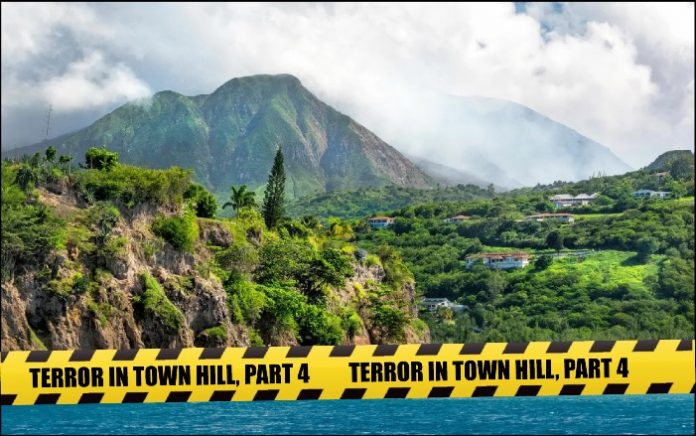
Part 4 of 4 in a series: Reflection and Redemption.
In the Spring of 1973, the second annual Leeward Islands Track and Field Championships were held in Antigua. As the event got underway at the Antigua Recreation Ground in the heart of downtown St. John’s, competitors and spectators began inquiring about the little girl from Montserrat who ran barefoot and won the Juniors mile race the previous year in St. Kitts.
Sarah “Mon” Meade didn’t just win in Basseterre in April of 1972, she “licked” the field, according to a newspaper report. Although she had just turned 16, she stood out because of her petite stature. Some thought she was 13 or 14. She not only left an impression with her stunning victory, she got acquainted with some of her rivals. One of her new friends was 14-year-old Theodora Newton of Nevis. After the competition, the two became pen pals. But for tragic reasons, that correspondence lasted only a few months.
A year later, Newton represented Nevis at the competition in Antigua. She says that Mon became the topic of conversation. Everyone was shocked to learn that her life had been cut short, especially in such as gruesome manner. To this day, they wonder what could have been possible with her immense running talent.
A TIME WARP
Like beauty, time is squarely in the eye of the beholder. Although measured in intervals, time is ultimately defined by perspective. Fifty years is an eternity if one is serving a prison sentence. But it can feel like a snapshot when grieving an unspeakable loss. Wounds might heal with time, but scars are much more resilient – especially the ones we can’t see.
For many, the events in the Fall of 1972 still feel as raw as they did a half century ago. Folks now in their 60s and 70s vividly recall the emotional trauma, fear, uncertainty and gloom that descended on Montserrat. Younger ones who were not aware of the incident find it difficult to fathom that such an event could occur on the serene Emerald Isle.
The heinous murder petrified and paralyzed the island. But it also taught some harsh lessons. For one, evil can permeate any society, no matter how peaceful or God-fearing. Also, one of the endearing qualities of Montserrat is its quaint, laid-back existence. But sadly, being quaint also means being vulnerable.
Before the grisly crime, Montserrat had been undergoing a cultural revolution. In 1971, the Shamrock Cinema opened, giving Montserrat a feeling of modern inclusion. In 1972, Chase Manhattan Bank set up a branch just yards from “Roundabout” and the hallowed Evergreen Tree in Plymouth. Montserrat already had Barclays Bank (UK) and Royal Bank of Canada, and now the Americans had joined the local market, luring new customers with their “Christmas Club” and other promotions.
After the much-publicized murder trial in 1973, Montserrat was in recovery mode. A national election was contested in which Austin Bramble’s Progressive Democratic Party retained power. Jim Allen and Alford Corriette were regional cricket stars, and Alphonsus “Arrow” Cassell was on his way to musical stardom.
Photo credit: Montserrat Mirror Joseph “Fine Twine” Bramble
In 1974, however, Montserrat was again rattled by a perpetrator on the loose. Joseph “Fine Twine” Bramble – a convicted rapist – was the target of an island-wide manhunt. Folks again began locking up their homes early, and women traveled with caution. Fine Twine was a habitual lawbreaker and peripheral character but he was not a killer. So the atmosphere was a bit different than 1972. Fine Twine was eventually captured.
WHERE ARE THEY NOW?
Most of the central figures from the Sarah “Mon” Meade case have died, including defendant George “Fowl” Lee, star witness Joseph “Asia Blood” Buffonge, and Joe-Joe Buffonge (alias “Look and Laugh”). Police officers Sydney Charles Sr., Paddy Lee and Winfield Griffith have also passed on, as have attorneys Claude Earl Francis and Desmond Christian. John “Darda” Dyett, Mon’s stepfather, passed away in 2008.
One of the surviving jurors is Joseph Galloway, who still lives in Montserrat. He recalls being sequestered for about two weeks at the Coconut Hill Hotel in Town Hill. He and colleagues realized they were part of history in what turned out to be the most famous case in Montserrat. He says the jurors formed a kinship that lasted for years.
“During the trial, we used to deliberate at the end of the day,” says Galloway, who hails from St. John’s in northern Montserrat. “The jury foreman was a guy named Mulcare. He used to say to us, ‘You guys were dynamite today!’ Years later, every time we [the jurors] saw each other we would greet each other by just saying, ‘Dynamite!’ “
Convicted murderer Joseph “Midda” Buffonge – originally sentenced to life in prison – ended up serving about 18 years. While incarcerated, he was counseled by a Prison Ministry. In the aftermath of Hurricane Hugo in 1989, he was granted work release as Montserrat rebuilt from the category 5 storm. He eventually earned full release, thanks to a petition that was approved by Montserrat Governor Frank Savage. Several factors were reportedly considered, including time served, his counseling by the Ministry, plus good behavior. Upon release, Buffonge worked at Romeo’s Wayside, a family hardware store.
Joseph “Midda” Buffonge
“He was a very intelligent guy, a great repair man . . . but he loved money,” says Julian Romeo, one of his supervisors. “He never spoke about the case – and I didn’t ask.”
Despite his release back into society, Buffonge couldn’t eradicate the stigma surrounding the murder, and many in Montserrat were upset that he had gotten a new lease on life after ending someone else’s. A nurse who treated him at Glendon Hospital in the mid-1990s says she was still afraid of him even though he was prone and much older.
A former police officer recalled several interactions with Buffonge, some while he was incarcerated and others following his release.
“I drove him to the hospital several times for treatment,” the officer said. “He was a soft-spoken, smart, calculated criminal. I remember a conversation when they were building the new Government Headquarters in Plymouth and he was doing plumbing there. He told me, ‘Ayu police think is me kill the girl but it’s not me.’ I said, ‘Well who did it?’ He was trying to blame George Fowl. He never looked at me directly. I learned in the police force that when you question an accused and they’re glancing down all the time, they’re lying.”
During the height of the volcanic crisis in the late 1990s, Buffonge relocated to Tortola. He eventually suffered a stroke and died on June 3, 2004.
Dr. Clarice Barnes, a Montserrat-born educator and curator who hosts the Under The Tamarind Tree show on Radio Montserrat, shared a story about meeting Midda in 2001.
Dr. Clarice Barnes
“I was working in the BVI and was introduced to him as a Montserratian. I did not recognize who he was. He was a skilled plumber receiving great respect on Tortola. I treated him as my man of business.
“Other Montserrat men who were helping me move into my apartment were not impressed with my insistence that he should be included in the group. Eventually, one told me that he was a bad man and I should not let him near my apartment.
“The man I met was a Christian doing evangelical work with the down and out. He had two young children and seemed to be a caring father. I was more than surprised when a Tortolian told me the story of the murder and asked me if it was true.
“The name Buffonge caused things to click. I was traumatized for days after coming to this realization. I reflected deeply on our God who forgives all things. I concluded that I should do the same but I stopped talking to him and kept him at a distance!
“I now wish I had the courage then to have asked him about the murder. He fell ill and died. I believed like others that he got what was due to him. I am still pondering our call as Christians to forgive.”
MEMORIES OF “MON”
Since the Terror In TownHill series began on September 27, 2022, there has been a great volume of feedback from those who lived through the incident. Many shared their memories of Sarah “Mon” Meade. Here are a few:
Glendora King, left, and Mervin Browne were childhood friends of Sarah “Mon” Meade.
▪ Glendora King, friend: “She was a quiet person, but jovial. She was a homebody. She didn’t even have a boyfriend. We both went to Maple Leaf school. I used to race her but I could never beat her. She used to come to our house all the time. I was the one who found her shoe when she was missing and took it to her parents. I cried when they found her body. I can imagine the pain she went through.”
▪ Mervin Browne, friend: “I grew up in George Street. We played together as kids. I remember we were playing hide and seek behind the Catholic church. I hid on top of the roof of the church building. When I jumped down I landed on a piece of board and a nail went through my foot. Mon yanked it out of my foot. She seemed like a fearless young lady. I cannot recall us ever having a disagreement.”
▪ Imelda “Mel” Greenaway, friend: “Mon had a dry sense of humor. She would quietly listen to a conversation and then all of a sudden make a funny comment.”
▪ Sarah Dyett, mother: “She was a nice girl. She was involved with the church and sang in the choir. I was saying to myself the other day that if she was still here she would be 66 years old now. I still think about her.”
▪ Rachael Dyett, sister: “Although so many years have passed, we do forgive . . . but we can never forget.”
Sarah Melvina “Mon” Meade (March 20, 1956 – September 25, 1972)
Photo credit: Richard Taub
The Plymouth courthouse was the site of a 1973 murder case that had Montserrat's complete attention.
Part 3 of 4 in a series: A Trial of Tribulations.
On Monday, July 16, 1973, the trial of Joseph “Midda” Buffonge and George “Fowl” Lee finally got underway – more than nine months after the two were jointly charged with the murder of Town Hill teenager Sarah “Mon” Meade. For the next eight days, the courthouse and its surroundings on Parliament Street in Plymouth would be a spectacle. Those who couldn’t get a seat in the gallery converged outside. Downtown workers played hooky to get a glimpse of the action. School children huddled near the side windows, jostling for the best vantage point as they peeked through the white metal louvers.
John Stanley Weekes, who would later be appointed Attorney General, was a Magistrate who served as court registrar. It was his duty each morning to open the courtroom doors and allow as many members of the public to enter as seating would permit.
“Before I let them in, I would ask them to please enter in an orderly fashion and take their seats,” says Weekes, who now resides in the United Kingdom. “As soon as I open the door, everyone would rush in. I would have to step aside to avoid getting trampled.”
Such was the high interest in a case that would go down as the most memorable in Montserrat history. The Preliminary Inquiry – held four months earlier – featured some bombshell depositions. And now the Assizes Court was set, with the judge, jury, defense attorneys and Crown prosecutor assigned and assembled for the trial.
These were the main legal representatives:
▪ Franklyn Adams, Judge: The St. Kitts native attended law school in Canada. He was a prosecutor during the 1960 trial in Montserrat of Samuel “Lucky Sam” Weekes, who ended up being the last person hanged on the island.
▪ Claude Earl Francis, attorney for Midda Buffonge: The veteran jurist was a two-time Parliamentary representative for Barbuda. His son Ralph was also a prominent lawyer.
▪ Kenneth Allen, attorney for George Lee: Hailing from St. Peter’s in Montserrat, Allen attended the Inns of Court School of Law in London and was called to the bar in 1959.
▪ Desmond Christian, Crown prosecutor: He served on the Georgetown (Guyana) Magistrate’s Court, notably during prosecutions following the Jonestown Massacre in 1978.
Claude Earl Francis, left, and Kenneth Allen QC
MOMENT OF TRUTH
With so much at stake in the trial, precautions were taken to assure the jurors were not influenced. The nine-member, all-male jury was sequestered, coincidentally, at the Coconut Hill Hotel, just yards from the crime scene. Simon Meade was a chef at the hotel during the trial. During an interview in 2007, he explained the protocol.
“There were always two policemen there,” he said. “The jurors would play dominoes and other games. If one of them got up to go to the restroom, the police would make sure that’s where they went. They couldn’t talk to outsiders. Your family couldn’t visit you.”
When the trial began, Christian – the Crown attorney – went full force at the defendants, describing their alleged actions as not just violent but diabolical: “This crime was conceived in iniquity and carried out with the spirit of a demon,” he told the jury.
Christian had developed a reputation in legal circles for being long-winded, but for this case he had a key witness whose testimony would speak volumes. His name: Joseph Buffonge, better known as “Asia Blood”. He was the cousin of Joseph “Midda” Buffonge. That’s correct: the main suspect and the star witness had the same name.
“Asia Blood” was a fisherman and mason who lived in Streatham in eastern Montserrat. His stunning narrative, first disclosed at the Preliminary Inquiry in March, was now presented live for the jury. Here’s a condensed version of his testimony:
A TWISTED TALE
“Asia Blood” was on his boat in Plymouth harbor on Monday, September 25, 1972 – the same day Sarah “Mon” Meade disappeared – when defendant George “Fowl” Lee showed up and beckoned Asia to come ashore. When Asia stepped onto the dock, he also saw Midda and Midda’s father Joe-Joe, the man nicknamed “Look and Laugh” who is also Asia’s uncle. Midda said to him, “You is the man I wanted to see.” Midda then placed a U.S. $50 bill in Asia’s pocket.
Asia was told to meet the three others at Joe-Joe’s home in Town Hill. When he arrived, he says Midda told him: “Asia boy, I have a dead here. I want you to help me.” Midda went into another room and returned holding a pistol. He told Asia he wanted to show him something. The four men went into the bathroom, where Asia says he saw something wrapped in a gray blanket. Midda told him to open the blanket. When he did, Asia says he saw the body of Mon, a girl he recognized from seeing around George Street.
Asia asked Midda what he wanted him to do. Midda explained the plan: “George Fowl” would transport the body on a garbage truck to the rubbish heap at Jumbie Hole. Midda and Asia would then place the body on Asia’s boat, go out to sea and dump it.
Midda arranged a meeting for that night at Shamrock Cinema. But Asia says he never showed up and was chastised by Midda the following morning (Tuesday, September 26). Asia, who says he only agreed to the first meeting after seeing the gun, says Midda then arranged another meeting place to carry out the plan. But Asia again didn’t show up. He says he never saw the men again.
It must be noted that Asia Blood had served time in prison before this incident. The credibility of an ex-convict will always be met with skepticism. But either Asia was telling the truth or he was an extremely creative liar. Some might also wonder why Asia would freely testify against his cousin. A legal expert familiar with the case said it’s possible that police urged him to testify or else he could be considered an accessory to the murder.
Asia’s testimony was deeply damaging for Midda. But it got worse. George Cooper, a fellow prisoner while Midda was remanded, testified that Midda admitted to placing the body where it was found between the Coconut Hill Hotel and the Wall family residence – apparently after the burial-at-sea plan fell through.
Joseph “Midda” Buffonge.
As for Lee (George Fowl), he was obviously implicated by Asia’s testimony, but other witnesses also hurt his case. His co-workers on the garbage truck – Henry “Mussolini” Cabey, Beresford “Lord Hailes” Loving and Samuel “Black Sam” Aymer – revealed that Lee spoke early Monday (September 25) about Mon being missing, hours before anyone else – including her parents – knew. They also said that on Wednesday morning (September 27) that the four men were clearing trash from Fort Ghaut when Lee suddenly took off. It is believed that he overheard passersby saying Mon’s body was found.
Lee ended up at the crime scene. Peter “Red Poll” Howson, a popular businessman in Plymouth at the time, testified that he overheard Lee say, “If enough money was paid, you all would not have seen the body.”
The defense attorneys, faced with overwhelming evidence against their clients, tried to capitalize on some timeline inconsistencies. Francis, the attorney for Midda, even suggested that Sarah Meade possibly died from natural causes, and that her injuries were inflicted after death. Mon was a physically fit 16-year-old with no history of health issues. Francis’ far-fetched theory was easily debunked by evidence . . . and common sense.
VERDICT AND TRAGEDY
The trial wrapped up Tuesday, July 24, as counsels for the defense and the Crown, plus Justice Adams, made final summations. At 4:30 p.m., in front of a throng of spectators, the jury foreman revealed a verdict of guilty for Midda Buffonge and George “Fowl” Lee. Adams pronounced the death sentence (by hanging) for both.
At this point the case took an even stranger turn.
As Midda and George Fowl were being perp-walked from the courthouse back to jail, a seemingly unshaken Midda was overheard saying about the judge: “He want me fu heng? A bet you he dead before me.”
Photo courtesy family of Judge Adams Justice Franklyn Adams in undated photo.
Observers said Judge Adams – who was a portly man – appeared fatigued as the case wore on. A few hours after the verdict, Adams, his wife Ruth, and their daughters Debra, Diana and Dahlia, went to dinner at the home of former Chief Minister William H. Bramble, who lived in Groves, about a mile northeast of Plymouth. During the dinner, Adams complained of feeling unwell. The Montserrat Mirror newspaper quoted W.H. Bramble as saying, “As we rose from the table at around 9:30 [p.m.], the Judge said, ‘I feel as though I’m going to fall.’ . . . And down he went.”
Austin Bramble, the son of William H. Bramble, was Montserrat’s Chief Minister at the time. He lived next door to his father. He was summoned to the house. Almost a half century later, he still vividly recalls the surreal atmosphere.
“It was one of the most stressful incidents of my life,” says Bramble, now 91. “When I got there, his body was still there. Mrs. Adams was in real grief. There was crying. My parents were crestfallen. It really shook us up.”
Two doctors were called to the home, but they couldn’t save the 50-year-old Adams. The coroner later arrived. A postmortem at Glendon Hospital revealed that Adams died of “myocardial infarction” – a heart attack.
The following day, Donald Brookes and Eugene Walwyn – Adams’ law partners in St. Kitts – arrived in Montserrat aboard National Airlines to repatriate Adams’ body. Six policemen stood guard and escorted Adams’ body from the terminal at Blackburne Airport to the airplane. Another police guard saluted the aircraft as it became airborne.
Adams’ death shocked the entire region and was now the focus of talk on Montserrat. Some simply attributed his death to obesity and the stressful trial, while others had more cryptic opinions, citing Midda’s bold prediction.
Adams’ death was not only tragic, it affected the case because he had not yet sent his order of execution to Montserrat Governor Willoughby Thompson. Though a formality, it is also a legal requirement.
THE APPEAL
Even before the verdict was read on July 24, Kenneth Allen – attorney for George “Fowl” Lee – told Lee he would appeal if Lee were found guilty. In fact, attorneys for both defendants filed appeals, and the case was heard by the Court of Appeals in October of 1973 at the same courthouse. The acting Chief Justice was P. Cecil Lewis, and the two acting Justices of Appeal were Neville Peterkin and John Renwick.
P. Cecil Lewis, left, and Neville Peterkin
During the appeals hearing, Francis – Midda’s attorney – argued that his client should be freed based on five different grounds. The only ground that ended up succeeding was the final one, which stated that Buffonge can’t be executed because the judge died before delivering the order to the governor. The other grounds were all rejected and Midda was sentenced to jail for the rest of his natural life.
Ironically, even if Judge Adams had completed the execution order, Midda Buffonge would not have been hanged. Great Britain outlawed capital punishment in 1969, but it was never officially announced in the colonies because authorities wanted the consequence of being hanged to serve as a deterrent.
Allen, Lee’s attorney, argued that the Crown failed to prove its murder case against his client. In essence, just because someone knows a crime has been committed, it doesn’t mean they participated or encouraged the crime.
In hindsight, charging George “Fowl” Lee with murder was probably an overreach, based more on emotion rather than physical evidence. The legal system is one of nuances and technicalities that can be exploited by clever attorneys. A person might be guilty of something – but not what they’re being charged with. Allen also cited a procedural oversight by the judge in the original case, and Lee’s conviction was struck down.
The exoneration of George “Fowl” Lee dominated the front page of the Montserrat Mirror.
CLOSURE . . . SOMEWHAT
Just like that, a year-long ordeal was over. By this time, the specter of the crime had started to wane, and life in Montserrat – notably Town Hill – had regained some semblance of normalcy. There were no more “lasso” incidents and the main suspect was behind bars.
But there were lingering questions. For one, it remains unclear why Joe-Joe Buffonge, Midda’s father, was never charged even as an accessory. Testimony clearly indicated that he knew about the crime and that Mon’s body was in his home at some point.
Mon’s mother, Sarah Dyett, can’t forget her brief encounter with Joe-Joe Buffonge on the day she went to Plymouth to report her daughter missing. Told that Mon didn’t come home, Joe-Joe said to Mrs. Dyett: “She a go come home man, she a go come home.”
“All that time,” Mrs. Dyett says, “the damage was already done.”
Part 2 of 4 in a series: Investigation and Arrests.
For more than a century in Montserrat, the prison was located in Plymouth at the junction of Parliament and Strand streets, just south of the public market. The sign outside – “H.M. Prison” – was convenient because it can mean His or Her Majesty and doesn’t have to be replaced each time the monarchy changes hands.
At one point during the 1960s, the inmate population at H.M. Prison dropped to one – and that prisoner was set to be released in a few days. Suddenly, court cases that were usually settled with a simple fine – obscene language, drunk and disorderly, simple assault, etc. – were punished with jail time because, well, prison is also a business.
Montserrat is a dependent British colony, but in many ways it’s also an entity. Often excluded on world maps, the island forged a reputation as an organic sanctuary, enticing many visitors to return and drop anchor permanently. Hospitality is a hallmark . . . but safety has also been a main selling point.
The shocking murder of Sarah “Mon” Meade in the autumn of 1972 transformed Montserrat from a beacon of tranquility to a precinct of paranoia virtually overnight, ripping apart the cloak of comfort that made the island exceptional.
The discovery of the teenager’s tortured and decaying body in Town Hill was deeply atypical of the Emerald Isle, a place where folks leave their doors unlocked, hitchhiking is a custom, and law enforcement is more ceremonial than compulsory. The sheer brutality of the crime terrified locals, especially residents of Town Hill, who went out of their way to avoid the area where the body was found. Parents were now worried about the safety of their daughters, workers organized carpools, and students traveled in groups. No one wanted to be alone.
The Royal Montserrat Police Service, under immense pressure to make an arrest, launched an investigation. A unit whose toughest duty usually consisted of breaking up fights at weekend dances was now tasked with finding a ruthless killer.
From left, Inspectors Sydney Charles Sr. and Paddy Lee and Sergeant Winfield Griffith.
The Criminal Investigation Department (C.I.D.) featured some venerable officers, such as Sergeant Winfield Griffith and Inspectors Sydney Charles Sr. and Patrick “Paddy” Lee. Most of these men were physically imposing. Police in Montserrat don’t generally carry firearms, so their presence alone was often a deterrent. Griffith hailed from Barbados and Charles from Nevis. Lee was a Montserratian, from St. George’s Hill. The three men had additional incentive to solve the crime because they all lived in Town Hill and had young daughters.
As expected, the murder dominated conversation on the island. People began to compare notes and recount incidents they first dismissed as minor or isolated. Anonymous tips trickled in. And eventually, some nefarious motives began to unfold.
A BREAK IN THE CASE
On Thursday, September 28, 1972 – the day after Sarah Meade’s body was found and later laid to rest – police brought in a man for questioning. He was a Montserratian who had returned home six weeks earlier after spending time in St. Croix.
Joseph “Midda” Buffonge was a 30-year-old veteran seaman. He described himself to police as a navigational officer with the Merchant Marine Fleet. According to legend, he and shipmates once had to be rescued when their vessel – which was overloaded with cement – sank off the coast of Trinidad.
Now back in Montserrat, Midda could often be found at the home of his father, Joe-Joe Buffonge, the stone mason who was nicknamed “Look and Laugh”. Inspector Lee visited the home in Tom Beth (Town Hill) and told the seaman there was a telegram from St. Croix for him at the station.
Photo credit: Montserrat Mirror Joseph “Midda” Buffonge in 1973.
Once at the station, Midda soon realized there was no telegram. He was taken to C.I.D. and grilled by Sergeant Griffith and Inspector Charles. According to case files, Midda engaged the officers in verbal jousting, giving sarcastic responses and even lobbing a personal insult toward Griffith, who promised Midda that he would “pay for his mouth.” At one point Midda expressed distrust of the officers and refused to answer any more questions unless the conversation was tape recorded. Midda was savvy, but an avalanche of circumstantial evidence was mounting against him.
Asked his whereabouts between September 24 to 27 – the time window of Mon’s disappearance – he gave answers that all seemed innocuous: playing dominoes two nights in a row at an area bar; borrowing a book from the headmistress at Kinsale Primary School; helping his father with chores. He also said he had not been on Peebles Street – site where Mon’s body was found – since returning from St. Croix on August 14, 1972. The timeline for most of his claims could not be corroborated, and in fact were refuted by several witnesses.
A crucial turning point came when Inspector Charles showed Midda a photo of Mon and asked if he knew her. “Who me, me ain’t know she,” he replied indignantly.
It turned out to be a damaging denial because three Town Hill residents revealed that they heard Buffonge call out to Mon –by name – as she walked on Fort Barrington Road about a week before she disappeared. One witness – Matilda “Jenny” Gage – said Buffonge also directed crude sexual remarks toward the teen, calling her “pret up” and in need of a “good seeding”. Based on those revelations, plus other findings, Midda Buffonge was arrested and charged with murder on Tuesday, October 3, 1972.
The October 6, 1972 edition of the Montserrat Mirror reveals the first suspect arrested in the slaying of Sarah “Mon” Meade.
WHO IS THE LASSO MAN?
How did the police zero in on Midda Buffonge so quickly? Apparently, he was on their radar even before the murder. One of the officers in the C.I.D. was Winston Telesford, a native of Grenada who would end up spending decades on the Montserrat force.
Telesford, speaking on September 29, 2022, explained that about a week before the murder, police received a tip that someone tried to “lasso” a woman on Parsons Road. The woman thankfully managed to get away. Rumors began to circulate that Midda was the culprit. A separate source said other women reportedly felt the touch of a dangling rope as they walked under trees at night in the Town Hill area.
Telesford says he and Sgt. Griffith had the home of Joe-Joe Buffonge under surveillance for several days. But after not spotting anything suspicious, they decided to pause the stakeout for a day. “Griffith said we should take a break,” Telesford says. “He was my [superior] so I had to listen. The next day, I heard that a girl was missing.”
Depositions from witnesses, plus testimony at the trial, indicated that Mon’s body was at the home of Joe-Joe Buffonge at some point. Fifty years later, Telesford still regrets not being able to save the teen. “I would have definitely caught [Midda] if we didn’t take that day off because anyone he brought to that house we would have seen it.”
As for the “lasso” phenomenon, it is one of the most controversial and bizarre episodes in Montserrat history. Several people familiar with the incident say it was central to the motive of the crime. The following explanation was gathered:
Midda Buffonge reportedly owned a “Blackheart” book, which focused on the practice of sorcery and human sacrifice as a means of attaining wealth and power. One source said that in order for the ritual to work, it was necessary to “lasso” the victim – preferably a young girl – in order to sell her soul to the devil. These details have not been confirmed.
The practice of black magic is part of Caribbean folklore. In the early 20th century, American author L.W. de Laurence published books on the occult and had a mail-order business in Chicago that sold occult paraphernalia. He gained a following in parts of the Caribbean, and obeah is often referred to as “de Laurence” – after the author.
The “Lasso Man” saga spawned at least two calypso songs in Montserrat. In the Festival calypso competition in December of 1972, the Mighty Ruler sang Lasso Man, calling for the killer’s execution with the lyrics, “Black Ranger boy you have to die.” The Mighty Arrow also had a song called Lasso Man on his 1973 album Arrow Strikes Again. The lyrics gave some context to the “lasso man” story and its effect on Montserrat.
LISTEN TO “LASSO MAN” BY ARROW (1973)
ANOTHER SUSPECT
As the investigation continued and more residents were questioned, police realized that Midda Buffonge likely had an accomplice. Neighbors recalled seeing Buffonge in the frequent company of a Town Hill resident named George “Fowl” Lee, a 31-year-old garbage collector and laborer. Buffonge and Lee were apparently longtime fishing buddies. On October 4, 1972, Lee was brought in for questioning.
Three of Lee’s co-workers on the garbage truck were also questioned. They stated thatearly Monday morning (September 25) Lee mentioned to them that a young girl was missing, and added that “nobody kill the child but Midda.” Those conversations took place hours before Sarah “Mon” Meade’s parents had even filed a report. How could Lee know before everyone else that Mon was missing?
That was all the evidence police needed. Lee was arrested and charged with murder on October 5. When he was cautioned (read his rights), he reportedly replied: “Is joke you making man, is joke you making.”
Photo credit: Montserrat Mirror George “Fowl” Lee in 1973.
AWAITING THEIR FATE
Buffonge and Lee were now remanded into custody. At the time, the Assizes Court would convene three times a year: March, July and November. Both men were arrested in early October – too late for the November Assizes. They now had ample time to reflect, to plan their defense, and also to engage in jailhouse banter with other prisoners. Some of those conversations would come back to haunt one of the defendants.
In March of 1973, the Preliminary Inquiry was conducted. Twenty-seven witnesses submitted depositions. They included family members of the victim, associates of the defendants, investigators and regular citizens. They also included some of the most memorable characters and nicknames of the era: “Red Poll,” “Black Sam,” “Bouncing Willy,” “Twist Mouth Mack,” “Rum Punch,” “Joe Conna,” “Peter Devil” and “Mussolini.”
One witness in particular provided a compelling, detailed and damaging account of how the suspects planned to cover up the crime. His testimony at the trial would prove riveting.
Photo credit: Kenyatta Liburd / Facebook
The body of Sarah "Mon" Meade was found just off Peebles Street (photo facing south) on September 27, 1972.
Part 1 of 4 in a series: A Senseless Crime.
Former residents of Town Hill in Montserrat still proudly refer to themselves as the “Over the Bridge” crew. Town Hill, now relegated to remnants due to the destructive Soufriere Hills volcano, was located slightly southeast of Plymouth – near the southern end of the Fort Ghaut Bridge that connected downtown to several villages on the outskirts.
Montserrat’s real estate boom in the 1960s and ’70s introduced ritzy communities such as Old Towne, Isles Bay and Richmond Hill. Before that, Town Hill was Montserrat’s Beverly Hills – home to Government House, the Coconut Hill Hotel and business families such as the Walls and Osbornes. Policemen, doctors and attorneys lived there. It was where soca legend Alphonsus “Arrow” Cassell grew up. And in 1978 it became home to the American University of the Caribbean School of Medicine (AUC). The street names – Peebles, Howes, Mercer, Meade, Taylor – honored the luminaries who resided there.
Town Hill was not just a haven for the affluent, however. It featured residents of all rungs on the socio-economic ladder. The greater Town Hill area included Amersham, Jubilee Town, Fort Barrington, Tom Beth and Parsons.
Another section was Victoria Village, located in the southwestern flank of Town Hill. In 1972, it was the home of a petite 16-year-old named Sarah Meade. Everyone called her “Mon” – a once-popular “pet” name in Montserrat. “Mon” is normally reserved for women named Mary but is sometimes a “jumbie” name – a traditional practice of naming a child after a deceased person for protection. Sarah “Mon” Meade lived with her mother and stepfather – Sarah and John Dyett – and her 10-year-old sister Rachael.
Mon first attended the St. Augustine Catholic School in George Street, then Plymouth Primary – a school also known as “Maple Leaf” because it was built by the Canadian International Development Agency (CIDA). Mon was a talented runner who was especially strong in the distance events – 400 meters, 800 meters and mile.
In April of 1972, Montserrat sent a contingent of athletes to St. Kitts for the inaugural Leeward Islands Track and Field Championships. Among them were two runners from the Montserrat Secondary School – Franklyn Dyer, who would later be known as calypso singer “Mighty Falcon” – and Magdalene O’Brien. Mon also competed at the meet, which was held at Basseterre High School. Running barefoot, she outclassed her rivals to win the junior mile race. Montserrat finished third at the event, behind Antigua and St. Kitts but ahead of Nevis.
Photo credit: Montserrat Mirror Sarah “Mon” Meade
FATEFUL DAY
By September of 1972, Mon was now out of school. She was not working, however she was taking typing lessons and she would also assist her stepfather each morning by accompanying him to the hills of Amersham, where he would milk his cows. Mon would carry the milk back down to the home as Mr. Dyett continued his farm work.
On the evening of Sunday, September 24, 1972, Mon walked from Victoria Village to attend choir practice at the Roman Catholic Church on George Street. The 1.5-mile walk took about a half-hour. Afterward, she went to the home of her great-aunt, Charlotte Lynch, who lived near the church. Mon often slept there, then walked back to Victoria Village in the morning to help her stepfather. George Street was almost a second home to Mon because her mother also worked there as a domestic for Miss Alma Ryan, a well-known woman in the community who owned a shop on Old Chapel Street.
The following morning – Monday, September 25 – Mon left her great-aunt’s home and began her customary commute back home. She never arrived. When her parents awoke around 6 a.m. and didn’t see Mon, they weren’t alarmed. They figured she was simply running late. Mr. Dyett left for the mountain, and Mrs. Dyett made breakfast for Mon and went to work at Miss Alma.
When Mrs. Dyett returned home in the early afternoon, she was stunned to see the breakfast she left for Mon was untouched. Mr. Dyett was also surprised that Mon didn’t meet him at the mountain to pick up the milk, which she always did even if she returned home after he left. Something was amiss. Mon’s parents contacted the family in George Street and questioned neighbors in Town Hill. No one had seen Mon. At around 6 p.m., they decided to file a police report.
On their way to the police station in Plymouth, they saw Joe-Joe Buffonge, who lived in Tom Beth near Victoria Village. Buffonge – a well-known stone mason who went by the nickname “Look and Laugh” – was small in stature, bow-legged and rode a donkey.
“He asked me where I was going,” said Sarah Dyett, now 84 and still living in Montserrat. “I told him I’m going to the station to file a report because my daughter never came home. He said to me, ‘She a go come home man, she a go come home.’ ”
That brief exchange would replay in the mind of Sarah Dyett as the sad events unfolded.
GRUESOME DISCOVERY
Police searched in vain for the missing teen from Monday evening through Tuesday. As is customary in Montserrat, news spread quickly by word of mouth. Reticent to assume the worst, locals began conjuring theories. Some jokingly speculated that Mon had run away from home to join a boyfriend.
Early Wednesday, a girl from the neighborhood – 13-year-old Glendora King – visited the Dyett home to inform that a shoe was found near the junction of Wall and Osborne streets in Town Hill. John Dyett visited the area and saw a left-foot navy blue leather slipper, which he identified as belonging to his stepdaughter. He took the shoe to the police, who commenced a search of the area.
At around 10 a.m., in a bushy area off Peebles Street between the Coconut Hill Hotel and the home of the Wall family, the lifeless body of Sarah “Mon” Meade was found.
The yellow trail shows the route Sarah Meade often took from George Street to her home in Victoria Village. Other points of reference are shown, including where her body was found.
In short time, the scene became a mini-spectacle. An ambulance arrived. Police took photos of the corpse and surroundings. Folks from the area began to converge as word of the grim discovery made the rounds. At 10:30 a.m., Philip W. Bailey, a Medical Practitioner with the Ministry of Health, arrived and conducted an investigation of the scene.
At 11 a.m., the body was transported to Glendon Hospital, where Bailey conducted a postmortem at 1 p.m. The report was brutal. Sarah Meade’s internal organs were partly decomposed. Rigor mortis had set in. Maggots and grubs were present under and atop her skin. In her mouth was a clump of grass that had pushed her tongue to the side. Her skull and left eye socket were fractured, likely from being struck with a rock. She was wearing a mini-dress that was pulled up to her chest, and she was naked from the waist down. “The state of undress and the attitude of the body suggested that sexual interference had occurred,” the report said.
Due to the state of decomposition, Mon’s body was prepared for burial immediately following the postmortem. “They wouldn’t let me see the body,” Sarah Dyett said.
At the time, Montserrat did not have facilities for long-term storage of the dead. Most funerals took place within one or two days after death, with some held the same day. After a short service, Mon was interred at the public cemetery just below St. Anthony’s Church.
STATE OF SHOCK
Before the death of Sarah “Mon” Meade, murders in Montserrat were few and far between, and those incidents were not particularly a mystery. They were mostly committed during angry disputes, and the perpetrators were summarily arrested and punished.
The island had never experienced anything this heinous. Montserrat has endured more death from natural disasters than homicides: the devastating hurricanes of 1924 and 1928, Hugo in 1989, and the transformational volcanic eruption of 1997. Like the terrifying earthquakes of 1934 and ’35, the murder of Sarah Meade rocked Montserrat to its core.
“Everyone was scared. When we walked home from school we would avoid passing by the area where the body was found . . . even though it was high day.”
Myrle Roach, author and former Town Hill resident
The ripple effect was felt island-wide. Young girls were now afraid to walk alone at night. At the time, the Shamrock Cinema in Plymouth was the hot spot. Young ladies who once spurned offers from young men to escort them home now happily obliged.
Myrle Roach, who was 12 years old at the time and lived in Town Hill, recalls the anxiety that permeated the otherwise tranquil Emerald Isle.
“Everyone was scared,” she says. “When we walked home from school we would avoid passing by the area where the body was found . . . even though it was high day.”
Carlton “Funkyman” Allen, whose annual awards show was once a staple of Montserrat Festival, lived in Boston Village near Parsons at the time. He says walking home from Plymouth at night presented a quandary.
“It was scary because I didn’t want to go down Peebles Street [where the body was found], I didn’t want to go up Wall Street because the Masonic Lodge was there and a lot of people were scared of that place, and I didn’t want to pass through Jubilee because it was dark.”
Montserrat, like much of the Caribbean, has an abundance of ghost stories. Tales of the occult – along with the “jumbie dance” and “jumbie table” – are tethered to the culture. In the easygoing and safe Emerald Isle, it was even said that locals are more afraid of the dead than the living. But in 1972, there was a killer in their midst.
Photo courtesy Randy Greenaway Alfred Archibald, better known as Saltfish or Lord Alfredo, won the Road March title four times in Montserrat.
On an overcast Tuesday in October of 2015, Alfred Archibald was laid to rest at Northern Cemetery in Nottingham, England. It was a sparse gathering, the mourners mostly locals who befriended Archibald after he relocated from Montserrat in 1998. Resting atop his coffin were a snare drum, four drumsticks and a black cowboy hat. The coffin was inexplicably draped with the national flags of Uruguay and Argentina – two countries Archibald had never visited.
Archibald – the Montserrat music star better known as “Lord Alfredo” or “Saltfish” – died of respiratory failure on August 31, 2015. He was a resident at the Framework Housing Association, which provides shelter – plus clinical and health services – to people battling addiction or mental illness. The Nottingham City Council spent weeks trying to locate Archibald’s next of kin and even published his name in the local newspaper. When no one stepped forward, the Council paid for his funeral, which took place 36 days after his death.
Only about a dozen of Alfredo’s countrymen attended the service. Alfredo had become somewhat forgotten in a city that not many Montserratians reside. The man whose Road March songs once lured hundreds to the streets was sent off with a modest procession. It was hardly a turnout befitting his contribution to Montserrat and to music but it followed a theme in what was a life equally rife with talent and turmoil.
Alfredo spent his final years wandering the streets of Nottingham and beating on a drum. Since he was a boy, he yearned to visit England, where his mother migrated during the Windrush era. But he never envisioned the manner in which he would finally get there, whisked from Montserrat along with other mental health patients during the height of the volcanic crisis.
Alfredo’s time in Montserrat was partly defined by odd behavior, but there was a method to his madness. He was a musical mystic who marched to the beat of his own drum, a master of melody, improvisation and profound simplicity. He was obsessed with music, the military, and, at one time, bodybuilding. But sadly, physical and mental fitness are not mutually inclusive.
Photo credit: Facebook / My Montserrat Lord Alfredo was once an avid body-builder, starting in the late 1960s.
HAILING FROM KINSALE
Alfred John Henry Archibald was born on September 22, 1949 and grew up in Kinsale, about a mile south of Plymouth, the capital. He was raised by his grandfather, John Mills, after his mother, Mary Mills-Archibald, migrated. Mr. Mills, who had emigrated from St. Kitts, was a tall, slender man with a bushy handlebar moustache. He operated a shop on Parliament Street in Plymouth and sold the popular “menthol” – a hard, sugar-coated candy that delivered the cooling sensation of a lozenge.
Former neighbors say Mr. Mills loved Alfred, and even sent him to private school Piper’s Prep in Plymouth. Alfred also attended nearby Wesley School. Rupert Pond, a musician who would later collaborate with Alfred, was his classmate at Wesley, a Methodist school.
“He would come to school with his pockets full of menthol and share with his friends,” Pond says. “I would say he was an average student, but even back then you could tell there was something a little off with him.”
During the 1960s, movies were shown at the Roman Catholic compound on George Street. Many of these films were Westerns, and boys would play “Cowboys and Indians”. Pond recalls some of Alfredo’s daring and dangerous tactics.
“Saltfish would go on top of the building, and someone would pretend to shoot him, and he would just fall off the roof to the ground,” says Pond, still marveling at how Alfredo never sustained a serious injury . . . or worse.
The nickname “Lord Alfredo” was obviously a takeoff of his given name, Alfred. A former classmate explained that the “Saltfish” moniker came about because Alfredo would beg shopkeepers for the bones and tails that were left over after the saltfish was cut. He would take the scraps home, boil them and add the water to rice.
Alfredo showed interest in music early, and he especially fancied percussion instruments. Neighbors say there was always some sound emanating from the residence, even the simple “shack-shack” – a long, slender seed pod from the Flamboyant tree that makes a rattling sound when shaken.
MELODY MAKER
As a teenager, Alfredo joined the Melody Makers, a band owned by fellow Kinsale resident Charles Mulcare. On December 28, 1967, the Melody Makers were the backing band for the Festival calypso show at the Montserrat Secondary School. It was the calypso finals debut of Alphonsus “Arrow” Cassell, who arrived with his own band, ostensibly because he didn’t feel the Melody Makers could play up to his standard. Arrow finished first runner-up and refused his consolation prize. Alfred “Mighty Warrior” Christopher won the crown.
“The Melody Makers played their hearts out for me that night,” says Christopher, now 84 and living in Florida. “It was almost as if they wanted to send a message to Arrow. When I walked on stage to sing, Saltfish said to me, ‘Christo, ley awi go!’ I can remember seeing him sweating away on the drums.”
During this period in the late 1960s, Alfredo joined a trend that many young men in Kinsale adopted: bodybuilding. Wilford “Moose” Meade, who later became a gym owner, restaurateur and political contender, was among them. In the early days, without access to proper weights, the men pumped iron using vehicle engine parts, such as a flywheel.
In an interview from the early 1990s, Alfredo said his body “dropped” in 1969 when he took a hiatus from bodybuilding. So in the early 1970s he decided to focus on music.
Photo credit: The Montserrat Reporter Lord Alfredo belts out a tune in this undated photo.
A WAKE-UP CALL
Alfredo made his big splash as a solo artist in 1973 with the song Jump Up Girl, also called Wake Up Girl. The only recording of the song is a live version, captured at Sturge Park during the ’73 calypso eliminations. The backing band was Aquarius, which featured Pond – Alfredo’s former Wesley classmate – and the versatile Michael “Dasha” Underwood. Christopher, who by this time had retired from the calypso arena, was the show’s MC.
“Saltfish never used to go to the bandhouse for practice,” Christopher says. “On the night of the show, Dasha told [the Festival Committee] they wouldn’t play for Saltfish because they didn’t know his song. Saltfish asked them to let him play the guitar, and he told the band, ‘Just follow me.’ “
The band members were reluctant at first but finally agreed. Alfredo strummed the rhythm, and with Pond playing a classic bass line, the song was an instant hit and earned the Road March title. Jump Up Girl is considered by many to be Montserrat’s first official, consensus Road March.
LISTEN TO ‘JUMP UP GIRL’ (1973)
The following year, Alfredo won the Road March again, this time with It’s Morning Light, which had a similar theme to Jump Up Girl, with the lyrics, It’s morning light, wake up honey pie. In 1975, he made it a trifecta with The Sound of Music. A year later, Arrow – now an international recording star – used Alfredo’s song A Time For Everything on his album Positively Jumpy.
MILITARY MAN
During his musical journey, Alfredo also fulfilled one of his childhood dreams by joining the Montserrat Defense Force. It was the best of both worlds for him because the Defense Force featured a band . . . and in a marching band, the drummer plays an integral role.
Ozie Carty, a former trumpeter with the band Hammah International, served with Alfredo in the Defense Force.
“I remember he carved a big gun from wood and he would walk around town with it,” Carty says. “He would always dress in some kind of military color, usually brown or khaki.”
Alfredo took his role in the Defense Force seriously. He was once placed on guard duty during camp. The soldiers were issued a strict curfew. Major Fred Barzey was commanding officer at the time. Barzey – apparently believing the rule didn’t apply to him – returned to camp after curfew, and Alfredo refused to allow him entry. Barzey would later expel Alfredo from the Defense Force for being unkempt, and friends say that dismissal broke Alfredo’s heart.
Carty says Alfredo had an uncanny knack for creating songs.
“He always had his drumsticks with him. He wasn’t like most drummers. His drumming would make a rattling sound, like in the military. When [Hammah International] used to play for him, he was very easy to work with. He knew the melody and chord structure. He would take the guitar and strum it and tell our guitarist [Silas Carty], ‘This is the kind of strumming I want.’ ”
Alfredo also displayed a wealth of knowledge that belied his lack of a secondary education. During a 1992 interview, he spoke about being inspired by the movie The Sound of Music – notably actor Christopher Plummer’s rendition of Edelweiss – and classic instrumentals such as Peanut Vendor.
Photo courtesy Randy Greenaway Lord Alfredo in December of 1993.
TOUGH TIMES
In December of 1979, Alfredo’s beloved grandfather John Mills passed away in Glendon Hospital at age 82. Sadly, the recipe for the classic “menthol” also died with him. Mr. Mills’ son continued the business, but many say the menthol never tasted the same.
As for Alfredo, he eventually ended up living alone in the family home in Kinsale. By all accounts he never held a steady job.
“I remember he used to make boats out of coconut shell and sell them,” says Meade, the former bodybuilder. “Other than that, I don’t remember him working.”
Instead, Alfredo sometimes panhandled, usually for a quarter or 50 cents at a time. He once accumulated about $500 in coins. When he went to Barclays Bank to exchange the coins for paper currency, the bank contacted the police, believing the coins were stolen. Thankfully, a police officer who also resided in Kinsale vouched for Alfredo.
Alfredo’s peculiar behavior, reclusiveness and appearance caused many to wonder about his mental state. Others wrote it off as him simply being eccentric.
In recent years, studies about mental health have evolved, and so have the diagnoses and treatment. In the 1970s and ’80s, Montserrat was still entrenched in an era in which people who behaved oddly were simply branded as crazy. Alfredo became a patient of the mental health unit. Although never known to be violent, he would sometimes receive sedative injections that would turn him into a virtual “zombie” – according to several witnesses.
In 1980, Alfredo made a brief return to local musical stardom when he captured his fourth Road March. But this time, the song – while jumpy and catchy – was rooted in trauma. Socialism Jam featured the lyrics, Jam to the left, Wail to the right, Wine in the center. In Jonathan Skinner’s publication When Calypso Goes Too Far (2001), Alfredo stated that the song described a sexual assault he suffered. Another line in the song possibly alluded to his mental struggles: I couldn’t come ’79 because my head was too high.
LISTEN TO ‘SOCIALISM JAM’ (1980)
FINALLY, ENGLAND
In the 1980s and ’90s, Alfredo released songs sporadically, such as Global Jam, J’ouvert ’89 and People’s Tune. Like most residents in Montserrat, he was displaced when the volcanic crisis began in 1995. During the tumultuous years of massive migration to England, he finally made it to the UK and was placed in Nottingham, first at Alexandra Court, then later at the Framework Housing Association. He was not in touch with many Montserratians, including family members. He made new friends who addressed him as “John” – his middle name – and he sang karaoke on Friday nights at a pub on Mansfield Road. There were even rumors that he became a dentist.
Sharon Hoey, an Occupational Therapist, was Alfredo’s support worker at Framework. Speaking in October of 2022, she detailed her memories of “John”.
“During the last year of his life, John went with me to a drumming club where he met with local people from the Nottingham Community and joined a drumming circle. Sometimes this was outside in community gardens and sometimes in a community center. The drummers were all sorry to hear of his passing.
“When John was hospitalized at the end of his life I visited him as much as I could and he made me smile with his demands. He wanted me to bring him Caribbean food, mango and ‘good ginger beer’. He made me write a list. We once arranged a Caribbean night where he played the drums and guitar and sang. I remember him singing Edelweiss, Que Sera Sera and he also did some yodeling. I got him a Montserrat flag and put it on the wall.
“John talked to me occasionally about being a musician in Montserrat and he told me someone had stolen his music. I wasn’t sure how much of it was true with his mental health. He was generally very quiet with people at Framework but it was lovely to hear him open up at times.”
Asked about the South American flags on Alfredo’s coffin, Hoey could not explain the mystery. “I wondered if they came from his room or if the Council got wrong flags,” she says. “I know he had kept the Montserrat flag I gave him.”
Photo courtesy Sharon Hoey Lord Alfredo plays the drums during his time in Nottingham.
Beatrice Fenton, a fellow Montserratian who lived in Nottingham, bumped into Alfredo every now and then.
“Whenever I would see him we would chat about Montserrat, and in his quiet way he would smile,” Fenton says. “In 2012, I asked him if he was going to join the many people celebrating 50 years of Festival in Montserrat. He told me he needed documentation and financial aid.”
That trip home never transpired. Three years later, Alfredo was gone, just three weeks shy of his 66th birthday. He made specific requests for his sendoff. Among them, he wanted a traditional Methodist service, he asked to be buried in Nottingham, and he requested two hymns: O God, Our Help in Ages Past and Onward Christian Soldiers. He also asked to be buried in military attire.
His death certificate listed several respiratory and cardiac ailments that led to his demise. It also finally revealed his diagnosed mental affliction: Schizophrenia.
The Nottingham City Council teamed with the Co-op Funeral Home to arrange Alfredo’s service. They chose the “Simple Plan” – the cheapest non-cremation package – but it was hardly a pauper’s burial. Alfredo’s coffin arrived in a Mercedes-Benz mini-van, and several members of the funeral home bowed in reverence before its removal for interment. The drum, drumsticks, cowboy hat and flags also provided an aura of dignity.
In a cold, six-foot grave, 4,100 miles from home, dressed in a uniform of war, Alfred Archibald was finally at peace.
Photo credit: Michael Sweeney / Facebook Lord Alfredo’s coffin is draped with the flags of Uruguay and Argentina on October 6, 2015.
Photo credit: Beatrice Fenton / Facebook
LORD ALFREDO SINGS ‘MUSIC SENSATION’
Video courtesy Sharon Hoey Lord Alfredo performs at the Framework Housing Association on May 1, 2015. He died August 31, 2015.