


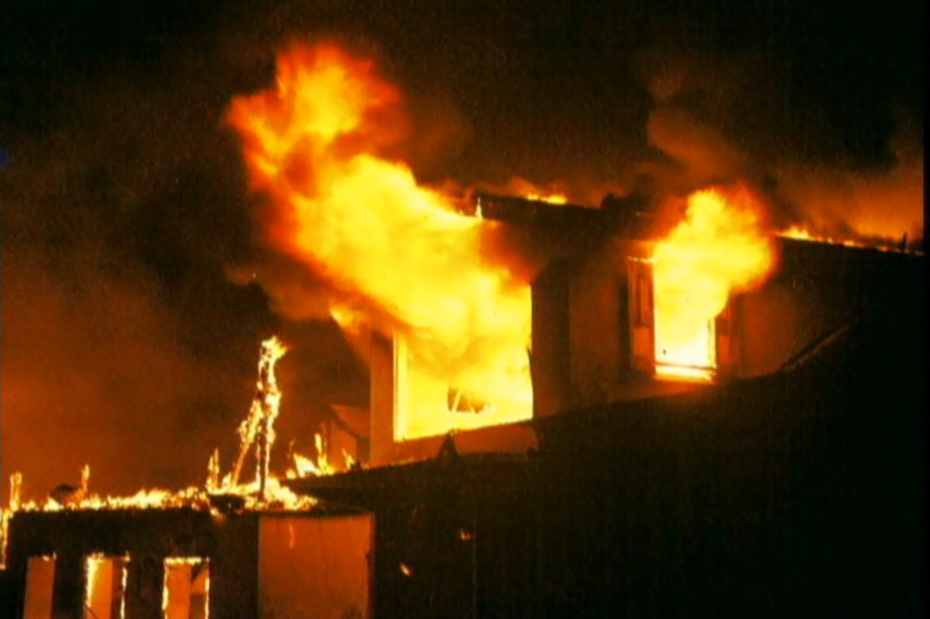
Fifteen businesses were destroyed by the George Street Fire in 1966.
First of a two-part series.
The new year is often ushered in with fireworks. For Montserrat the start of 1966 was marked by a historic fire. This was no celebratory blaze. By the time the inferno was reduced to smoldering rubble, 15 businesses and homes had been destroyed and 30 people were homeless. Thankfully, there were no deaths. But the disaster ravaged a crucial commercial sector in Plymouth and exposed the vulnerabilities of a quaint British colony.
Six decades later, many recall the fire vividly. There were hasty evacuations of the elderly and vulnerable, mishaps by the firefighting crew, and a daring night landing at Blackburne Airport by Leeward Islands Air Transport (LIAT) owner Frank Delisle, who arrived with equipment and reinforcements.
In the aftermath, several businesses – most of whom had no insurance – were shuttered for good. For some who had insurance, the damage far exceeded the coverage. However, the incident elicited profound community support. A Fire Relief Fund was created and there was even a benefit concert featuring a young Alphonsus “Arrow” Cassell.
Despite an investigation there was never an official finding of what caused the fire. But many Montserratians had their suspicions, and all signs pointed to one suspect.
Through newspaper archives, interviews with survivors, plus a 2006 documentary by Montserrat historian Randy Greenaway, Montserrat Spotlight has delved into the fire and its far-reaching impact.

George Street before the fire, circa 1965. The business at right is Hamsey Allen’s store, which had a soft drinks factory in the back.
WHERE THERE’S SMOKE . . .
On September 17, 1965 – less than four months before the George Street Fire – Montserrat endured the tragedy of the Pan Am plane crash at Chances Peak that claimed 30 lives. Now, the island was faced with another unprecedented disaster.
On January 6, 1966, Montserrat had just completed a successful Festival season in which Justin “Hero” Cassell won the calypso king title and Rose Willock was crowned Festival queen. The island was now in full preparation mode for the Royal visit of Queen Elizabeth on February 19. It would be the monarch’s first trip to Montserrat.
But on that fateful Thursday evening a distinctive sound permeated the air.
“I was at home in Cork Hill when I heard the bugle,” said Alfred Christopher, a member of the Montserrat Defense Force from 1957 to 1978. “In those days a member of the Defense Force would drive around and blow a horn, alerting soldiers to report to the headquarters in town.”
Montserrat did not have a full-fledged Fire Department, only a Fire Brigade with a handful of volunteers and a small fire truck at the Police Station on Harney Street. Fires are rare in Montserrat and can usually be handled by the Brigade. But this was no ordinary blaze. As with all emergencies, the Defense Force was brought in for support. Ironically, the Defense Force headquarters was located on George Street, directly in the path of the fire.
“When I got to George Street the fire didn’t look that bad,” said Christopher, now 87. “It was more smoke than anything. But then some strong winds started blowing from the south and the fire started to spread.”


The “Brother” Dan Fenton building, where the fire started in 1966, is pictured during the 1990s. Next door is where Marse Reggie Osborne’s business was located, with Defense Force headquarters upstairs.
DESTRUCTIVE PATH
The fire began at the two-story building owned by “Brother” Dan Fenton, located just west of Old Chapel Street on George Street – on the left side if one is heading west. The blaze spread next door (west) to another two-story establishment, this one featuring the Defense Force Headquarters upstairs and Reggie Osborne’s Drinks Factory below.
Many buildings on George Street – and in Plymouth – were two stories and made of stone on the bottom and wood on top with galvanize roofs. Some of the proprietors and their families lived on the second floor. At first it appeared as if the fire would be confined to one side of the street. Then the improbable happened.
“The fire came across the street along the electrical wire,” said Roosevelt “Cubby” Jemmotte, who lived on George Street. “It was like a rat running across a wire.”
Jemmotte, then 21, was working as an agent with British-American Life Insurance, located in the T.W. Bramble building, a short walk east from Jemmotte’s family home on the northern side of George Street. Some newspaper reports stated that the fire began at around 10 p.m. but Jemmotte says it was much earlier.
“I was in the office finishing my reports for the day when I looked out and saw the fire across the street. I ran down to the police station on Harney Street to tell them there was a fire.”
When Jemmotte returned to the scene he witnessed the fire traveling across the electrical wire toward the northern side of George Street, not far from his family home. Jemmotte quickly evacuated his mother and other relatives, taking only clothes and other necessities.

MANY AFFECTED
According to a report in the Montserrat Mirror newspaper, the businesses and homes destroyed or affected were:
● Southern side of George Street: Dan Fenton Building, home of the West Indies Packing Company, which sold frozen goods; Reggie Osborne’s Drinks Factory; Defense Force Headquarters, located atop Osborne’s factory; Hulda Rogers building (Rogers lived upstairs and Mrs. Mary Charles had a shop downstairs); home of Mrs. Harper, a retiree and widow; Advance Dress Shop, located on first floor of Mrs. Harper’s building and owned by Mrs. Daisy Nanton; home and rum shop of “Son-Son” Allen.
● Northern side of George Street: Lindy Eid’s New York Store; T.W. Bramble Building featuring British-American Life Insurance Company and office of Dr. Desmond Wooding; shop of Charles Jones; home and pre-school of Teacher “Tudie” Donoghue and her two sisters; Hamsey Allen’s Shop and Drinks Factory; Jemmotte family residence; residence of Franklyn Farier, Montserrat’s Health Inspector.
ADDING FUEL TO FIRE
Fires are destructive enough without assistance. But on that night the blaze received several boosts that helped it to expand: strong winds (oxygen), fuel (wood) and one more potent element.
“Lindy Eid used to have alcohol stored in his shop so it helped to ignite the fire,” Jemmotte revealed in the Greenaway documentary.
Over on the southern side of the street, Defense Force members managed to remove some items from the clubhouse, including rifles. But bullets were left behind. Although they were blanks, when the fire made contact with them, a barrage of shots rang out in the area. George Street sounded like the Old West.
“Bullets react the same way whether it’s blanks or they have the projectile,” explained Major Joseph Lynch, a former commanding officer of the Defense Force.
Teresa Pond-Moses lived on George Street, about 200 yards north of the fire. She recalls walking down to the area with her mother at about 10 p.m. and witnessing the spectacle.
“We saw flames leaping from one side of George Street to the other,” she said. “It was like a monster dragon belching long, vicious tongues of fire trying to eat the houses.”

Lindy Eid’s New York Store ablaze during the George Street Fire.
FIGHTING THE BLAZE
It quickly became apparent that Montserrat’s Fire Brigade was ill-prepared to handle the blaze. In Greenaway’s documentary, Fire Brigade member James “Raypa” Meade said it took some time to open the fire hydrant in Plymouth because Brigade leader Corporal Thomas, who lived in Parsons, possessed the only key. By the time Thomas arrived and the hydrant was unsealed, extensive fire damage had occurred.
The Brigade members tried their best to stifle the blaze and even doused some buildings in the path of the fire as a pre-emptive strike. Then, another problem. The hydrant water supply ran out. Thankfully, the Federal Palm, a regional shipping vessel, was just offshore.
Richard Samuel, another Brigade member, stated in the documentary: “[Federal Palm] sent in a hose but their connection couldn’t fit our pipe. The next alternative was to use the sea water. So we brought down the small fire truck [to the wharf] and I operated the pump.”
Realizing the fire was getting out of control, the authorities contacted Antigua for help. Frank Delisle, a native of St. Kitts who moved to Montserrat in the 1940s and eventually launched LIAT – the region’s first airline – was now living in Antigua. Delisle assembled some Antigua firefighters, along with equipment, and prepared for the short flight to Montserrat on his six-seater Beechcraft Twin Bonanza. There was one problem. Blackburne Airport had no lights. It was also unpaved. Delisle told his contacts in Montserrat to simply have some cars parked adjacent to the airstrip with their headlights on. They obliged, and the experienced pilot made a safe landing in the middle of the night.

PICKING UP THE PIECES
The fire-fighting coalition now included the Fire Brigade, Defense Force, Antigua crew, the Federal Palm crew, plus normal citizens, including Father Joseph Stryckers, priest at the Roman Catholic Church on George Street. At around 4:15 a.m. the fire was finally vanquished. It was a combination of water and fortune. As the fire headed west it eventually met alleys on either side of George Street. The gaps stemmed the progress, making it easier for the fire to be put out.
When dawn arrived hundreds flocked to town to check on friends and loved ones, assess the damage or simply satisfy curiosity. As folks shared stories about the harrowing night, tales of heroism began to emerge, such as the swift evacuation of the elderly, many of whom were asleep when the fire began.
It is said that the night brings mischief, and nefarious deeds also began to surface, such as sporadic looting. But the mobilization of a community was what eventually quelled the blaze and sparked a rebuilding.
“I remember seeing Father Stryckers walking up George Street at about 5 o’clock in the morning looking exhausted,” said Teresa Pond-Moses, who was 12 at the time. “He had been battling the fire for hours. We later learned that before he became a priest he was a fire-fighter.”
The ordeal was over but so much remained unknown. Who or what started the fire? How much damage occurred? Where would many of the displaced residents end up? How would the incident affect preparations for the Royal visit? And by the way, who stole Marse Reggie’s money from his safe?
Yes, there were burning questions.
Coming in Part 2: Fund-raising, accusations, consolation prizes and sad irony as unfortunate chapter concludes.


